Jun
21
2013
Posted by
admin
Comments

In Case You Missed It… Articles Roundup Week of 6/21/13

UNI VenezuelaHunger wg e1371848667693 In Case You Missed It… Articles Roundup Week of 6/21/13

Courtesy of: La Prensa

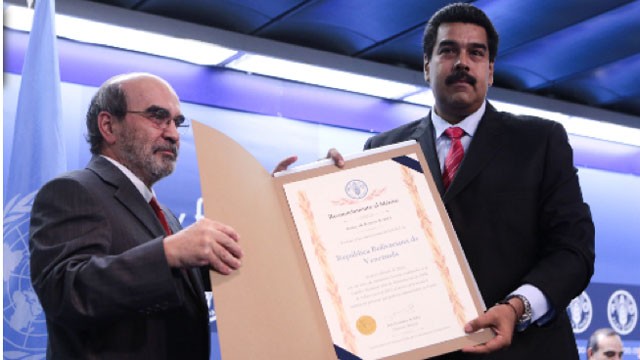
This Week: The Venezuelan constitutional court is expected to rule on Henrique Capriles’ lawsuits challenging the April 14 elections; in an attempt to improve his international image, President Maduro tours Europe, meeting with Pope Francis to discuss poverty, the fight against organized crime and regional disputes; ahead of his meeting with the Maduro, Capriles warns the Pope of basic democratic and human rights violations in Venezuela; in a survey of presidents, Venezuela’s Maduro receives worst ratings of all national leaders; and attackers torch buses and damage the rectory building at a leading Venezuelan university. Venezuela experiences soaring inflation, reporting a 6.1 percent spike last month alone; S&P expects “next to no growth” in the Venezuelan economy this year and downgrades its sovereign debt rating from “B+” to “B”; amid severe food shortages, the United Nations ironically congratulates Venezuela for reducing hunger; and Capriles maintains that Venezuela has not beaten hunger or poverty, questioning the FAO award.  In an attempt to alleviate goods shortages, Venezuela will supply more U.S. dollars to importers; in response to rationing rumors, Venezuela will allegedly import 760.000 tons of food; Venezuela’s non-oil exports hit the lowest level since 2009; and Venezuela’s Congress will discuss legislation that would prohibit baby bottles.

Top Constitutional Court to take up actions contesting April 14 election, El Universal

The Constitutional Court of the Supreme Tribunal of Justice (TSJ) is to hear and rule on all the seven laswsuits filed by former opposition presidential candidate Henrique Capriles and the opposition alliance Unified Democratic Panel (MUD) challenging the April 14 presidential vote.

Pope Francis meets Venezuelan President Maduro, Reuters

Maduro meets Pope Francis in the Vatican City and discussed poverty, the fight against organized crime and drug trafficking, and regional issues including a dispute between Venezuela and Colombia.

Capriles warns pope of rights violations in Venezuela, Global Post

Venezuela’s opposition leader told Pope Francis on Saturday that the government was violating basic democratic and human rights, just two days before President Nicolas Maduro visits the Vatican.

Venezuelan president pulls off the lowest score in Spanish survey, El Universal

Polls conducted by Spanish firm Real Instituto Elcano, after the controversial results of the presidential election held on April 14 in Venezuela, show Venezuelan President Nicolás Maduro’s ratings are the lowest, scoring 2.5 out of 10 points, behind his Argentinean counterpart rated with 2.7 points.

Attackers torch buses at Venezuela university, Miami Herald

A group of masked assailants has attacked a leading university in the Venezuelan capital, torching two buses and seriously damaging its rectory building.

Soaring inflation adds even more stress to the Venezuelan economic model, El Universal

Venezuelan economy reported a 6.1% spike in May which led to an accumulated inflation of 19.4%, thus crushing any possibility of meeting the 14% to 16% target set by the government for 2012.

Citing Governability, S&P Cuts Venezuela’s Debt. Bondholders, Look Out Below, Wall Street Journal

Standard & Poor’s cut its sovereign rating on Venezuela from “B+” to “B” another step deeper into junk territory, reflecting the government’s diminishing ability to implement measures to reverse declining GDP growth, rising inflation, and weakening external liquidity in the context of growing political disagreements within the administration.

UN Congratulates Venezuela for Reducing Hunger, ABC News

The FAO, the UN organization that specializes in nutrition, included Venezuela in a group of 18 nations that that have cut their number of hungry people by half over the past 20 years.

Capriles: hunger is addressed with investment and production, El Universal

Following the recent award given to the Venezuelan Government by the FAO, Capriles claimed on Tuesday that the country has not overcome hunger and poverty and stressed that the award was not in line with both the true food shortage Venezuela was going through and the more than 3,000 households living under severe poverty.

Venezuela Plans Expanded Dollar Auctions to Fight Shortages, Bloomberg Businessweek

Venezuela will boost supplies of dollars, through auctions that will begin early in the second half of the year,  to importers as it seeks to alleviate a shortage of goods that is fueling the fastest inflation in the region.

To silence rationing rumours, Venezuela announces 760.000 tons of imported food is on the way, MercoPress

A 760.000 tons of different food items were imported into several cities in Venezuela that were suffering serious shortages, including  staples and other items such as coffee, sugar, cooking oil, butter, milk, flour and most recently toilet paper, but the situation instead of improving has worsened.

Venezuela’s non-oil exports hit lowest level since 2009, Reuters
Venezuela’s non-oil exports fell in March to their lowest level since early 2009 in another sign of the economic problems accruing for President Nicolas Maduro’s fledgling government.

Venezuela considers taking bottles from babies’ mouths, Reuters

Venezuela’s Congress will discuss legislation next week that would prohibit bottle feeding of infants to try to encourage breast feeding and reduce the use of baby formula, said a lawmaker of the ruling Socialist Party.
 
Jun
14
2013
Posted by
admin
Comments

As Venezuelans Struggle to Find Food, Maduro to Receive UN Award for Food Production

WO AN794 VENEZU G 20130516180502 e1371227734904 As Venezuelans Struggle to Find Food, Maduro to Receive UN Award for Food Production

Courtesy of: Reuters

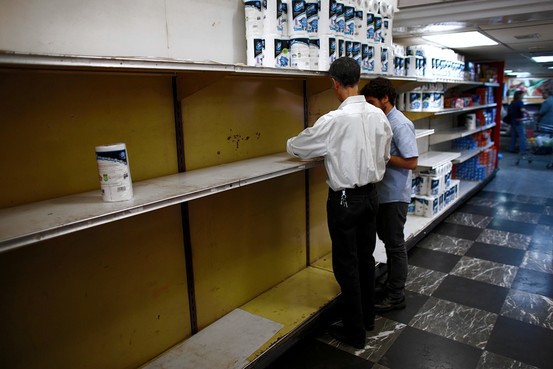
For months, What’s Next Venezuela and other major news outlets have been reporting on the rampant shortages plaguing Venezuela. In light of this reality, we and many others were stunned to learn this week that President Nicolás Maduro is expected to receive an award from the Food and Agriculture Organization of the United Nations (FAO) for the “progress” Venezuela has made in food-related matters. The irony is palpable; shortages in Venezuela are now so severe that Venezuelans have turned to a mobile app that helps them locate basic goods like milk and toilet paper.

Maduro’s troubling two months in office and record shortages have caused many, including Congresswoman Ileana Ros-Lehtinen, to wonder aloud whether the award is indeed justified. While the FAO argues advances have been made with regards to food development and consumption in Venezuela, the facts and figures beg to differ.

The Venezuelan Central Bank reported that shortages in May rose to 21.3 percent, its highest level in 64 months. In other words, two out of 10 products were not in stock in grocery stores and supermarkets. Furthermore, that same month Venezuelan consumer prices increased at a record pace after a devaluation of the currency pushed up the cost of imports. Prices climbed 6.1 percent from April, accelerating the annual inflation rate to a record-high 35.2 percent.

Price controls and foreign exchange restrictions in the import-dependent nation have triggered shortages in every sector of the Venezuelan economy. Basic food products such as chicken, milk, sugar and toilet paper have become an ordeal to find. Not even the Catholic Church has been exempt of the country’s growing scarcities. Wheat flour used for the sacramental wafers is scarce, while the supply of altar wine used for Holy Communion is threatened, likely forcing the Church to ration supplies.

Maduro’s only solution to the problem has been to blame Venezuelans for “overconsumption.” Such a charge stands in utter contrast to the scenes of hungry Venezuelans swarming a grocery truck when it finally arrived with the food they needed. Maduro, meanwhile, has responded by telling Venezuelans not to “panic” and to “regularize consumption,” accusing the public for the government’s failed policies.

Thus far, the free mobile application – which uses crowdsourcing to pinpoint areas that actually have basic necessities – has been the most successful solution for everyday Venezuelans.  After struggling to find milk, an enterprising 21-year-old Venezuelan student decided to develop the app, which has been downloaded over 12,000 times. In a country where citizens are forced to rely on their smart phones to find basic food products, the rationale behind this award is difficult to understand.

 
Jun
13
2013
Posted by
admin
Comments

ICYMI: Venezuela gets a lifeline from the United States

The Washington Post
June 11, 2013
By Editorial Board

kerry jaua 644x362 e1371130314425 ICYMI: Venezuela gets a lifeline from the United States

Courtesy of: Agence France Presse

Nicolás Maduro, the former bus driver chosen by Hugo Chávez to lead Venezuela after his death, has been struggling to consolidate his position since being declared the victor in a questionable presidential election in April. With the economy stalling, inflation spiking and shortages spreading, the new president appears at a loss about how to respond, other than to blame domestic and foreign enemies. Nor has he been able to overcome a serious split in the Chavista movement between his own, Cuba-backed clique and another based in the military.

Perhaps most alarming for Mr. Maduro, an energized opposition has refused to accept the election outcome; its capable leader, Henrique Capriles, has been gaining sympathy around the region. The president of neighboring Colombia, Juan Manuel Santos, met with Mr. Capriles on May 29, prompting paroxysms of rage from Mr. Maduro and his aides. Other Latin American governments, while avoiding a confrontation with Caracas, have made it clear they regard the new leader’s legitimacy as questionable; the regional group Unasur called for an audit of the election results.

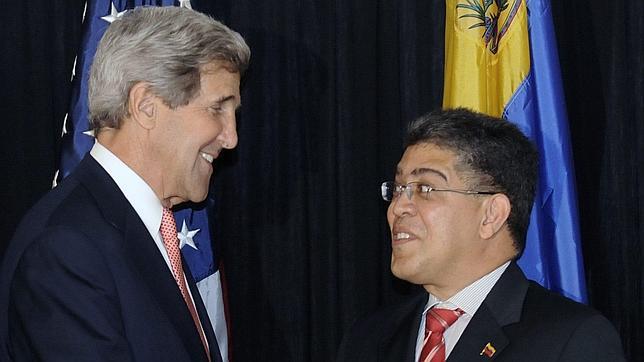
One government, however, has chosen to toss Mr. Maduro a lifeline: the United States. Last week Secretary of State John F. Kerry took time to meet Venezuelan Foreign Minister Elias Jaua on the sidelines of an Organization of American States meeting, then announced that the Obama administration would like to “find a new way forward” with the Maduro administration and “quickly move to the appointment of ambassadors.” Mr. Kerry even thanked Mr. Maduro for “taking steps toward this encounter” — words that the state-run media trumpeted.

What did Mr. Maduro do to earn this assistance from Mr. Kerry? Since Mr. Chávez’s death in March, the Venezuelan leader has repeatedly used the United States as a foil. He expelled two U.S. military attaches posted at the embassy in Caracas, claiming that they were trying to destabilize the country; he claimed the CIA was provoking violence in order to justify an invasion; and he called President Obama “the big boss of the devils.” A U.S. filmmaker, Timothy Tracy, was arrested and charged with plotting against the government — a ludicrous allegation that was backed with no evidence. Though Mr. Tracy was put on a plane to Miami on the day of the Kerry-Jaua encounter, Mr. Kerry agreed to the meeting before that gesture.

There’s nothing wrong, in principle, with diplomatic meetings or even in dispatching an ambassador to a country such as Venezuela. The State Department has also been meeting with senior opposition leaders and has yet to say it recognizes the presidential election results. But Mr. Kerry’s words amounted to a precious endorsement for Mr. Maduro — and the Obama administration appears bent on cultivating him regardless of his actions. Perhaps the increasingly desperate new leader has secretly promised concessions to Washington on matters such as drug trafficking. But with senior government and military officials involved in the transhipment of cocaine to the United States and Europe, he is unlikely to deliver.

In short, this looks like a reset for the sake of reset, launched without regard for good timing or the cause of Venezuelan democracy.

To read this article at The Washington Post, please click here.