Oct
25
2012
Posted by
admin
Comments

Venezuelan Assembly Considers New Media-Control Law

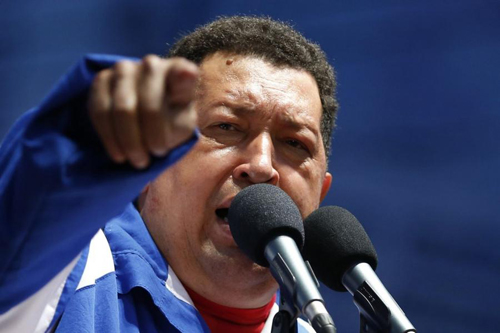
hugo chavez Venezuelan Assembly Considers New Media Control Law

Courtesy of: Reuters

Having secured reelection, Hugo Chávez has signaled his intention to pivot back to his most extreme socialist policies. After presenting a more moderate face as a candidate, Chávez has pledged to deepen his socialist revolution as president. The pace of expropriations slowed in the politically crucial months before Oct. 7, but now the administration promises to begin nationalizing private companies with renewed vigor. Just weeks after his victory, even the remaining trace of Venezuela’s independent media, already one of the most harassed, has been put on notice.

The Chávez-friendly National Assembly appears set to approve legislation that extends the government’s strictest information-control requirements to cable TV. Previously the most severe restrictions – enshrined in the Ley Resorte law – applied only to broadcast television stations. These entities were required to abide by content requirements and to air Chávez’s “cadena” addresses at a moment’s notice. The Assembly’s proposed law would extend these restrictions to Venezuela’s private cable stations as well.

This legislation, which includes the Orwellian proposal to ensure “the enforcement of cultural information,” could deal a blow to Venezuela’s scant remaining free media. In addition to forcing stations to broadcast cadenas, the law would also limit the amount of “foreign” content aired on Venezuelan cable stations, infringing on Venezuelan TV viewers’ ability to get news or commentary from sources outside the country. Carabobo state Rep. Miguel Cocchiola, a member of the opposition, calls the law “a tool [for the government] to enhance communication hegemony.”

During the election, Chávez’s abuse of his cadena power was well documented, as it allowed him to saturate Venezuela with campaign propaganda and interrupt coverage of Capriles campaign events. Meanwhile, the Capriles campaign was forced to pay for airtime, while many noted that compiling the resources needed to match the reach of the state media would have been an impossible task. According to the watchdog group Transparency International, Chávez used cadenas for more than 87 hours during the campaign.

Such attacks on free media are nothing new for Chávez’s “21st Century Socialism,” which militates against the free economy and free media alike. From the closure of the popular network RCTV to the constant fines and sanctions levied against Globovision, Chávez has systematically censored, harassed or otherwise silenced privately-owned media outlets he deems critical of his persona or government.

Multiple watchdog groups have affirmed that independent media remain an endangered species in the country. Since 2005, defamation of the president has been punishable by six to 30 months in prison. Mr. Chávez has revoked the broadcast license of at least 240 radio stations – nearly 50 percent of all radio stations in the country – perceived as critical of the government. Today, Chávez controls at least two national radio networks, six television channels, 72 regional television stations, four newspapers and over 600 radio stations across the country.

As expected, news coverage on government-owned television is far from balanced. According to a report from the Wall Street Journal, during the last week of September – just days before the Oct. 7 election – government news channel VTV dedicated 18 hours of coverage to Chávez. Its tally for Mr. Capriles was 30 minutes.
 
Oct
19
2012
Posted by
admin
Comments

In Case You Missed It… Articles Roundup Week of 10/19/12

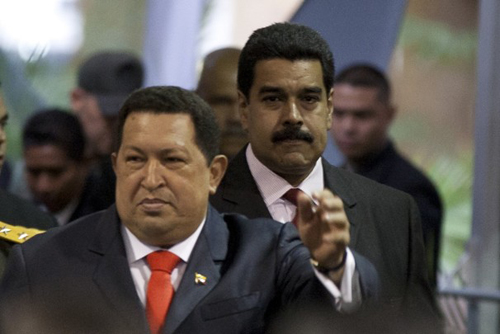
Venezuela Chavez Maduro In Case You Missed It… Articles Roundup Week of 10/19/12

Courtesy of: AP

Less than a week after winning reelection, Chávez swore in his new Vice President, former Foreign Minister Nicolas Maduro and six other cabinet ministers. On Monday Chávez will submit his fiscal year 2013 budget to the National Assembly, largely based on his socialist model. According to the National Institute of Statistics (INE), Venezuela’s inflation rate will reach almost 20 percent by the end of the year. The country’s international reserves are also far below an optimal level. Recent political polarization is threatening freedom of speech in Venezuela, as a new report reveals “mistreatment, detentions, insults, confiscation of equipment, and fundamental rights violations” against journalists, camerapersons, and others in the press. Meanwhile, Chávez has begun to develop Venezuela’s defense industry with plans to build drones with the help of China, Russia and Iran. Chávez breaks diplomatic ties to Paraguay with his decision to expel their diplomats following the ouster of his ally, former President Fernando Lugo. Simultaneously, Chávez’s ties to former Brazilian President Lula are strained after Lula said in a recent interview that Chávez should prepare for his succession. In most recent news, the Venezuelan National Assembly stirs up controversy as they take steps to regulate cable TV.

Venezuela’s Chavez swears in vice president, 6 other ministers in post-election shake up, The Washington Post

CARACAS, Venezuela — Venezuelan President Hugo Chavez swore in his new vice president and six other Cabinet ministers on Saturday, less than a week after winning a new mandate to extend his self-styled Bolivarian revolution.

Venezuela’s 2013 budget bases on socialist model, El Universal

The Venezuelan Government on Monday will summit to the National Assembly a FY2013 draft budget that will be based on the socialist model.

Venezuela Official Inflation Just Under 20%, Latin American Herald Tribune

CARACAS — According to the government’s National Institute of Statistics (INE), Venezuela’s September inflation came in at 1.6%, above the value in August of 1.1%. Factoring in September’s rate, inflation for the first nine months of the year has been 11.5%. One-year inflation stands at 19.98%.

Venezuela’s international reserves far from optimal level, El Universal

Venezuelan international reserves remain below the optimal level (USD 26.8 billion) established by national authorities.

Polarization threatens freedom of speech in Venezuela, El Universal

The Venezuelan Press Block (BPV) presented a report on Sunday at the 68th Inter-American Press Association (IAPA) General Assembly, held at the city of Sao Paulo, Brazil, denouncing increased aggressions against journalists, due to political polarization in Venezuela.

Venezuela serious about producing drones, UPI.com

CARACAS, Venezuela, Oct. 16 (UPI) — Venezuelan President Hugo Chavez is pursuing plans to develop a home-grown defense industry topped by a drone built reportedly with Chinese, Iranian and Russian help.

Venezuela’s government expelling the last of Paraguay’s diplomats in Caracas, envoy says, Fox News

CARACAS, Venezuela – Venezuela’s government has decided to expel Paraguay’s remaining diplomats from the country, the top envoy at the Paraguayan Embassy said Wednesday. Charge d’affaires Victor Casartelli said that he and three other Paraguayan diplomats in Caracas were told by Venezuela’s Foreign Ministry to leave within three days.

Venezuela’s oil exports to Asia to jump to 2.8 million bdp, El Universal

State-run oil holding Petróleos de Venezuela (Pdvsa) is in negotiations with India’s Reliance Industries and Oil & Natural Gas Corp (ONGC) for investments in the Ayacucho and Boyacá oil fields, informed on Wednesday Pdvsa’s Corporate Planning Executive Director, Fadi Kabboul, at a press conference in India.

Venezuela’s Chavez should prepare for succession: Lula, Chicago Tribune

BUENOS AIRES (Reuters) – Venezuela’s newly re-elected president, Hugo Chavez, should start preparing to hand over power, former two-time Brazilian President Luiz Inacio Lula da Silva said in a newspaper interview published on Thursday.

Venezuela’s National Assembly to regulate cable TV, El Universal

The Venezuelan National Assembly (AN) is to make a law for the regulation of subscription television services, informed the President of the People’s Power and Media Committee of the AN, Darío Vivas, deputy for the ruling party United Socialist Party of Venezuela (PSUV).

 
Sep
11
2012
Posted by
admin
Comments

ICYMI: Venezuela’s government begins process of withdrawing from OAS human rights bodies

The Washington Post via Associated Press
September 10, 2012

CARACAS, Venezuela — Venezuela has begun the process of pulling out of two human rights bodies by formally withdrawing from a regional human rights pact, the Organization of American States said Monday.

Venezuela’s government notified OAS Secretary-General Jose Miguel Insulza that it is renouncing the American Convention on Human Rights, the OAS said in a statement.

It said Insulza regrets that decision, calling the human rights convention “one of the pillars of the legal regulations” aimed at defending human rights in the Americas.

Venezuela’s decision means that after one year it will no longer be a party to the Costa Rica-based Inter-American Court of Human Rights or the Washington-based Inter-American Commission on Human Rights.

“The Secretary General expressed his hope that … Venezuela may reconsider its decision,” the OAS said.

The human rights convention says countries may renounce the document “by means of notice given one year in advance.” It also says that process won’t release any withdrawing party in the meantime from obligations in the convention.

The Venezuelan government didn’t immediately comment on the matter.

President Hugo Chavez announced in July that he planned to pull out of the Inter-American Court of Human Rights after it sided with a Venezuelan, Raul Diaz, who was accused of participating in 2003 bombings of the Spanish Embassy and Colombian consulate in Caracas. Four people were injured in those attacks.

Diaz was sentenced to more than nine years in prison, but in 2010 he fled the country after a court allowed him out for work during certain hours. He sought asylum in the United States. Diaz has long maintained he had no role in the attacks and has accused Venezuelan authorities of violating his rights in the case.

Chavez accused the court of “supporting terrorism” by siding with Diaz.

Venezuelan human rights groups have warned that if Chavez’s government withdraws from such bodies, victims of rights abuses would have fewer venues in which to make their cases.

Chavez said previously that he favored the idea of pulling out of the Inter-American Commission on Human Rights, accusing it of wrongly campaigning against his government and acting at the behest of the U.S. government.

Henrique Sanchez Falcon, a law professor at Central University of Venezuela, called the government’s decision a negative step, saying if Venezuela does withdraw from the rights bodies it would constitute a violation of the country’s own constitution and would require changes to some articles.

Human rights activist Liliana Ortega, who heads the Venezuelan rights group Cofavic, condemned the government’s action.

“We appeal for restraint and for this decision to be overturned because we also think it’s a very serious political mistake to do it at this time, and not only in the electoral context but also for the message it sends to the world,” Ortega said in a telephone interview.

Chavez is seeking another six-year term in the country’s Oct. 7 presidential election.

To read this article on The Washington Post, please click here.