Nov
30
2012
Posted by
admin
Comments

In Case You Missed It… Articles Roundup Week of 11/30/12

 In Case You Missed It… Articles Roundup Week of 11/30/12

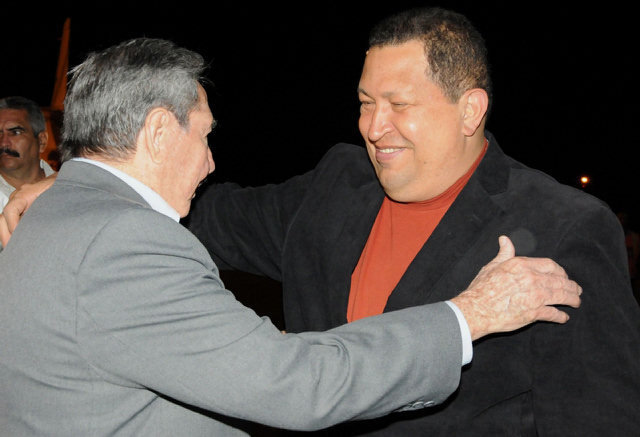
Courtesy of: Raul Abreu / AP

This week: the Bolivar’s value hits a record low as Chávez feels the pressure to increase bond sales; the Venezuelan opposition seeks amnesty for political prisoners and opponents of Chávez living in exile; and Venezuelan Judge Afiuni says she was raped while in prison, after she was jailed for issuing a ruling that irked Chávez. Chávez’s recent medical trip to Cuba causes many Venezuelans to question his longevity and the viability of his socialist regime; the central bank of Venezuela reports that non-oil exports are at their worst level since 1997; Henri Falcón, the opposition governor of Lara, says he and supporters were attacked with tear gas and stones during a political event. Meanwhile, Chávez continues to advance his plan for communes in Venezuela; the UN Economic Commission for Latin America and the Caribbean registered an escalation of poverty in Venezuela, despite the decrease in poverty in other Latin American countries. Lastly, the Economist reports that Chávez’s nationalization of Venezuelan ports has led to inefficient, congested wharves and a dramatic increase in imports.

Chavez Choking on Bolivars to Spur Venezuelan Bond Sales, Bloomberg

The bolivar’s plunge to a record on the black market is pressuring Venezuelan President Hugo Chavez to end the longest drought of dollar-bond sales in five years.

Venezuela opposition seeks amnesty for prisoners and return home for Chavez opponents in exile, Washington Post

CARACAS, Venezuela — Venezuelan opposition lawmakers have drawn up a list of prisoners they consider to be wrongly jailed and want freed, and are also demanding that dozens of government opponents living in exile should be allowed to return home.

Venezuelan Judge Who Angered Chávez Says She Was Raped While in Prison, New York Times

CARACAS, Venezuela — An arrested judge at the center of one of Venezuela’s most prominent human rights cases was raped while in prison and then had an abortion behind bars after becoming pregnant, according to the judge’s lawyer and a book published last week in Caracas that has stirred new controversy around the case.

Venezuelan non-oil exports at the worst level since 1997, El Universal

Venezuela’s entry into the Common Market of the South (Mercosur) took place amidst the worst moment of the local industry. Dependence on oil revenues, higher imports, and small export capacity are just some of the aspects defining the country’s current economy.

Chavez’s return to Cuba for treatment rattles Venezuela, Reuters

(Reuters) – Venezuelan President Hugo Chavez flew into Cuba on Wednesday for cancer-linked medical treatment that revived questions about the viability of his socialist rule and left Venezuelans again guessing about his exact condition.

Venezuela Opposition Gov Says Supporters Attacked, ABC News

The opposition governor of Lara state in central Venezuela says he and his followers were attacked with guns, tear gas and stones during a political event, presumably by rival ruling party supporters.

Communal state advances in Venezuela, Buenos Aires Herald

Barely a wink after the October presidential elections, Venezuelans will once again be returning to the polls on Sunday, December 16. With Hugo Chávez re-elected for another six years with 54 percent of the vote, but absent and silent for the last 12 days and now heading to Cuba for more medical treatment, in the coming elections Venezuelans will now choose 23 governors and 233 state lawmakers.

Venezuela Raises Prices on Corn Flour, Rice, Coffee, Loyo Says, Bloomberg

Venezuela raised price caps on pre- cooked corn flour, white rice and ground coffee by as much as 46 percent, Agriculture Minister Juan Carlos Loyo said today. The cost of a kilogram of pre-cooked corn flour rose 46 percent to 5.93 bolivars ($1.38) from 4.06 bolivars and a kilogram of white rice rose 28 percent to 7.2 bolivars from 5.62 bolivars, Loyo said on state television.

ECLAC: Poverty and indigence escalate in Venezuela, El Universal

According to the UN Economic Commission for Latin America and the Caribbean (ECLAC), based on information compiled until 2011, seven out of 12 countries in Latin America reported a drop in poverty.

Cancelling Christmas, The Economist

THOSE who claim to deplore the commercialisation of Christmas should move to Venezuela. Seasonal products, from Christmas trees to toys, trinkets and delicacies, are piled up in the country’s ports, thanks to inefficient, congested wharves and a dramatic increase in imports.
 
Sep
20
2012
Posted by
admin
Comments

Can PDVSA Survive Chávez?

jose r cardenas Can PDVSA Survive Chávez?

José R. Cárdenas

José R. Cárdenas served in several foreign policy positions during the George W. Bush administration (2004-2009), including on the National Security Council staff. He is a consultant with Vision Americas in Washington, DC.

The recent explosions at the Amuay oil refinery in Punto Fijo that killed some 41 people could not have come at a worse time for Hugo Chávez, as it has drawn intense scrutiny on what has become of the state oil company PDVSA since Chávez imposed total state control over its operations in 2002.

It is not a pretty sight. In fact, the company stands at the center of a cautionary tale about the destructive impact of Chávez’s politically-motivated policies. For today, PDVSA represents less a modern oil company than it does a political operation designed only to boot the political fortunes of the President.

One would think that a company sitting atop what is believed to be the world’s largest oil reserves at a time of record prices could absorb some measure of short-sighted policies and still function ably. That PDVSA is not is a measure of how disastrously Chávez has ignored critical re-investments in maintenance, safety, and the development of new means of production.

Instead, the company’s last ten years have been marked by decreasing production, safety mishaps, politicization of management, inflated payrolls, and corruption. All the while, Chávez has directed PDVSA to take an ever-larger role in activities that have little or nothing to do with extracting and refining oil.

First, production. The government claims it is producing 2.9 million barrels per day (b/d), but experts claim that with refineries today operating at 69 percent capacity the actual output is more like 2.4 million b/d. In 1997, the year before Chávez was first elected, output was around 3.6 million b/d, one-third more than today. Experts say that given Venezuela’s prospects, it should be producing 5 million b/d. So far, high international prices have masked the impact of the declining cash flow, but that mirage will not last forever.

Secondly, those with knowledge of the Venezuelan oil industry say there has been a critical lack of re-investment into maintenance and production. They say investment in oil related activities has averaged $9 to $10 billion per year over the last four years — half of what is necessary to maintain production and just one quarter of what PDVSA needs to expand production and build new facilities.

So where is the money going? Into an account controlled directly by Hugo Chávez, bypassing the Central Bank and the National Assembly, meaning there is no accountability and no transparency of how the funds are dispersed. We do know, however, that earlier this year Finance Minister Jorge Giordani said that the government had invested more than $500 billion in social programs.

Now, there is certainly nothing wrong in using oil revenues to boost the social sector; the critical question is whether those revenues are being used efficiently and with an eye towards the long-term health of PDVSA and Venezuela. But it seems all that is lost on Hugo Chávez. The political goal of – getting re-elected – is all encompassing and trumps concerns of productivity and safety.

Today, PDVSA is involved in activities wholly outside its competence: including managing food imports and distribution, building houses, mining, agriculture, and meat production. Indeed, the list is being constantly expanded according to Chávez’s whims. As such, the number of PDVSA employees has expanded from some 40,000 in 2002 to around 115,000 today. The results have been predictably slap-dash.

Clearly, poor re-investment, declining production, diversion to non-oil related activities, bloated payroll, and skyrocketing debt are taking their toll on PDVSA. With no indication Chávez has any intention to change his policies, it’s an open question how long the company can maintain its present course. But PDVSA’s fate is intricately linked to Chávez’s populist political project. He came to power claiming to the masses that for decades “others” (elites, foreign interests) had plundered Venezuela’s national patrimony at their expense. He was to be their avenger, making up for years of neglect by squeezing every last ounce of Venezuelan crude out of the ground for the people’s benefit — even if he effectively kills Venezuela’s ability to secure oil revenues in the process. Populism may have been a great way to get elected, but it is a terrible way to govern.

 
May
9
2012
Posted by
admin
Comments

Check out our New Election Headquarters

election hq Check out our New Election Headquarters

With Hugo Chávez’s health problems leaving many to wonder whether he’ll even be on the ballot in October and an energetic young challenger posing the most serious threat of his 13 year reign, the 2012 Venezuelan elections promise to be the most compelling since Chávez came to power in 1999.

The world’s eyes are turned to the oil-rich nation to see what its fate will be. Global investors have driven up the value of Venezuela’s oil company’s bonds in hopes that a new leader will reform the market. The Castros, and the people of Cuba, wonder how much longer Venezuela’s money and oil will support their regime. Government officials in China wonder if their loans, and the access to oil that goes with them, will be honored by Venezuela’s next leader. Iran, Korea, and Vietnam have just inked new deals for Venezuelan oil as well. Like the tensions in the Middle East, events in this Latin American nation will have serious consequences for the global oil market.

Meanwhile, inflation has soared – topping 28 percent last year – and expropriations and other Chávez economic policies have caused Venezuelans to suffer from shortages of even the most basic goods (Venezuela is forced to import a staggering two-thirds of its food needs). Crime has skyrocketed during Chavez’s tenure, with the murder rate quadrupling since Chávez took office. In fact, 2011 was the most violent year in the country’s history, with 19,000 murders, and an increasing number of robberies and kidnappings. The country’s housing deficit exceeds 2.5 million homes, as its infrastructure is crumbling. And over the last 13 years, corruption in Venezuela has reached unprecedented levels, while facing criticism for undermining freedom of the press.

As a result, What’s Next Venezuela has launched a new election headquarters to ensure you have all the latest information about the candidates, the issues and campaign developments on the ground, as they happen.

Our election site is updated with all the news you need to stay informed in real time. Click here to check it out.