Aug
31
2012
Posted by
admin
Comments

In Case You Missed It… Articles Roundup Week of 8/31/12

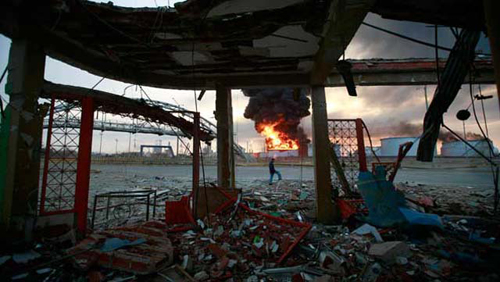
Explosion en Amuay In Case You Missed It… Articles Roundup Week of 8/31/12

Courtesy of: AFP

A series of incidents in the past week – a prison riot, bridge collapse and explosion at an oil refinery – may have damaged Venezuelan President Hugo Chávez’s reelection hopes, as new polls show he has lost the lead to opposition candidate Henrique Capriles. The explosion at the refinery in Amuay has drawn attention to the state oil company’s decaying infrastructure and Chávez’s mismanagement of the country’s oil resources. Questions remain, however, about whether the guilty parties will face any punishment for the accident. Meanwhile, an NGO released a report about media attacks in Venezuela, Chávez uses the government-controlled media to attack the opposition and the electoral council bans an opposition ad about violence in the country – opposition leaders called the ban a violation of free speech.

Venezuela’s presidential campaign: Gaining ground, The Economist

Technical glitches, heckling from his own supporters, thinning crowds and bad polling news. With just over six weeks to go before Venezuela’s presidential election, Hugo Chávez’s bid for another six years in office no longer looks quite the push-over it once seemed.

Venezuela’s Chavez faces new election threats, Miami Herald

It’s been a rough month for Venezuelan President Hugo Chávez. In less than two weeks, he has had to deal with a deadly prison riot, a collapsing bridge, flooding, an embarrassing confrontation with steel workers on live TV and the country’s worst oil-industry disaster, which killed at least 41 and still has families digging through the rubble looking for loved ones.

Chavez Trails Rival Capriles for First Time in Poll, Businessweek

Venezuelan President Hugo Chavez trailed opponent Henrique Capriles Radonski for the first time in a Consultores 21 poll ahead of elections in October.

Venezuela oil blast evidence of deteriorating infrastructure (+video), Christian Science Monitor

Venezuelan Vice President Elías Jaua said Saturday evening the death toll had reached at least 39 after a blast tore through the country’s biggest oil refinery, Amuay in Falcon state.

Venezuela’s Refinery Explosion: Has Chávez Made Petroleum Too Political?, TIME

When I visited Venezuela’s Paraguaná oil refinery complex, the world’s second largest, in 2007, anxieties seemed to flare like its burn-off pipes.

Critics question flow of Venezuelan aid, Financial Times

At the entrance to a rundown neighbourhood in the outskirts of Managua, the capital of Nicaragua, a sign proclaims: “Welcome to District Hugo Chávez”.

The Misrule of Law, New York Times

Venezuelans are reeling this week from the deadliest accident in our nation’s industrial history.

Press freedom group: Venezuela media under assault, Associated Press

The Committee to Protect Journalists said in a new report Wednesday that Venezuelan President Hugo Chavez’s government has used threats and a barrage of restrictive measures to gradually weaken the country’s private news media.

Insulting Hugo Chavez challenger is prime-time TV in Venezuela, LA Times

It’s prime-time TV in Venezuela and the host is saying that opposition presidential candidate Henrique Capriles, whose grandmother was a Holocaust survivor, is a Nazi and Hitler cultist.

Venezuelan electoral officials order political ad off the air, Chavez opponents cry foul, AP

Venezuelan electoral officials have ordered off the air a political ad that depicts the murder of a young man to highlight concerns about crime.

 
Aug
29
2012
Posted by
admin
Comments

Venezuela’s Chávez faces new election threat — a run of calamities

In recent weeks, Venezuelan President Hugo Chávez has faced prison riots, a bridge collapse and the country’s most lethal oil-industry disaster. Some wonder if the woes will stick to the Teflon comandante.

The Miami Herald

August 29, 2012

By Jim Wyss | [email protected]

MDG Venezuela President 008 300x180 Venezuelas Chávez faces new election threat — a run of calamities

Courtesy of: Leo Ramirez / AFP

BOGOTA — It’s been a rough month for Venezuelan President Hugo Chávez. In less than two weeks, he has had to deal with a deadly prison riot, a collapsing bridge, flooding, an embarrassing confrontation with steel workers on live TV and the country’s worst oil-industry disaster, which killed at least 41 and still has families digging through the rubble looking for loved ones.

The avalanche of bad news would be hard on any leader, but this train of troubles comes as Chávez, 58, is heading into an Oct. 7 presidential race that polls suggest is getting tighter.

For the last 14 years in office, Chávez has played the roll of an energetic leader with a common touch. Even when his administration had missteps, voters rarely held their charismatic comandante accountable.

But the scale of this month’s calamities might change that dynamic, said Xavier Rodríguez Franco with Entorno Parlamentario, a legislative watchdog group.

“The events the country has had to face recently clearly show a breakdown in the government’s ability to manage,” he said “And that breakdown is dragging down the president’s image.”

Chávez’s days of discontent started Aug. 15 when a vital bridge connecting Caracas to eastern Venezuela collapsed. Four days later, gangs at the Yare I penitentiary confronted each other with guns and explosives leaving 26 dead, including a visiting family member. It was an embarrassment for an administration that has declared prison security one of its top concerns but has been unable to staunch the bleeding. During the first half of this year, 304 inmates have been killed and 572 have been injured, according to the Inter-American Commission on Human Rights, which called on the government to step up efforts to disarm prisoners.

The following day, Chávez traveled to the city of Guyana to hold a live broadcast — carried on all TV and radio stations — with workers of the state-run Sidor steel plant. Presidential cadenas are usually tightly scripted and designed to highlight government achievements, and they’re a key part of Chávez reelection strategy.

That’s why Venezuelans were surprised to see steel workers shout over the president and complain that the government hadn’t renewed their labor contract, which expired over two years ago. Amid the commotion, Chávez’s microphone was cut and the broadcast abruptly ended. It was the first time that anyone could recall a cadena being cancelled mid-transmission.

That the outburst took place in a Chávez stronghold (he won 68.8 percent of the vote in Bolivar state in 2006) only underscored the sense of malaise.

Russ Dallen, managing partner at Caracas Capital Markets financial firm, said Chávez appears to be distracted by his battle with an undisclosed form of cancer — which dates back to at least June 2011 — and which the president claims to have beaten.

“This is not the Chávez we have come to know over the last decade and a half,” he said. “Clearly, his illness has affected him and he’s not the maximum leader he has been in the past. And that’s why you see so many things collapsing, and this time the problems are sticking.”

But all the troubles were overshadowed early Saturday, when a huge fireball erupted at the   refinery, part of the nation’s largest refinery complex. The blast left 151 wounded and homes leveled.

The government said the plant would be operating again within two days, but the fire was only subdued on Tuesday and the administration now says it won’t be operational until Friday.

Critics blame Chávez, who they say has used the state-run oil company PDVSA, which operates the refinery, as a cash-cow for his pet projects even as it neglects maintenance and repairs.

In 2011, the company invested $39.6 billion in popular social programs, including $4 billion in the government’s housing program. But seven out of nine maintenance programs planned for Amuay that year were postponed due to lack of materials, wrote Daniel Kerner, with the New York-based Eurasia Group, citing PDVSA’s 2011 annual report.

The Amuay accident “highlights PDVSA’s significant operational problems stemming from both severe mismanagement and underinvestment,” he wrote. “In recent years, the firm has become a key financing arm for President Hugo Chávez’s social programs limiting PDVSA’s investment capacity in a context where crude production… has steadily declined.”

The man fighting Chávez for the presidency, Henrique Capriles, 40, has called for full investigations into Amuay, the jailhouse riot and the bridge collapse. Earlier this week, he likened the string of problems to a disaster film.

“This isn’t a movie that unfolds chapter by chapter,” he said. “It’s unconscionable that the government’s candidate [Chávez] can irresponsibly and insensibly say that the show must go on.”

For the moment, Chávez is leading most polls. Datanalisis, a closely followed pollster, has Capriles with 34.3 percent of the vote and gaining versus Chávez’s 46.8 percent. Consultores 21, another major polling firm, however, shows Capriles with a thin lead, at 47.7 percent versus Chávez’s 45.9 percent.

It’s too early to tell if August’s woes will move those numbers. But Kerner predicted the Amuay disaster is “probably not a game changer…Chavez still remains favored to win, but the accident could sway some undecided voters.”

Chávez has pledged millions in aid and offered to build thousands of new homes for Amuay residents. He’s also trying to turn the tables, accusing opponents of being “vultures” who want to turn disaster into political gain.

“Just as we see streams of foam putting out the fire in Amuay,” he said this week, “the bourgeoisie is also using disgraceful streams to try to put out our patriotic fire and fervor.”

To read this article on The Miami Herald, please click here.