Oct
5
2012
Posted by
admin
Comments

Survey Gives Edge to Chávez Opponent

The Wall Street Journal
October 5, 2012
By Kejal Vyas
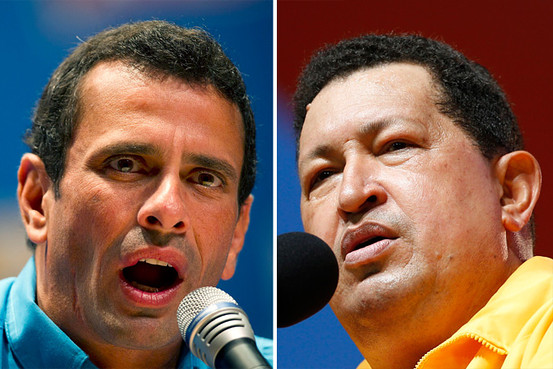
OB UW131 1005ve G 20121005141618 Survey Gives Edge to Chávez Opponent

Courtesy of: Reuters

CARACAS—Venezuelan opposition presidential candidate Henrique Capriles has extended his lead over President Hugo Chávez in the latest survey released just days ahead of the hotly contested vote.

Venezuelans head to voting stations this Sunday in a race that is proving to be Mr. Chávez’s greatest challenge after nearly 14 years in office. The president has promised a deepening of his statist policies if he wins another six-year term. However, his campaign was slowed down over the past year as he battled an undisclosed type of cancer, which Mr. Chávez says he has overcome.

The survey conducted by local private pollster Consultores 21 found the challenger increasing his support to 51.8% while Mr. Chávez declined to 47.2%, according to Saul Cabrera, director of the firm. The survey was conducted as a vote simulation between Sept. 27 and Oct. 2 using 1,546 respondents. It had a margin of error of 2.5%.

Earlier this week, Mr. Cabrera said that his firm didn’t use telephone surveys because they found respondents hesitant to answer questions on political affiliation to unknown people. He said those surveys typically found the number of undecided voters shoot up past 20%.

Mr. Capriles, a 40-year-old energetic state governor, has embarked on an aggressive nationwide “house by house” tour since winning the opposition primaries in February. The center-left candidate has pledged to keep many of the social programs that Mr. Chávez spearheaded but says he wants to run them more efficiently and sees a greater role for the private sector in Venezuela’s economy.

Both candidates officially ended their campaigns on Thursday. Mr. Chávez delivered his final appeal to voters during a rain-soaked gathering of thousands of red-clad government supporters who filled the streets of downtown Caracas. Meanwhile, Mr. Capriles capped off his campaign with speeches in three western Venezuelan states.

Though Consultores 21 is one of only two pollsters calling for a close race, most surveys have shown Mr. Capriles closing the gap in recent months.

Venezuelan electoral laws prohibit the publication of polls in the week ahead of elections but Mr. Cabrera said their privately commissioned survey was made available only to clients.

Consultores 21′s last poll published in September had recorded Mr. Capriles leading with 48.9% while 45.7% supported Mr. Chávez. That survey was conducted using a secret ballot and gave Mr. Capriles a wider lead than a separate poll conducted by the firm using open questions, which showed the contender holding a one point advantage.

Venezuela’s political arena remains highly polarized and some critics have challenged the validity of polls.

Write to Kejal Vyas at [email protected]

To read this article on The Wall Street Journal, please click here.

 
Oct
5
2012
Posted by
admin
Comments

ICYMI: Survey Gives Edge to Chávez Opponent

The Wall Street Journal
October 5, 2012
By Kejal Vyas

OB UW131 1005ve G 20121005141618 ICYMI: Survey Gives Edge to Chávez Opponent

Courtesy of: Reuters

CARACAS—Venezuelan opposition presidential candidate Henrique Capriles has extended his lead over President Hugo Chávez in the latest survey released just days ahead of the hotly contested vote.

Venezuelans head to voting stations this Sunday in a race that is proving to be Mr. Chávez’s greatest challenge after nearly 14 years in office. The president has promised a deepening of his statist policies if he wins another six-year term. However, his campaign was slowed down over the past year as he battled an undisclosed type of cancer, which Mr. Chávez says he has overcome.

The survey conducted by local private pollster Consultores 21 found the challenger increasing his support to 51.8% while Mr. Chávez declined to 47.2%, according to Saul Cabrera, director of the firm. The survey was conducted as a vote simulation between Sept. 27 and Oct. 2 using 1,546 respondents. It had a margin of error of 2.5%.

Earlier this week, Mr. Cabrera said that his firm didn’t use telephone surveys because they found respondents hesitant to answer questions on political affiliation to unknown people. He said those surveys typically found the number of undecided voters shoot up past 20%.

Mr. Capriles, a 40-year-old energetic state governor, has embarked on an aggressive nationwide “house by house” tour since winning the opposition primaries in February. The center-left candidate has pledged to keep many of the social programs that Mr. Chávez spearheaded but says he wants to run them more efficiently and sees a greater role for the private sector in Venezuela’s economy.

Both candidates officially ended their campaigns on Thursday. Mr. Chávez delivered his final appeal to voters during a rain-soaked gathering of thousands of red-clad government supporters who filled the streets of downtown Caracas. Meanwhile, Mr. Capriles capped off his campaign with speeches in three western Venezuelan states.

Though Consultores 21 is one of only two pollsters calling for a close race, most surveys have shown Mr. Capriles closing the gap in recent months.

Venezuelan electoral laws prohibit the publication of polls in the week ahead of elections but Mr. Cabrera said their privately commissioned survey was made available only to clients.

Consultores 21′s last poll published in September had recorded Mr. Capriles leading with 48.9% while 45.7% supported Mr. Chávez. That survey was conducted using a secret ballot and gave Mr. Capriles a wider lead than a separate poll conducted by the firm using open questions, which showed the contender holding a one point advantage.

Venezuela’s political arena remains highly polarized and some critics have challenged the validity of polls.

Write to Kejal Vyas at [email protected]

To read this article on The Wall Street Journal, please click here.

 
Aug
30
2012
Posted by
admin
Comments

Heading for the Home Stretch in Venezuela

jose r cardenas Heading for the Home Stretch in Venezuela

José R. Cárdenas

José R. Cárdenas served in several foreign policy positions during the George W. Bush administration (2004-2009), including on the National Security Council staff. He is a consultant with Vision Americas in Washington, DC.

Venezuela’s presidential election is less than six weeks away, but there has been no shortage of twists and turns in recent days that will likely impact the vote on October 7th. First, the polls, including this week’s stunner that has for the first time given challenger Henrique Capriles a couple of percentage points lead over President Hugo Chávez.

Now, polls are notoriously difficult to gauge in Venezuela, with accusations regularly traded that both sides skew their polling to favor their interests. But Consultores 21 is one of the more reliable pollsters in Venezuela; the firm accurately predicted that the opposition would win a slight majority in the popular vote in the National Assembly elections in September 2010.

Many other polls continue to show Chávez with a lead, but there is every reason to believe the gap is narrowing as Capriles’ energetic campaign blankets the country. The difference in energy level between the two candidates is palpable, as Chávez, despite all the theatrics portraying him as recovered from his cancer, is clearly nothing like his old self.

But cancer isn’t Chávez’s only problem. Other recent incidents spell trouble for his campaign.

For instance, this week’s deadly explosion at Venezuela’s largest oil refinery at Amuay was both a tragedy and a monumental case of bad-timing as it brought unwanted attention to the government’s poor track record of maintaining Venezuela’s infrastructure. The accident has also given new fuel to (well-founded) accusations that the Chávez government has placed a premium on political loyalty over technical competence in its management of state enterprises.

Also this month, the governor of Carabobo state, Henrique Salas Feo, charged that Cuba’s inefficient management of the key port of Puerto Cabello was exacerbating food shortages. Chávez gave the Cuban government a lucrative contract to manage the port but, according to Salas Feo, the result has only been more corruption and increased delays in transporting goods.

Also troubling for Chávez are indications that things may no longer be that rosy between him and his working-class base. Last week, the government was forced to hastily cut off a national television feed when workers began disrupting a Chávez campaign appearance in the northeastern state of Bolívar.

It seems that most of the workforce in the area’s state-owned factories wanted to let the President know of their displeasure that his government had repeatedly failed to renegotiate their collective contract (guaranteed in Chávez’s constitution), meaning their wages have been frozen for some two years, even as inflation has approached 30 percent.

Indeed, one suspects that spiking prices and food shortages, as well as rising street crime and deteriorating public services and infrastructure, may be taking their toll on Chávez’s base. If that is so, the home stretch of the campaign will be defined less by Capriles’s ability to present a fresh face of the opposition to Venezuelan voters — by most measures he has appeared to already have accomplished that — than by whether disillusioned Chávez supporters are fed up enough to switch their allegiances.

Of course, all things aren’t equal in Venezuela. Chávez still maintains huge advantages in money and access to the airwaves, and he still has plenty of militant supporters to intimidate voters. And a desperate Chávez is a dangerous Chávez. But it appears he is finding it increasingly difficult to prevent the election from becoming a referendum on his record in office. Whether he can survive such a referendum remains to be seen.