Dec
21
2012
Posted by
admin
Comments

In Case You Missed It… Articles Roundup Week of 12/21/12

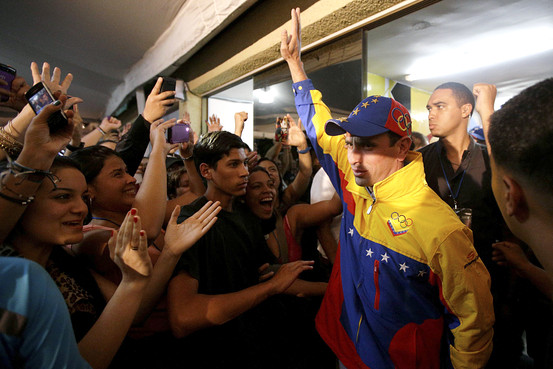
OB VS154 velect G 20121217024727 In Case You Missed It… Articles Roundup Week of 12/21/12

Courtesy of: Associated Press

This week: Capriles held on to his governorship of Miranda in Sunday’s state elections, solidifying his place as the opposition’s leader; power struggles between Chávez’s most influential allies begin to brew as the shadow of the president’s cancer looms; the budget for Venezuela’s states and communities will be less than it was in 2009; socialist communes will receive more funds in 2013 than mayor and governor’s offices. Meanwhile, Chávez suffers a respiratory infection and must remain in a state of “absolute rest”; Chavez’s battle with cancer and the possibility of a new presidential election will likely delay a needed currency devaluation; Venezuelan allies fear they will lose their socialist patron if Chávez dies or is forced to step down; Venezuela’s Supreme Court considers may decide whether  Chávez’s presidential swearing-in can be postponed. Lastly, Venezuela’s National Electoral Council (CNE) announces that the election of 335 mayors and municipal councils will be held next May 26.

Venezuela’s Capriles Solidifies Threat to Chávez, Wall Street Journal

Henrique Capriles held on to his governorship in state elections Sunday, solidifying his place as the opposition’s most likely candidate if President Hugo Chávez’s illness forces a new race for Venezuela’s presidency.

Behind appearance of unity among Chavez allies, some Venezuelans see power struggles brewing, Associated Press

Hugo Chavez’s most influential allies are projecting an image of unity while the president recovers from cancer surgery in Cuba, standing side-by-side and pledging to uphold his socialist movement no matter what happens.

Venezuela’s FY2013 budget below that of 2009, El Universal

During the presentation of the national budget for fiscal year 2013, Finance Minister Jorge Giordani stressed that next year the regions would be receiving more funds than in 2012. However, official data shows that the FY2013 budget will be actually below that in 2008-2009.

Venezuelan communes to get more funds than mayor’s offices, El Universal

Venezuela’s Budget Law for fiscal year 2013 provides that some USD 4.9 billion will be allocated by the Inter-territorial Compensation Fund (FCI) to the projects and plans of governor’s offices, mayoralties and communal councils.

Venezuela’s Chavez Suffers Respiratory Infection After Surgery, Businessweek

Venezuela’s President Hugo Chavez suffered a respiratory infection after cancer surgery in Cuba that was treated by doctors and controlled on Dec. 17, Information Minister Ernesto Villegas said yesterday. Chavez is currently in stable condition, Villegas said in a national address on television and radio.

Chavez’s cancer may put Venezuela devaluation on hold, Reuters

Venezuelan President Hugo Chavez’s battle with cancer and the possibility of a new presidential election look likely to delay key economic policy decisions including a sharp currency devaluation needed to shore up public finances.

Analysis: Allies to lose socialist patron if Venezuela’s Chavez goes, Reuters

Murals adorning a Caracas slum that has given militant backing to President Hugo Chavez over the years are a virtual pantheon of international radicals. From Colombia’s FARC guerrillas to the Palestine Liberation Organization and Ernesto “Che” Guevara, the images and slogans on teeming slopes above Chavez’s presidential palace hail socialist revolutionaries the world over.

Top Venezuela judge: court could decide if constitution allows delay of Chavez’s swearing-in, Washington Post

The president of Venezuela’s Supreme Court said Thursday that it could decide whether it’s constitutional to postpone the date of ailing President Hugo Chavez’s swearing-in as he recovers from cancer surgery in Cuba.

Venezuela’s electoral council: Local elections will be held on May 26, El Universal

The Venezuela’s National Electoral Council (CNE) announced on Thursday that the election of 335 mayors and municipal councils, in addition to two mayoralties in Caracas metropolitan area and their respective chambers will be held next May 26.

 
Nov
2
2012
Posted by
admin
Comments

In Case You Missed It… Articles Roundup Week of 11/2/12

rangel silva1 In Case You Missed It… Articles Roundup Week of 11/2/12

Courtesy of: Últimas Noticias

As the Giants’ celebrate their win in the World Series, Venezuelans celebrate Pablo Sandoval as the first Venezuelan to win MVP. Meanwhile, Venezuela’s economy deteriorates further as Chávez’s government prepares to issue new debt. Expropriations remain in the news while the Venezuelan government announces it will pay for the expropriated steel company Sidetur. On Wednesday, there was another power outage in northwest Venezuela. Chávez also announced that his current defense minister, Henry Rangel Silva, will be seeking election as governor in Trujillo. Venezuela loses trade advantages with the EU in 2014. Raul Castro received the Venezuelan delegation visiting Cuba to discuss further economic aid from Venezuela to Cuba. Meanwhile, food and consumer imports soar in Venezuela as the domestic industries are unable to meet demand. Amidst recent deterioration of oil refineries, Venezuela’s sales of oil byproducts to the United States have substantially declined. Lastly, the CNE authorizes changes in the ballots and voting regulations for Venezuela’s gubernatorial elections, arguing that the changes were made in order to “make the information easier for voters.”

World Series is a showcase for Venezuela, where baseball’s a passion and talent flows like oil, Fox News

On a ragged baseball diamond, its grass tall and infield dirt pockmarked, nearly 200 boys practice for hours every day. Many of them are inspired by the example of Detroit Tigers slugger Miguel Cabrera, who learned the game on this very field.

Venezuela: a mega bond in the works?, Financial Times

With Venezuela’s presidential elections now well behind us, speculation has been growing on Wall Street that the government may issue new debt soon.

Venezuela: Minister Henry Rangel eyes state governorship, BBC

Mr Chavez said the navy commander, Adm Diego Molera, would be his replacement. Gen Rangel, a close associate of the president, will run for the governorship of Trujillo in state elections on 16 December.

Venezuela Official: Gov’t to Pay for Steel Maker, ABC News

Venezuela’s government will pay a fair price for an expropriated steel company taken over by the state, a government official said Wednesday.

Blackout hits northwest Venezuela, Fox News Latino

A large power outage on Wednesday affected two northwestern Venezuelan states, Electrical Energy Minister Hector Navarro said.

Venezuela sheds trade advantages at the EU in 2014, El Universal

Argentina, Brazil, Cuba, Venezuela and Uruguay are in the list of countries that will stop being the recipients in 2014 of trade incentives by the European Union (EU), reported on Wednesday the community executive board.

Raul Castro Receives Venezuelan Delegation Visiting Cuba, Prensa Latina

President Raul Castro received Venezuela”s Vice President Rafael Ramirez, who is leading a high-level delegation that is visiting the island.

Imports feed consumption in Venezuela, El Universal

The manufacturing sector in Venezuela stills faces difficulties to meet domestic demand, particularly that of food and consumer goods.

Venezuela’s oil byproducts sales to the US drop 43%, El Universal

Amidst deterioration of refineries in Venezuela and new commitments to ship crude oil to allied countries, such as China, Venezuela’s sales of oil byproducts to the United States have substantially declined.

CNE: High court ruling on migrations in register of voters must be waited, El Universal

Sandra Oblitas, the Vice-President of the Venezuelan National Electoral Council (CNE), reported that the special regulations for the gubernatorial elections of December 16 were passed on Wednesday.

 
Oct
11
2012
Posted by
admin
Comments

After Sunday, What’s Next?

514473580 After Sunday, Whats Next?

Courtesy of: Luis Acosta / AFP / Getty Images

In the aftermath of Sunday’s vote, which saw Hugo Chávez elected to his fourth term as president, several things have become clear. Henrique Capriles, leading a unified and energized opposition, was the toughest challenger Mr. Chávez has ever faced. The Chávez government wielded its control of Venezuela’s media relentlessly, preventing Capriles’ message of unity to find pragmatic solutions to everyday problems from gaining any traction on the airwaves. Others have rightly pointed out the bias in Venezuela’s electoral authority, the CNE. Despite the unlevel playing field, Capriles, who doggedly marched through more than 250 towns, succeeded in turning nearly half the country to his cause.

Even though one’s initial impression of Sunday’s vote may yield a dreary sense of “more of the same,” the coming years promise to be crucial for Venezuela. Chávez’s victory brings with it none of the certainty of past triumphs. For one, the president’s cancer still looms over Venezuela’s future: despite his repeated denials, many believe that Chávez remains terminally ill. Given that Venezuela’s constitution stipulates that a new election be held if a president dies in the first four years of his term, the country’s rejuvenated opposition may have another chance to make its case before Venezuelans. Regardless of the president’s health, December’s gubernatorial and April’s mayoral elections give the opposition an opportunity to make further gains against Chávez’s socialist project.

And that opposition still has much to fight for. Chávez, ever the ideologue, is poised to direct his government to take over more of the private economy. The 2012 campaign has weakened Chávez’s political support, but it is unlikely to have shaken his commitment to his socialist project. After a few quiet months in the run-up to the election, we may see the pace of expropriations tick up again. In fact, just two days after Chavez’s election victory, Vice President Elias Jaua confirmed that the expropriation policy will indeed continue.

Venezuela’s stagnating economy may be in for a crushing blow, meanwhile, as Chávez’s election-year borrowing-and-spending may well lead to a currency devaluation. This borrowing, along with high global oil prices, has thus far papered over the cracks in Venezuela’s anemic economy. As Chávez poured millions into his populist reelection effort, he failed to address the fundamental weaknesses in the nation’s economy: food shortages, electrical outages and a crumbling public infrastructure.

But what goes up must come down: the poorly-managed state oil company PDVSA has continually operated under capacity; as prices fall, Venezuela’s leaders’ failure to plan for the future will redound upon the nation’s people. The fatal refinery explosion in Amuay is but a recent illustration of the consequences of PDVSA’s mismanagement.

Meanwhile, a fresh six-year term will shield Chávez from political consequences of the corruption within his government. Former judge Aponte Aponte shocked Venezuelans and, indeed, the hemisphere with his revelation that the government fed instructions to the nation’s judiciary. With Chávez no longer facing the public scrutiny of a campaign, the incentives for such corruption will only increase.

For those in the U.S. policy community, engagement in the future of Venezuela remains essential. Chávez, to be sure, is unlikely to curb Venezuela’s relationship with allies like China, Russia or Iran, or to liberalize Venezuela’s trade policy toward the United States. But the twin pressures of a possibly-fatal illness and a collapsing economy mean that, for Chávez’s Venezuela, the reckoning has yet to come.