Aug
31
2012
Posted by
admin
Comments

In Case You Missed It… Articles Roundup Week of 8/31/12

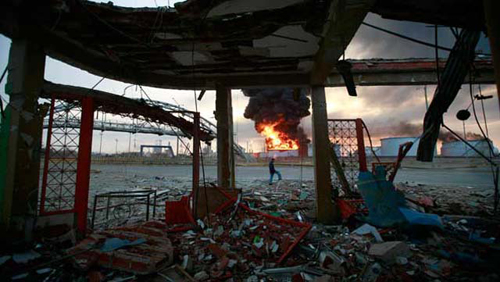
Explosion en Amuay In Case You Missed It… Articles Roundup Week of 8/31/12

Courtesy of: AFP

A series of incidents in the past week – a prison riot, bridge collapse and explosion at an oil refinery – may have damaged Venezuelan President Hugo Chávez’s reelection hopes, as new polls show he has lost the lead to opposition candidate Henrique Capriles. The explosion at the refinery in Amuay has drawn attention to the state oil company’s decaying infrastructure and Chávez’s mismanagement of the country’s oil resources. Questions remain, however, about whether the guilty parties will face any punishment for the accident. Meanwhile, an NGO released a report about media attacks in Venezuela, Chávez uses the government-controlled media to attack the opposition and the electoral council bans an opposition ad about violence in the country – opposition leaders called the ban a violation of free speech.

Venezuela’s presidential campaign: Gaining ground, The Economist

Technical glitches, heckling from his own supporters, thinning crowds and bad polling news. With just over six weeks to go before Venezuela’s presidential election, Hugo Chávez’s bid for another six years in office no longer looks quite the push-over it once seemed.

Venezuela’s Chavez faces new election threats, Miami Herald

It’s been a rough month for Venezuelan President Hugo Chávez. In less than two weeks, he has had to deal with a deadly prison riot, a collapsing bridge, flooding, an embarrassing confrontation with steel workers on live TV and the country’s worst oil-industry disaster, which killed at least 41 and still has families digging through the rubble looking for loved ones.

Chavez Trails Rival Capriles for First Time in Poll, Businessweek

Venezuelan President Hugo Chavez trailed opponent Henrique Capriles Radonski for the first time in a Consultores 21 poll ahead of elections in October.

Venezuela oil blast evidence of deteriorating infrastructure (+video), Christian Science Monitor

Venezuelan Vice President Elías Jaua said Saturday evening the death toll had reached at least 39 after a blast tore through the country’s biggest oil refinery, Amuay in Falcon state.

Venezuela’s Refinery Explosion: Has Chávez Made Petroleum Too Political?, TIME

When I visited Venezuela’s Paraguaná oil refinery complex, the world’s second largest, in 2007, anxieties seemed to flare like its burn-off pipes.

Critics question flow of Venezuelan aid, Financial Times

At the entrance to a rundown neighbourhood in the outskirts of Managua, the capital of Nicaragua, a sign proclaims: “Welcome to District Hugo Chávez”.

The Misrule of Law, New York Times

Venezuelans are reeling this week from the deadliest accident in our nation’s industrial history.

Press freedom group: Venezuela media under assault, Associated Press

The Committee to Protect Journalists said in a new report Wednesday that Venezuelan President Hugo Chavez’s government has used threats and a barrage of restrictive measures to gradually weaken the country’s private news media.

Insulting Hugo Chavez challenger is prime-time TV in Venezuela, LA Times

It’s prime-time TV in Venezuela and the host is saying that opposition presidential candidate Henrique Capriles, whose grandmother was a Holocaust survivor, is a Nazi and Hitler cultist.

Venezuelan electoral officials order political ad off the air, Chavez opponents cry foul, AP

Venezuelan electoral officials have ordered off the air a political ad that depicts the murder of a young man to highlight concerns about crime.
 
Aug
30
2012
Posted by
admin
Comments

Heading for the Home Stretch in Venezuela

jose r cardenas Heading for the Home Stretch in Venezuela

José R. Cárdenas

José R. Cárdenas served in several foreign policy positions during the George W. Bush administration (2004-2009), including on the National Security Council staff. He is a consultant with Vision Americas in Washington, DC.

Venezuela’s presidential election is less than six weeks away, but there has been no shortage of twists and turns in recent days that will likely impact the vote on October 7th. First, the polls, including this week’s stunner that has for the first time given challenger Henrique Capriles a couple of percentage points lead over President Hugo Chávez.

Now, polls are notoriously difficult to gauge in Venezuela, with accusations regularly traded that both sides skew their polling to favor their interests. But Consultores 21 is one of the more reliable pollsters in Venezuela; the firm accurately predicted that the opposition would win a slight majority in the popular vote in the National Assembly elections in September 2010.

Many other polls continue to show Chávez with a lead, but there is every reason to believe the gap is narrowing as Capriles’ energetic campaign blankets the country. The difference in energy level between the two candidates is palpable, as Chávez, despite all the theatrics portraying him as recovered from his cancer, is clearly nothing like his old self.

But cancer isn’t Chávez’s only problem. Other recent incidents spell trouble for his campaign.

For instance, this week’s deadly explosion at Venezuela’s largest oil refinery at Amuay was both a tragedy and a monumental case of bad-timing as it brought unwanted attention to the government’s poor track record of maintaining Venezuela’s infrastructure. The accident has also given new fuel to (well-founded) accusations that the Chávez government has placed a premium on political loyalty over technical competence in its management of state enterprises.

Also this month, the governor of Carabobo state, Henrique Salas Feo, charged that Cuba’s inefficient management of the key port of Puerto Cabello was exacerbating food shortages. Chávez gave the Cuban government a lucrative contract to manage the port but, according to Salas Feo, the result has only been more corruption and increased delays in transporting goods.

Also troubling for Chávez are indications that things may no longer be that rosy between him and his working-class base. Last week, the government was forced to hastily cut off a national television feed when workers began disrupting a Chávez campaign appearance in the northeastern state of Bolívar.

It seems that most of the workforce in the area’s state-owned factories wanted to let the President know of their displeasure that his government had repeatedly failed to renegotiate their collective contract (guaranteed in Chávez’s constitution), meaning their wages have been frozen for some two years, even as inflation has approached 30 percent.

Indeed, one suspects that spiking prices and food shortages, as well as rising street crime and deteriorating public services and infrastructure, may be taking their toll on Chávez’s base. If that is so, the home stretch of the campaign will be defined less by Capriles’s ability to present a fresh face of the opposition to Venezuelan voters — by most measures he has appeared to already have accomplished that — than by whether disillusioned Chávez supporters are fed up enough to switch their allegiances.

Of course, all things aren’t equal in Venezuela. Chávez still maintains huge advantages in money and access to the airwaves, and he still has plenty of militant supporters to intimidate voters. And a desperate Chávez is a dangerous Chávez. But it appears he is finding it increasingly difficult to prevent the election from becoming a referendum on his record in office. Whether he can survive such a referendum remains to be seen.

 
Aug
29
2012
Posted by
admin
Comments

Explosion at Oil Refinery Raises Concerns about PDVSA’s Infrastructure

Amuay refinery explosion Explosion at Oil Refinery Raises Concerns about PDVSAs Infrastructure

Courtesy of: AFP / Getty Images

Early Saturday morning, a massive explosion occurred at Venezuela’s largest oil refinery, killing 48 and injuring 80, stopping production, and rocking the nearby town.

Residents reported smelling gas the night before, but many thought nothing of it, as the odor had occurred many times before. This time, however, was different. At 1 a.m. an explosion engulfed the refinery and also destroyed homes in the town of Amuay, injuring residents who were still sleeping. Two hundred homes were damaged by the blast and 33 families were displaced.

The fires burned for three days, causing several more oil tanks to explode, and were only extinguished yesterday. The refinery has not resumed production, and may not do so for several more days. Concerns remain that once production resumes, the fires may flare up again. Investors, meanwhile, worry that the halt in production from one of the world’s largest refineries could drive up prices.

President Hugo Chávez arrived on the scene Sunday, roughly a day and a half after the explosion first occurred, declaring three days of mourning for those killed in the accident. His initial response was to deny the residents’ reports of the gas leak, telling a reporter that it was “impossible” that there was any deficiency in maintenance at the plant. However, El Nuevo Herald reports that documents from a reinsurance agency that performed an inspection of the plant in March detailed a long list of maintenance problems and safety issues.

Chávez has promised a full investigation though, in light of his original remarks, some question how thorough it will be or whether it will be made public.

The accident calls attention to the decay of the PDVSA’s infrastructure, which has seen a steady decline in production since Chávez took power in 1998. Although Venezuela possesses the largest proven oil reserves of any nation, it lacks the infrastructure to extract and refine this oil safely and efficiently, a shortcoming which has caused serious problems for its economy.

The event couldn’t come for a worse time for Chávez, as new polls show opposition candidate Henrique Capriles with a lead in the polls. It also comes on the heels of an embarrassing moment last week when Chávez was blindsided by protestors in a national broadcast as well as another large prison riot, on which Chávez has refused to comment.

Upon arrival at Amuay, Chávez expressed solidarity for the victims and then stated, somewhat oddly, that “the show must go on.” Indeed, with just over a month before the presidential elections, Chávez probably wishes he could put this all behind him.