Mar
1
2013
Posted by
admin
Comments

In Case You Missed It…Articles Roundup Week of 3/1/13

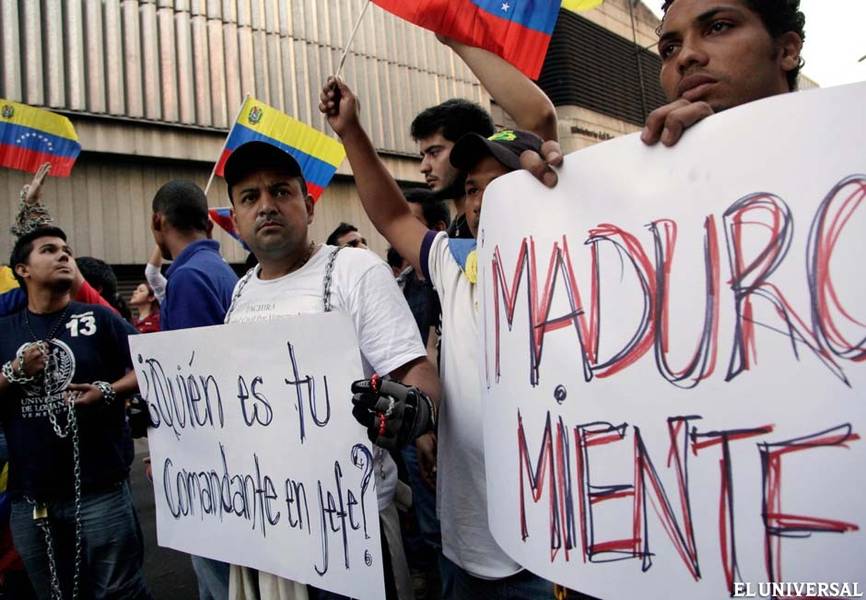
protestaap123.jpg.940.600.thumb  e1362172682790 In Case You Missed It...Articles Roundup Week of 3/1/13

Courtesy of: Associated Press

This week: Since his secretive return to Venezuela, confusion and uncertainty have surrounded Chávez’s health; while Chávez remains hidden from the public eye, the possibility of a new presidential election looms; members of the opposition march to demand answers on the president’s health; and vice president Nicolás Maduro admits on national television that Chávez is “is fighting for his health, for his life.” Price and currency controls cause pharmacy drug shortages to reach 40 percent; an electricity crisis and constant power cuts stir anger towards the Venezuelan government; price hikes continue in Venezuela, with the black market price of the dollar now at four times its official value; reports surface that 27.5 percent of Venezuelan imports reported by the government in 2012 in fact never happened; and Venezuela’s comptroller finds multiple administrative irregularities in two state-owned TV networks. Lastly, the Inter-American Commission on Human Rights urges Venezuela to reconsider its withdrawal from the respected human rights commission; authorities violently disperse student demonstrations demanding answers on Chavez’s health; US officials believe the US will have to play a role in any forthcoming transition of power in Venezuela; and opposition leader Leopoldo López is arrested as part of what he calls a “political persecution” by  the Chávez government.

Confusion reigns over Chávez’s condition, Financial Times

There has been no sign of Hugo Chávez since the stealthy pre-dawn return to Caracas of Venezuela’s ailing leader a week ago, but at least one person is confident of his wellbeing.

As Chávez’s silence persists, Venezuela mulls new elections, Miami Herald

President Hugo Chávez spent his first week back in Venezuela too frail to be seen in public and too weak to receive well wishers. But despite his precarious health, few doubt Chávez’s prowess at the ballot box.

Opponents to Hugo Chavez Continue to Demand Answers, Fox News Latino

Hundreds of opponents to the government of Hugo Chávez demonstrated Saturday to demand answers about the condition of the Venezuelan president while he remains out of the public eye.

Venezuela’s Chavez clings to life, vice president says, NBC News

Venezuelan President Hugo Chavez is clinging to life, according to the country’s vice president. “The commander is fighting for his health, for his life,” Nicolas Maduro said on national TV Thursday.

Drugs shortage in Venezuela accounts for 40%, El Universal

Through letters and conversations with the Government, the Venezuelan pharmaceutical sector has warned it is “choking” as medicine shortage is reaching a critical level.

Venezuela: power cuts stir resentment, Financial Times

The problem may have gone largely unnoticed in Caracas, where everyone is fixated by the ongoing Hugo Chávez drama, but Venezuelans living in the provinces are getting fed up with blackouts that inconvenience their everyday life.

Price hikes in Venezuela, Al Jazeera

Scores of Venezuelans descended from the hillside slums of Caracas 24 years ago on this day, burning cars and looting to protest a hike in gasoline prices, the last straw in a series of austerity measures.

An estimated 27.4% of Venezuelan gov’t imports never happened, El Universal

Ten years after forex restrictions were put in place in Venezuela, distortion accentuates. Imports at a low exchange rate seem to be increasingly encouraging overbilling and other procedural practices.

Venezuela’s comptroller finds irregularities in state-run TV networks, El Universal

Lack of internal controls and supervision of budget and assets, absence of personnel management manuals and award of no-bid contracts without justification whatsoever are just some of the administrative irregularities found by the Controller’s Office of Venezuela in state-owned TV networks Ávila TV and Vive TV.

IACHR hopes Venezuela to rethink withdrawal, El Universal

The president of the Inter-American Commission on Human Rights (IACHR), José de Jesús Orozco Henríquez, said he hoped “respectfully” that the Venezuelan state reconsiders its intention to leave the American Convention on Human Rights.

Student demonstration dispersed by authorities in Venezuela, El Universal

One more time, the student opposition movement Operation Sovereignty took the streets, a week after a protest at the Cuban Embassy in Caracas.

Venezuela Charges Opposition Leader With Misuse of Funds in 1998, Bloomberg

Venezuelan opposition politician Leopoldo Lopez faces as much as four years in prison for alleged misuse of public funds more than a decade ago as President Hugo Chavez’s health prompts speculation about new elections.

US says it has a role to play in transition in Venezuela, El Universal

Roberta Jacobson said the aim is to convey to “Venezuelans of all political stripes” the message that it is important to hold elections on an equal footing.
 
Feb
28
2013
Posted by
admin
Comments

ICYMI: Venezuela’s Economic Troubles Continue

Joel Hirst is a democracy activist and a Principal at Cordoba Group International. He is a regular What’s Next Venezuela contributor.

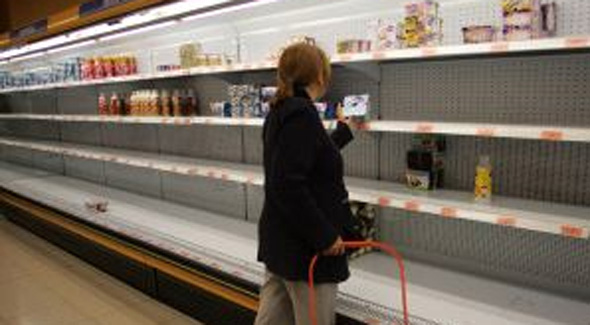
35176escasez22 e1362071656126 ICYMI: Venezuelas Economic Troubles Continue

Courtesy of: TalCual

Huffington Post
February 28, 2013
By Joel D. Hirst

For the past few months, the eyes of Latin America have been fixed on the ailing Venezuelan President Hugo Chávez. As news regarding his health does not improve, speculation has swirled about whether the three-term president will ever recover. For average Venezuelans, however, the more important debate concerns not whether the man himself will live out his fourth term in office, but whether the economic malpractice he has subjected on Venezuela — and which has wrought so much economic pain on the country — will be allowed to endure.

Chávez, first elected in 1999, proclaimed that his new political/economic doctrine of “21st Century Socialism” would provide a more equitable distribution of wealth for Venezuela’s poorest. After fourteen years of economic experiments; the economic model has been demonstrated as self-defeating. More than a decade of expropriations, government harassment of the private sector, and price and currency controls in fact proved disastrous for Venezuela’s economy and its people. Venezuelans have spent that decade struggling under the yoke of high unemployment, rampant inflation and crippling shortages of everything from rice to flour to coffee. It has left Chávez in the awkward position of blaming Venezuela’s hobbled private sector for the failure of his own socialist policies.

As the situation in Venezuela has deteriorated, Chávez has used private enterprise as a scapegoat — reinforced by Chavez’s near-total control of the country’s media — to maintain his hold on power. Yet there is no escaping the fact that the private sector in Venezuela is in a bad way, and it is only getting worse.

Expropriations have long been Chávez’s favorite tool to suppress the private sector. The government has seized almost a thousand companies over the past decade, in industries as varied as agriculture to tourism. Most of them are now state-owned and unproductive. Since Chávez was first elected, the number of private companies in Venezuela has dropped from 14,000 to 9,000 in 2011.

Chávez insisted such measures were necessary because private companies were “hoarding” their products to intentionally reduce supply. He claimed that seizures would boost productivity and reduce Venezuela’s dependence on imports. Not surprisingly, as has become evident in other countries that decide to nationalize large swaths their economy, the opposite has happened. Dramatic declines in productivity, shortages and inflation have ensued. With general shortages at an alarming 16.3 percent — the highest level in five years — the government’s excuses are simply no longer credible.

Those businesses that have escaped expropriation are subject to government threats and an ever-tighter regulatory environment. Widespread and arbitrary price controls govern nearly all goods and services sold to the public, including imports. The government has no methodology when determining whether a company’s earning is, according to them, “excessive,” giving them the power to subjectively decide prices.

Pharmaceuticals will soon become the latest target of price regulations. The government has ordered the country’s price controls agency to establish maximum prices for all medications. As the agency finalizes its decision, pharmacies will have to report their current selling prices to the authorities. The reports issued by pharmaceutical companies and laboratories illustrate the troubling fact that drug shortages in January stood at 40 percent. Once the new price controls come into force, that number will likely continue to rise.

Such stringent controls force many companies to operate at a loss, discouraging investment and bankrupting more of Venezuela’s remaining businesses. Companies that reduce their inventories in order to remain in business are threatened with expropriation or may see their wares confiscated on charges of “boycotting”, exacerbating the shortages of goods. Indeed, Venezuelan authorities seized 3,088 metric tons of food in January alone. According to AP, “Over the weekend, National Guard troops entered one market in downtown Caracas and confiscated 20 tons of beef, 15 tons of corn and four tons of garlic that allegedly violated price controls.”

Compounding the impact of price controls are equally stringent restrictions on foreign currency. As Chávez’s domestic policies crippled purchasing power and caused inflation to skyrocket, businesses turned to foreign reserve currencies, like U.S. dollars, to remain viable. But the Venezuelan government severely limits the supply of dollars, depreciating the value of private currency reserves and preventing companies from importing the goods that Venezuelans need. It typically takes between 180 and 250 days for foreign currency to be delivered, putting an additional strain on the balance sheets of both Venezuelan businesses and private citizens.

Add in the effects of a recent labor law, which forbids employers from laying off any worker who does not agree to resign, and the situation for business in Venezuela is indeed bleak. Chávez has succeeded in marginalizing the free market in Venezuela. The socialist utopia that he promised would follow, however, has failed to materialize.

Even as the rest of the world slowly emerged from the global recession of 2008, Venezuela’s economy decelerated. Unemployment tops eight percent (even after counting informal workers such as street venders). Inflation, currently at 22 percent, has soared. Venezuela sits atop the world’s largest proven oil reserves, yet the state-owned oil company PDVSA continually operates under capacity and in the red. An election-year spending binge has left the government drowning in debt, and without adequate resources to update Venezuela’s crumbling infrastructure.

In a tacit acknowledgement of its own failure, the government recently announced that it would devalue Venezuela’s national currency, the Bolivar, by nearly a third. After hearing the news, regular citizens raced to the streets to purchase anything they could find before the devaluation crippled their purchasing power still further. Private businesses quickly did the numbers as well, predicting even more losses in 2013. For example, Colgate-Palmolive expects an after-tax loss of approximately $120 million, while Halliburton anticipates a $30 million related charge.

The government announced the devaluation without warning, clearly hoping it would go unnoticed by a nation still fixated upon their president’s illness. Try as they may to scapegoat the private sector, the fact remains that this is precisely the society that the revolutionaries betted on. Their top lieutenants can no more ignore the consequences of their own actions than wish their ailing president back to health.

Recent reports indicate that Chávez has now returned to Venezuela, where his condition has not improved. No one knows for sure what will become of Chávez. His country, however, stands at a crossroads. And the eyes of the world will be watching.

To read this article at the Huffington Post, please click here.

 
Feb
26
2013
Posted by
admin
Comments

ICYMI: Hugo Chavez’s legacy of economic chaos; Tough times ahead for Venezuela

José Cardenas is a former senior official at the U.S. State Department, National Security Council and the U.S. Agency for International Development, where he served as Acting Assistant Administrator for Latin America and the Caribbean. He is a regular What’s Next Venezuela contributor.

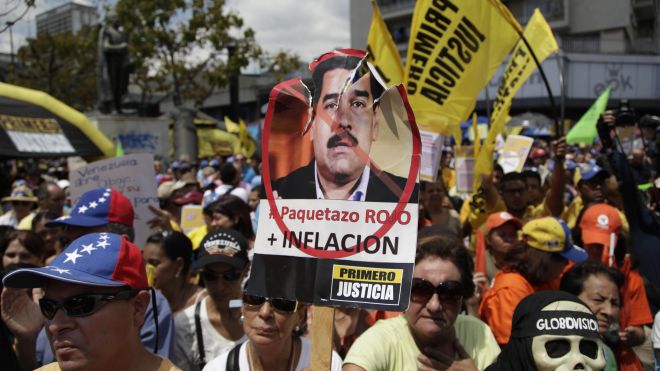
Venezuela Protest e1361899707868 ICYMI: Hugo Chavezs legacy of economic chaos; Tough times ahead for Venezuela

Courtesy of: Associated Press

Washington Times
February 26, 2013
By José Cardenas

The recent return home from Cuba in the dead of night of cancer-stricken Venezuelan President Hugo Chavez is likely not a sign that his condition is improving. In fact, it is more likely that his doctors have decided there is nothing more they can do than to allow him to go home to die peacefully, surrounded by family.

That suits just fine senior Venezuelan officials and their Cuban minders, who need Mr. Chavez’s physical presence nearby to better stage-manage a chavista succession. They now can tell the Venezuelan people, with whom Mr. Chavez maintains a deeply emotional connection, that the “comandante” remains intimately involved in the process, “approving” all decisions.

It appears the only decision to be made at this point, however, is whether Mr. Chavez’s inner circle declares the ailing leader “incapacitated” or whether they wait out the inevitable before calling elections within 30 days, as the constitution mandates.

If they have their wits about them, they probably will move to “retire” the Venezuelan leader sooner rather than later. A few months down the road, they are likely to be facing a much less favorable political climate than they are enjoying today. That’s because Mr. Chavez has bequeathed to them a ticking economic time bomb, which is set to blow up in the faces of the very people Mr. Chavez has claimed to represent — the poor and working masses.

Much will be written in the coming weeks that Mr. Chavez’s legacy is that he transformed Latin American politics by giving a voice to the voiceless. Less will be focused on just what the cost will be to those very same people, as well as their children.

Once the emotion of the moment passes, Venezuelans will be left to pick up the pieces from Mr. Chavez’s gross mismanagement of the Venezuelan economy. To squander Venezuela’s vast oil wealth takes real effort, but Mr. Chavez and his profligate spending proved up to the task. In what has been an abject lesson in the perils of populist economics, his actual legacy will be soaring inflation, a bloated public sector, a crippled private one, electricity blackouts, shortages of basic goods and one of the highest homicide rates in the world.

The first sign of more difficult days ahead came on Feb. 8, when the government ordered a 46 percent devaluation of the country’s currency. Inflation, already running at 22 percent, is now expected to surge, prices of goods will increase, and shortages of items such as toilet paper and cornmeal (the staple of arepa cakes) and even automobiles will grow worse.

Of course, the burden of such economic dysfunction always falls on the poor and working classes, who devote a higher portion of their incomes to basic necessities. As a result of the devaluation, Venezuelans’ real income is expected to decrease by 20 percent this year, at the time when their purchasing power already has dropped to 1966 levels.

What’s more, it will only get worse. Analysts say another devaluation is almost inevitable, given that this latest one will not come close to balancing the government’s books. Rumors are also rampant that the government will soon introduce rationing measures for basic food items.

Nor is any relief likely to come from the private sector, which has been plagued by price and currency controls, expropriations, government interventions, legal uncertainty and oppressive labor laws. Indeed, under Mr. Chavez, the number of private companies has dropped from 14,000 to 9,000. While a decade ago, 8 out of 10 jobs were generated by the private sector, today that figure is 6 out of 10.

Neither does it appear that China is willing to continue to pay Venezuela’s bills. Having already lent Mr. Chavez $39 billion against future oil sales, it recently sent home Venezuelan Foreign Minister Elias Jaua empty-handed, with no indication that further loans were in the offing.

The fix is already in that the uncharismatic Nicolas Maduro will be entrusted with trying to keep chavismo alive without Mr. Chavez. Whether he and his Cuban advisers can successfully exploit Mr. Chavez’s image to confront formidable challenges on the horizon remains to be seen. One thing is certain, however: As opposition leader Henrique Capriles tweeted upon Mr. Chavez’s return to Venezuela, “Hopefully the president’s return means that Mr. Maduro and his ministers can get to work. There are thousands of problems to resolve.” Without a doubt.

To read this article at The Washington Times, please click here.