Feb
28
2013
Posted by
admin
Comments

ICYMI: Venezuela’s Economic Troubles Continue

Joel Hirst is a democracy activist and a Principal at Cordoba Group International. He is a regular What’s Next Venezuela contributor.
35176escasez22 e1362071656126 ICYMI: Venezuelas Economic Troubles Continue

Courtesy of: TalCual

Huffington Post
February 28, 2013
By Joel D. Hirst

For the past few months, the eyes of Latin America have been fixed on the ailing Venezuelan President Hugo Chávez. As news regarding his health does not improve, speculation has swirled about whether the three-term president will ever recover. For average Venezuelans, however, the more important debate concerns not whether the man himself will live out his fourth term in office, but whether the economic malpractice he has subjected on Venezuela — and which has wrought so much economic pain on the country — will be allowed to endure.

Chávez, first elected in 1999, proclaimed that his new political/economic doctrine of “21st Century Socialism” would provide a more equitable distribution of wealth for Venezuela’s poorest. After fourteen years of economic experiments; the economic model has been demonstrated as self-defeating. More than a decade of expropriations, government harassment of the private sector, and price and currency controls in fact proved disastrous for Venezuela’s economy and its people. Venezuelans have spent that decade struggling under the yoke of high unemployment, rampant inflation and crippling shortages of everything from rice to flour to coffee. It has left Chávez in the awkward position of blaming Venezuela’s hobbled private sector for the failure of his own socialist policies.

As the situation in Venezuela has deteriorated, Chávez has used private enterprise as a scapegoat — reinforced by Chavez’s near-total control of the country’s media — to maintain his hold on power. Yet there is no escaping the fact that the private sector in Venezuela is in a bad way, and it is only getting worse.

Expropriations have long been Chávez’s favorite tool to suppress the private sector. The government has seized almost a thousand companies over the past decade, in industries as varied as agriculture to tourism. Most of them are now state-owned and unproductive. Since Chávez was first elected, the number of private companies in Venezuela has dropped from 14,000 to 9,000 in 2011.

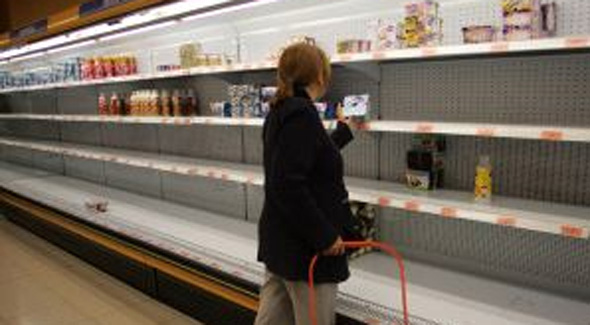
Chávez insisted such measures were necessary because private companies were “hoarding” their products to intentionally reduce supply. He claimed that seizures would boost productivity and reduce Venezuela’s dependence on imports. Not surprisingly, as has become evident in other countries that decide to nationalize large swaths their economy, the opposite has happened. Dramatic declines in productivity, shortages and inflation have ensued. With general shortages at an alarming 16.3 percent — the highest level in five years — the government’s excuses are simply no longer credible.

Those businesses that have escaped expropriation are subject to government threats and an ever-tighter regulatory environment. Widespread and arbitrary price controls govern nearly all goods and services sold to the public, including imports. The government has no methodology when determining whether a company’s earning is, according to them, “excessive,” giving them the power to subjectively decide prices.

Pharmaceuticals will soon become the latest target of price regulations. The government has ordered the country’s price controls agency to establish maximum prices for all medications. As the agency finalizes its decision, pharmacies will have to report their current selling prices to the authorities. The reports issued by pharmaceutical companies and laboratories illustrate the troubling fact that drug shortages in January stood at 40 percent. Once the new price controls come into force, that number will likely continue to rise.

Such stringent controls force many companies to operate at a loss, discouraging investment and bankrupting more of Venezuela’s remaining businesses. Companies that reduce their inventories in order to remain in business are threatened with expropriation or may see their wares confiscated on charges of “boycotting”, exacerbating the shortages of goods. Indeed, Venezuelan authorities seized 3,088 metric tons of food in January alone. According to AP, “Over the weekend, National Guard troops entered one market in downtown Caracas and confiscated 20 tons of beef, 15 tons of corn and four tons of garlic that allegedly violated price controls.”

Compounding the impact of price controls are equally stringent restrictions on foreign currency. As Chávez’s domestic policies crippled purchasing power and caused inflation to skyrocket, businesses turned to foreign reserve currencies, like U.S. dollars, to remain viable. But the Venezuelan government severely limits the supply of dollars, depreciating the value of private currency reserves and preventing companies from importing the goods that Venezuelans need. It typically takes between 180 and 250 days for foreign currency to be delivered, putting an additional strain on the balance sheets of both Venezuelan businesses and private citizens.

Add in the effects of a recent labor law, which forbids employers from laying off any worker who does not agree to resign, and the situation for business in Venezuela is indeed bleak. Chávez has succeeded in marginalizing the free market in Venezuela. The socialist utopia that he promised would follow, however, has failed to materialize.

Even as the rest of the world slowly emerged from the global recession of 2008, Venezuela’s economy decelerated. Unemployment tops eight percent (even after counting informal workers such as street venders). Inflation, currently at 22 percent, has soared. Venezuela sits atop the world’s largest proven oil reserves, yet the state-owned oil company PDVSA continually operates under capacity and in the red. An election-year spending binge has left the government drowning in debt, and without adequate resources to update Venezuela’s crumbling infrastructure.

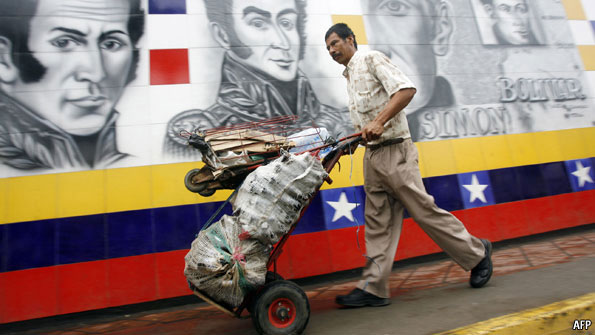
In a tacit acknowledgement of its own failure, the government recently announced that it would devalue Venezuela’s national currency, the Bolivar, by nearly a third. After hearing the news, regular citizens raced to the streets to purchase anything they could find before the devaluation crippled their purchasing power still further. Private businesses quickly did the numbers as well, predicting even more losses in 2013. For example, Colgate-Palmolive expects an after-tax loss of approximately $120 million, while Halliburton anticipates a $30 million related charge.

The government announced the devaluation without warning, clearly hoping it would go unnoticed by a nation still fixated upon their president’s illness. Try as they may to scapegoat the private sector, the fact remains that this is precisely the society that the revolutionaries betted on. Their top lieutenants can no more ignore the consequences of their own actions than wish their ailing president back to health.

Recent reports indicate that Chávez has now returned to Venezuela, where his condition has not improved. No one knows for sure what will become of Chávez. His country, however, stands at a crossroads. And the eyes of the world will be watching.

To read this article at the Huffington Post, please click here.
 
Feb
15
2013
Posted by
admin
Comments

ICYMI: Why Venezuela’s Devaluation is Biting

CNBC
February 14, 2013
By Kelley Holland

20130216 amp501 e1360958533813 ICYMI: Why Venezuelas Devaluation is Biting

Courtesy of: Agence France Presse

First came Colgate-Palmolive, but it wasn’t alone for long. Halliburton, Avon, and Merck soon joined a rapidly growing list.

These companies and more have announced that they will take an earnings hit in the wake of Venezuela’s latest devaluation of its currency, the bolivar fuerte, last Friday. And there is talk that more companies could join the crowd: just for starters, among U.S. multinationals, Goodyear is evaluating the impact of Venezuela’s move, but has lowered its operating income guidance. Among consumer consumer-oriented companies, Heinz, Clorox, Procter & Gamble, and Arcos Dorados Holding, the world’s largest McDonald’s franchisee, are quite active in Venezuela, and in the energy sector, Chevron participates in six energy-related projects in the country.

At least in some quarters, the devaluation appears to have been expected – which raises the question of why these companies weren’t better prepared. Shouldn’t they have hedged against this possibility?

Apparently, it’s complicated.

In Venezuela, “there is very little a company can do to hedge their exposure,” Willie Williams, director of institutional derivative sales at Societe Generale, told CNBC.com. “There is no non-deliverable forward market like in Brazil to hedge exposures. The best many companies can do is have expenses denominated in bolivars as well.”

Even if a company could find a way to hedge bolivar exposure, it could be very costly, says Eduardo Suarez, a currency strategist at Scotiabank. Trading volume in the “formal market” for the bolivar is usually less than $100 million per day, he says, and “such a small formal market would probably mean very high costs for the large transactions multinationals would require.”

There would be carrying costs for a hedge as well, he said. “Unless you time the hedge very well, you would be forced to pay a large negative carry to keep the hedges on for a prolonged period due to rate differentials.”

True – but those weren’t the only problems. “I think part of the issue is that many people became complacent into thinking that Venezuela would postpone any currency action until Chavez came back,” says Gustavo Arteta, an emerging markets FX strategist at UBS.

So far the announced earnings hits have been relatively minor – but this was not the first time Venezuela has devalued the bolivar, and the companies who took hits do have significant exposure to Venezuela. Arteta wrote in a note to clients that “our initial reading is that the devaluation is not large enough,” adding that the official rate is still not in sync with the black market rate. “We think that another devaluation to bring the official rate close to 9 or 10 should not be ruled out in Q2 or Q3.”

Hopefully, multinationals will find that one less of a surprise.

To read this article at CNBC, please click here.

 
Feb
17
2012
Posted by
admin
Comments

In Case You Missed It… Articles Roundup Week of 2/17/12

In this week’s roundup… Three million Venezuelans came out to the polls in Sunday’s primary election; Henrique Capriles Radonski won with an overwhelming 62 percent of the vote, and his primary opponents immediately vowed to support him; the opposition resisted the government’s order to turn over voter lists. Meanwhile, Chávez instituted a new round of price controls and shipped oil to war-torn Syria, potentially undermining Western sanctions against the country and its repressive leader, Bashar al-Assad.

Venezuela’s Capriles wins primary, seeks to beat Chávez, Reuters

Venezuelan opposition leader Henrique Capriles easily won a primary election on Sunday to become the unity candidate against President Hugo Chávez, vowing to end 13 years of socialist rule that he said has left the OPEC nation in crisis.

Chávez Opponent Surges in Venezuela, The Wall Street Journal

An intense young governor, part of a new generation of Venezuelan politicians, will be facing off against an ailing President Hugo Chávez after winning a landslide primary victory Sunday.

Chávez’s Challenger, The New York Times

A lot was at stake in Sunday’s opposition primary beyond figuring out who would take on Hugo Chávez in the presidential election this fall. Venezuelans wanted to know whether the chronically splintered opposition could get its act together enough to unite behind a single, credible contender.

And in the blue corner…, The Economist

More than a few supporters of the opposition to Hugo Chávez, Venezuela’s president, awoke on February 13th feeling the need to pinch themselves. The results of the open primary elections the night before, designed above all to pick a candidate to frustrate Mr Chávez’s bid for re-election in October, exceeded all expectations. The winner, as widely predicted, was Henrique Capriles, the governor of the state of Miranda.

Venezuela opposition: Row erupts over voter list, BBC News

Venezuela’s opposition says it has destroyed the list of voters in Sunday’s primary election, despite a court order that they be preserved. The Democratic Unity coalition said the records had been burned in accordance with a promise to ensure confidentiality.

Venezuelans Resist Order to Turn Over Voter Names, The New York Times

A furor has erupted in Venezuela over voter secrecy in an opposition primary election held on Sunday to choose a candidate to run against President Hugo Chávez, with political leaders expressing fear that the government might seek reprisals against voters if their names are publicized.

Despite housing pledges from Chávez, Venezuela’s homeless call racetrack home, The Washington Post

Venezuela already faced a housing shortage of 2 million units, the government’s own statistics show, with the state only managing to build a third of the 100,000 new units needed each year. Julio Borges, an opposition deputy in the National Assembly who frequently clashes with Chávez on housing issues, said governments that preceded Chávez’s built more housing.

Venezuela to Begin Presenting Regulated Price Caps to Companies, Bloomberg Businessweek

Venezuela will begin to present regulated prices to about 385 companies that produce personal care and cleaning products including Colgate-Palmolive Co., Procter & Gamble Co. and Unilever NV today.

Venezuela Gives Pepsi Venture 4 Days to Provide Water Receipts, Bloomberg

Pepsi-Cola Venezuela CA has four days to provide receipts to the government after the country’s price control agency received complaints that the company raised its price for mineral water ahead of price caps.

Exclusive: Venezuela ships fuel to war-torn Syria, Reuters

The government of Venezuela’s Hugo Chávez is emerging as a rare supplier of diesel to Syria, potentially undermining Western sanctions and helping the Syrian government fuel its military in the middle of a bloody crackdown on civilian protests.

Venezuela’s oil industry: Spilling over, The Economist

On February 4th Hugo Chávez, Venezuela’s president, held festivities to celebrate the anniversary of a failed coup attempt he led in 1992. He had busloads of public workers brought into Caracas for the occasion. Among them were high-ranking employees of PDVSA, the state oil company. That same day, a pipeline carrying pressurised oil fractured in the state of Monagas.