Feb
4
2013
Posted by
admin
Comments

ICYMI: Covert Flour Deals Show Venezuela Woe

Wall Street Journal
February 3, 2013
By Kejal Vyas

WO AM587 VENSHO G 20130203181503 e1360009164793 ICYMI: Covert Flour Deals Show Venezuela Woe

Courtesy of: AFP/Getty Images

CARACAS—On any given day at the Quinta Crespo wholesale market, dozens of people lurk in the back alleys trying to get their hands on a white powder. Dealers sell it on the sly at inflated prices, careful to avoid patrolling National Guardsmen who can arrest them.

But this is no illicit substance trading hands in this grimy downtown bazaar: It is corn flour, used to make Venezuela’s staple food, the pancake arepa.

In oil-rich Venezuela, the worst food and consumer-goods shortages in nearly four years are making buying flour and other goods such as meat, sugar, cooking oil and toilet paper into a harrowing ordeal. Even medicines, like asthma inhalers, are hard to come by.

WO AM575 VENSHO G 20130203175404 ICYMI: Covert Flour Deals Show Venezuela Woe

Courtesy of: Wall Street Journal

Business leaders say the explanation is simple: Currency controls adopted in 2003 to prevent capital flight also complicate the purchase of imports, while price caps, expanded in late 2011, don’t cover production costs.

Economists say the shortages those factors created were exacerbated by President Hugo Chávez’s overspending during his re-election campaign last year.

The shortages have become the government’s latest challenge, as it deals with the political uncertainty of Mr. Chávez’s now six-week absence from Venezuela as he recovers from cancer in Cuba.

The central bank’s Scarcity Index, a measure of the percentage of products missing from store shelves, jumped to 16.3% in December, the highest level since May 2008 due to price controls that were too low, many economists say.

“Here you have to know someone, know the right people, before you can get what you want,” said Antonio González, a 22-year-old bakery worker out looking for supplies in Quinta Crespo on a recent day.

Despite neon-colored signs posted outside stores saying sugar and flour are out of stock, Mr. González said some owners sell to preferred customers ready to spend anywhere from 30% to 90% above state-regulated levels.

The ingredients are unlikely to go toward products with low state-controlled prices, such as loaves of bread that cost 3 Venezuelan bolívars (70 cents). Instead, they are likely to be used for unregulated items like breads stuffed with cheese or ham, which can command more than 20 bolívars.

In the wealthier neighborhood of Chacao, many bakeries have limited customers to buying two baguettes. Many supermarkets remind shoppers they can purchase no more than two packages of cooking oil or corn flour, products whose prices are regulated. Long lines of customers buying rationed goods are a common sight.

Venezuela’s largest food packager and distributor, Empresas Polar, said in a recent report that the cost of buying white corn, among other raw materials it uses in its popular P.A.N. brand corn flour, was 50% above price-control levels.

The government acknowledges the latest wave of shortages, but it blames an unusual January rise in food consumption, as well as hoarders and speculators that it says seek to destabilize its socialist project.

In recent weeks, state television has broadcast live searches of warehouses for hidden inventory. Food Minister Carlos Osorio recently said that more than 17,000 tons of foodstuffs had been confiscated in recent weeks as authorities cracked down on around 3,000 storage houses allegedly hoarding goods.

“There are sectors of the opposition that want you to think that there is this total lack of food,” Mr. Osorio said in televised comments.

One official from a large Venezuelan food-packaging company denied that his company was hoarding. He called the government inspections of warehouses “political theater,” adding that state regulations require companies to frequently record movement of their supplies and “they already know how much inventory we have at all times.”

Ángel García Banchs, head of local economic-research house Econometrica, said in an opinion column: “There’s only one strategy left for the government, even though it’s a failed one from my point of view: to design and execute a media campaign to blame the shortages on private national companies.”

Despite price caps, many goods are sold at unofficial, higher prices. Central bank data show an unusual 5.7% rise in the prices of foods and nonalcoholic drinks in December.

Critics say the government flooded the market with dollars last year ahead of Mr. Chávez’s successful October re-election bid. The central bank’s 2012 annual report showed imports jumped 20% on the year to $56.4 billion, the highest in 16 years.

Since the October vote, the flow of dollars to the private sector has dried up. The dollar shortage has caused the black-market rate for the dollar to nearly double to 17.5 bolívars from October.

Last month, Venezuelan authorities announced a change to the tax system that it applies on its oil partners, a move that officials said will send $2.47 billion more to the central bank, which will be able to distribute the hard currency into the local economy.

Economists say Venezuela needs to change its currency-control system. One such move could be a devaluation of the state-set exchange rate of 4.3 bolívars per dollar. That would leave more dollars to distribute in the local economy, economists say.

But a devaluation would also exacerbate already high inflation by making the cost of imports higher in bolívar terms.

With Mr. Chávez ill, his government could be wary of any move that might spark discontent.

“If this is not a sign of a looming crisis, then only god knows what it will happen,” wrote Mr. Garcia Banchs, the economist.

To read this article at the Wall Street Journal, please click here.
 
Oct
19
2012
Posted by
admin
Comments

In Case You Missed It… Articles Roundup Week of 10/19/12

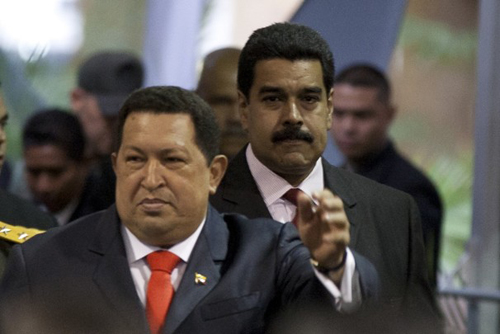
Venezuela Chavez Maduro In Case You Missed It… Articles Roundup Week of 10/19/12

Courtesy of: AP

Less than a week after winning reelection, Chávez swore in his new Vice President, former Foreign Minister Nicolas Maduro and six other cabinet ministers. On Monday Chávez will submit his fiscal year 2013 budget to the National Assembly, largely based on his socialist model. According to the National Institute of Statistics (INE), Venezuela’s inflation rate will reach almost 20 percent by the end of the year. The country’s international reserves are also far below an optimal level. Recent political polarization is threatening freedom of speech in Venezuela, as a new report reveals “mistreatment, detentions, insults, confiscation of equipment, and fundamental rights violations” against journalists, camerapersons, and others in the press. Meanwhile, Chávez has begun to develop Venezuela’s defense industry with plans to build drones with the help of China, Russia and Iran. Chávez breaks diplomatic ties to Paraguay with his decision to expel their diplomats following the ouster of his ally, former President Fernando Lugo. Simultaneously, Chávez’s ties to former Brazilian President Lula are strained after Lula said in a recent interview that Chávez should prepare for his succession. In most recent news, the Venezuelan National Assembly stirs up controversy as they take steps to regulate cable TV.

Venezuela’s Chavez swears in vice president, 6 other ministers in post-election shake up, The Washington Post

CARACAS, Venezuela — Venezuelan President Hugo Chavez swore in his new vice president and six other Cabinet ministers on Saturday, less than a week after winning a new mandate to extend his self-styled Bolivarian revolution.

Venezuela’s 2013 budget bases on socialist model, El Universal

The Venezuelan Government on Monday will summit to the National Assembly a FY2013 draft budget that will be based on the socialist model.

Venezuela Official Inflation Just Under 20%, Latin American Herald Tribune

CARACAS — According to the government’s National Institute of Statistics (INE), Venezuela’s September inflation came in at 1.6%, above the value in August of 1.1%. Factoring in September’s rate, inflation for the first nine months of the year has been 11.5%. One-year inflation stands at 19.98%.

Venezuela’s international reserves far from optimal level, El Universal

Venezuelan international reserves remain below the optimal level (USD 26.8 billion) established by national authorities.

Polarization threatens freedom of speech in Venezuela, El Universal

The Venezuelan Press Block (BPV) presented a report on Sunday at the 68th Inter-American Press Association (IAPA) General Assembly, held at the city of Sao Paulo, Brazil, denouncing increased aggressions against journalists, due to political polarization in Venezuela.

Venezuela serious about producing drones, UPI.com

CARACAS, Venezuela, Oct. 16 (UPI) — Venezuelan President Hugo Chavez is pursuing plans to develop a home-grown defense industry topped by a drone built reportedly with Chinese, Iranian and Russian help.

Venezuela’s government expelling the last of Paraguay’s diplomats in Caracas, envoy says, Fox News

CARACAS, Venezuela – Venezuela’s government has decided to expel Paraguay’s remaining diplomats from the country, the top envoy at the Paraguayan Embassy said Wednesday. Charge d’affaires Victor Casartelli said that he and three other Paraguayan diplomats in Caracas were told by Venezuela’s Foreign Ministry to leave within three days.

Venezuela’s oil exports to Asia to jump to 2.8 million bdp, El Universal

State-run oil holding Petróleos de Venezuela (Pdvsa) is in negotiations with India’s Reliance Industries and Oil & Natural Gas Corp (ONGC) for investments in the Ayacucho and Boyacá oil fields, informed on Wednesday Pdvsa’s Corporate Planning Executive Director, Fadi Kabboul, at a press conference in India.

Venezuela’s Chavez should prepare for succession: Lula, Chicago Tribune

BUENOS AIRES (Reuters) – Venezuela’s newly re-elected president, Hugo Chavez, should start preparing to hand over power, former two-time Brazilian President Luiz Inacio Lula da Silva said in a newspaper interview published on Thursday.

Venezuela’s National Assembly to regulate cable TV, El Universal

The Venezuelan National Assembly (AN) is to make a law for the regulation of subscription television services, informed the President of the People’s Power and Media Committee of the AN, Darío Vivas, deputy for the ruling party United Socialist Party of Venezuela (PSUV).

 
Oct
17
2012
Posted by
admin
Comments

REPORT: CHÁVEZ EXPROPRIATES 1,168 COMPANIES IN A DECADE; JAUA SAYS THERE’S MORE TO COME

agropatria1210 REPORT: CHÁVEZ EXPROPRIATES 1,168 COMPANIES IN A DECADE; JAUA SAYS THERES MORE TO COME

Courtesy of: Jack Bocaranda / AVN

During the last 13 years, Hugo Chávez has earned his reputation as a fierce opponent of private industry. Even as inflation soared and Venezuelans experienced shortages of even the most basic goods, Chávez held true to his socialist ideology, nationalizing huge swaths of the nation’s economy – from farming to oil production to the media. A report from the analysis firm Conindustria indicates that from 2002 to 2012 Chávez’s government nationalized 1,168 private companies. From the seizure of private oil operations to the expropriation of millions of hectares of farmland to the takeover of vacation homes on Los Roques, Chávez has shown that no sector of the economy is beyond his grasp.

However, the pace of expropriations slowed drastically in the months before the election. It seemed that even Chávez recognized his crusade did not represent sound economic policy. The trend began late last year, when Chávez slowed the rate of expropriations and began striking deals with companies he once derided – part of an effort to prop up Venezuela’s economy in an election year.

But now, having been granted the political cover of a new six-year term, Chávez has vowed to deepen his socialist revolution. A reinvigorated opposition can challenge the president on many fronts, but on his bread and butter policy of expropriations, Chávez will likely have free rein. Former Vice President Elias Jaua said in an interview last week that Chávez plans to take full advantage of that power. He told media that the “strategic expropriation” of companies is again on the agenda for Chávez’s next term. Since that time, Jaua has been replaced by Foreign Minister Nicolas Maduro and now stands as a candidate for Governor of Miranda state against Henrique Capriles.

Economists agree that Chávez’s policies have made Venezuela one of the hardest countries on the world in which to do business.  And Venezuela’s people have felt the consequences: foreign direct investment has fallen to less than $1 billion per year from $3.9 billion the year before Chávez took office. Meanwhile, government policies have kept arable farmland idle, forcing Venezuela to raise imports by more than 400 percent to make up for the losses.

Unfortunately for Venezuelans, the situation seems unlikely to improve in the immediate future.