Jul
31
2012
Posted by
admin
Comments

Capriles visits 100 villages in 29 days of electoral campaign

The opposition presidential candidate called upon Venezuelans to post their proposals for the country via Facebook on http://hayuncamino.com/tupropones/

El Universal
July 31, 2012
Sara Carolina Díaz and María de Lourdes Vásquez
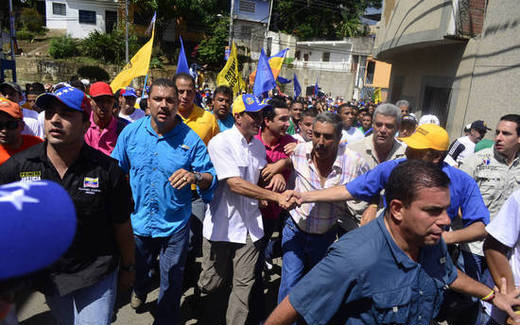
Capriles visits 100 village Capriles visits 100 villages in 29 days of electoral campaign

Henrique Capriles Radonski, the presidential hopeful for opposition alliance Unified Democratic Panel (MUD), visited five villages in central Aragua state (Courtesy of: G. Suárez)

Villa de Cura, in central Aragua state, became the 100th village visited by Henrique Capriles Radonski, the presidential candidate of opposition umbrella group Unified Democratic Panel (MUD), in 29 days of electoral campaign.

The candidate arrived in Villa de Cura from the villages of Barbacoa, Camatagua, San Casimiro and San Sebastián. At the end of the day, Capriles said that he is set to visit more than 300 villages by September. He added that he is determined to meet people eyeball-to-eyeball to convey his message of progress.

Capriles seized the opportunity to send “affective and respectful” greetings to public employees, and to the military officers commissioned in Aragua state, as well as to their families.

“I know that these towns are not visited by those who want to remain in power. They do not come here. They only visit the big cities. The difference lies in coming to towns, such as Camatagua, and listen to people,” said the candidate of the opposition.

He stated that “there is a battle of David versus Goliath in the country: Our only weapon are the votes.”

In Camatagua, he participated in a people’s assembly where he pointed out that the government priorities are not the same as those of the Venezuelan population. People posed five questions to the candidate, most of which were related to high crime rates in Venezuela.

He called upon people not to resign themselves to the situation of criminal violence hitting the country: “Many prisoners are between 18 and 19 years old. This means that they were five years old when this government began, but they took the path of violence anyway. This government talks as if the country was right, but the reality is very different from what they say on TV.”

Additionally, he pointed out that his Security Plan involves the promotion of sports and education, as well as arms control. “Have you seen the government seeking disarmament? No. They protect the weapons because they know where the weapons are.” He stated that the government officials lost connection with reality.

In Villa de Cura, he expressed concern about issues such as the lack of adequate education institutions, repeated power blackouts and lack of jobs, as a consequence of the dismantlement of the economic and production system.

“I have been told that many young people here are forced to leave their homes and depart for Guárico state to study because they have no universities (…) I tell you that we are going to build universities in all Venezuelan villages,” he stated.

He refused to answer to President Hugo Chávez’s insults, and said that his mother taught him “to respect the elderly.”

The opposition presidential candidate called upon Venezuelans to post their proposals for the country via Facebook on http://hayuncamino.com/tupropones/.

Translated by Karina Salas

To read this article on El Universal, please click here.
 
Jul
25
2012
Posted by
admin
Comments

Venezuela’s Free but Not Fair Elections

jose r cardenas Venezuelas Free but Not Fair Elections

José R. Cárdenas

José R. Cárdenas served in several foreign policy positions during the George W. Bush administration (2004-2009), including on the National Security Council staff. He is a consultant with Vision Americas in Washington, DC.

With Venezuela’s presidential election only a few short months away, international attention is starting to focus on the country leading up to the vote. Such scrutiny is welcome, given Hugo Chávez’s historical track record of tilting the playing field in his favor every time Venezuelans go to the polls.

In recent weeks, two reputable international organizations — Human Rights Watch (HRW) and the Brussels-based International Crisis Group (ICG) — have released comprehensive reports detailing the Chávez administration’s abuse of power, and the extremely difficult conditions being faced by the Venezuelan opposition prior to the October 7th election.

While the reports’ observations will not surprise anyone who has remained informed of Chávez’s systematic hollowing out of the country’s democratic institutions over the years, they are nonetheless important, non-partisan additions to the record by serious watchdog organizations. Try as he might, Chávez can hardly dismiss them as mouthpieces of “the empire.”

Human Rights Watch’s 133-page report, “Tightening the Grip: Concentration and Abuse of Power in Chávez’s Venezuela,” is a follow-up to their critical 2008 report that earned its authors an unceremonious expulsion from Venezuela. It concludes that basically nothing has improved and that, “the accumulation of power in the executive and the erosion of human rights protections have allowed the Chávez government to intimidate, censor, and prosecute critics and perceived opponents in a wide range of cases involving the judiciary, the media, and civil society.”

On the media in particular — which plays an essential role in ensuring freedom of expression in any electoral campaign — the report documents how “the Chávez government has used its regulatory authority to expand the number of pro-government media outlets, while reducing the availability of those that engage in critical programming.”

The International Crisis Group’s report, “Dangerous Uncertainty ahead of Venezuela Elections” paints an equally bleak picture: “Under President Chávez’s watch, power has been concentrated in the executive and checks and balances steadily eroded. Politics are polarised, society divided and levels of criminal violence high, while the proliferation of weapons and of pro-government armed groups offer easy opportunities for stoking violence.”

The report does an impressive deep-dive into all facets of the campaign and finds Chávez up to his old tricks: using his control of the state treasury and the media to try and steamroll any challenge, and to prevent the opposition from getting a fair hearing before the Venezuelan people.

For example, the report’s authors write, “Arguably the gravest symptom of CNE [Venezuela's electoral authority] bias is the failure to check blatant violations in the rules restricting the use of state resources for campaigning mostly – though not exclusively – by the ruling party.” The ICG report calls on Chávez to halt his practice of using the promise of government social programs to induce Venezuelans to vote for him.

On the media, they write, “…together the Chavista dominance of the state media, the cadenas [government-mandated broadcasts], the compliance or self-censorship of much of the non-state media and the harassment of outlets that openly support [opposition candidate Henrique] Capriles give the president a handy advantage.”

Nor does it appear that credible international observers will be present on election day, because the Chávez government has no intention of inviting any. Still, the ICG urges regional governments to press Venezuela for credible observers to monitor the election — a plea certain to fall on deaf ears in Caracas.

The ICG report also devotes some analysis to Henrique Capriles’ chances amidst Chávez’s continuing abuses of power. Most notable is the report’s assessment that Capriles’ campaign has not let itself become distracted by Chávez’s unfair tactics. It is focused, disciplined, moderate in tone, and absolutely committed to convincing voters that the opposition understands the country has changed and that working-class and poorer sectors’ interests will be respected.

Polls for October’s election continue to give the edge to Chávez, but his health remains the wildcard. The uncertainty – along with the substantial proportion of undecided voters – means events could go off in any number of directions should he succumb to his cancer. But the Capriles campaign remains clearly focused on the here and now. The playing field may be tilted in Chávez’s favor, but the opposition are clearly determined to take the campaign to him regardless of the disadvantages. In this they make Chávez, who continues to preposterously assert that his cancer is cured, look weak. It is indeed a measure of how far the Venezuelan opposition has come since the early days of Chávez’s rule.