Aug
26
2013
Posted by
admin
Comments

ICYMI: Chavez’s Inflation Bites His Successor

Wall Street Journal
August 25, 2013
By Mary O’Grady

OB YQ920 amcol0 G 20130825120857 e1377534741885 ICYMI: Chavez’s Inflation Bites His Successor

Courtesy of: European Pressphoto Agency

Hyperinflation and political witch hunts seem to go together. Just ask the Venezuelan opposition.

With the bolivar collapsing and prices spiraling higher, the government alleged this month that its No. 1 adversary, former presidential candidate Henrique Capriles, is linked to a prostitution ring that was using minors in the state of Miranda, where he is governor.

Lest that not be enough to turn Venezuela’s socially conservative working-classes against the popular Mr. Capriles, a leading congressman from the ruling United Socialist Party of Venezuela (PSUV) used gutter talk on the floor of the national assembly to accuse the governor of homosexuality.

Don’t suppose for a minute that this mudslinging is merely about destroying Mr. Capriles. The ruling chavistas, led by President Nicolás Maduro, need a circus because there is no bread—and that’s not a metaphor. At times in Venezuela, there really is no bread. Earlier this year there was, for a time, no toilet paper. Mr. Maduro knows he is in trouble.

The “proof” of the allegations against Mr. Capriles’s chief of staff, who is accused of running the sex ring, cannot be shown to the public, according to Mr. Maduro. He says that the “videos and photos” that the government confiscated in a raid are of “un-publishable orgies.” Venezuelans will have to use their imaginations while trusting the courts—now controlled by the military government—and the government itself to get to the bottom of it all. Developments will be reported on television, which is almost exclusively state-controlled and where most Venezuelans get their news.

Mr. Capriles has said that the allegations are an attempt to distract the population from the real problems in the country. The charges are certainly well timed. An official 46% devaluation in April took the bolivar-to-dollar exchange rate to 6.3 from 4.3. Those who actually need dollars are unlikely to get them at that rate. Instead they have to go to the black market, where one greenback costs as much as 38 bolivars, up from 22 in March.

The government forecasts that inflation will hit 40% this year. But Johns Hopkins University economist Steve Hanke, director of the Cato Institute’s Troubled Currency Project, says that the soaring cost for the bolivar in the market translates into an implied annual inflation rate of more than 250%.

Earlier this month Caracas-based economist José Manuel Puente described the perfect storm to the Los Angeles Times this way: “The slowdown in economic growth, high and persistent inflation and high levels of scarcities [of basic foodstuffs] will combine to make Venezuela’s the worst-performing economy on the continent, despite the extraordinary oil boom that the country is still benefiting from.”

A mid-July survey by the Venezuelan polling company IVAD, posted on the website lapatilla.com, suggests Mr. Maduro is having no luck dodging the blame like his predecessor Hugo Chávez did so deftly. Asked what are the principal problems facing the country, almost 82% of respondents named crime. More than 53% also pointed to shortages. The scarcity is caused by the price controls that the government is using to try to hold down inflation. Those controls could explain why only 31% named “the high cost of living.”

But more than 65% said the economic situation was worse or much worse than one year ago, and more than half blamed either the national government or Mr. Maduro for the country’s problems.

Because the allegations against Mr. Capriles by the PSUV included a pejorative term for a homosexual, gay-rights groups took offense. But Venezuela’s homosexuals needn’t feel special. Hate speech as a political tool has been common practice in Venezuela’s military government for more than a decade. Catholics, Jews, entrepreneurs and the bourgeoisie have all been on the receiving end.

Mr. Maduro, coached as he is by Fidel Castro, immediately recognized that gay rights are a priority for many members of the international left. So in the aftermath of the impolitic comments by his colleague in Congress, he quickly seized a gay-pride flag to wave while he continued his verbal assaults against Mr. Capriles.

Political nonconformists regularly singled out by chavista politicians for ridicule and acrimony won’t get off so easily. This week Mr. Maduro is expected to try again to force through congress an “enabling law” that will allow him to rule by decree.

Opposition Congressman Richard Mardo has already been stripped of his congressional immunity and is slated for trial on corruption charges. Other opponents are being investigated. The Venezuelan daily El Nacional reported this month that more than one third of congressional sessions in the first half of the year were spent “harassing the opposition,” including with physical violence.

The goal is to drum up mass hysteria against opponents. Apparently Mr. Maduro has decided that if inflation cannot be contained, Mr. Capriles and his allies will be.

To read this article at Wall Street Journal, please click here.
 
Jul
12
2013
Posted by
admin
Comments

In Case You Missed It… Articles Roundup Week of 7/12/13

1 photo e1373659882830 In Case You Missed It… Articles Roundup Week of 7/12/13

Courtesy of: Policy Mic

This week: In defiance of Washington, Venezuela offers asylum to NSA leaker Edward Snowden; 44 percent of Venezuelans seek better relations with the United States; if asylum is granted, Venezuela may face economic and diplomatic sanctions by the United States; Maduro faces a potential revolt from radical sectors of his party who think he is negotiating with the United States. Human Rights Watch sends a letter to the United Nations criticizing the Venezuelan government for using criminal investigations to intimidate the opposition; Venezuelan “birther” movement further questions Maduro’s legitimacy; swarms of motorcycles in Venezuela’s capital are linked to violent crime; facing a shortage of hard currency, Christmas toys may be in short supply this year in Venezuela. Venezuelan inflation rises to 4.7 percent in June, reaching a staggering 40 percent for the past year; Venezuelan Central Bank says it will sell $200 million at auction in an attempt to alleviate shortages; the Central Bank of Venezuela removes the cap on the amount of U.S. dollars individuals are allowed to buy via Sicad; Venezuela’s restrictive hiring and firing practices discourage companies from filling openings, further dampening investment in the country; and Venezuelan daily oil exports to US fall 8.3 percent in the first half of 2013.

Venezuela offers asylum to U.S. fugitive Snowden, Reuters

Venezuela’s President Nicolas Maduro offered asylum to Edward Snowden who is believed to be holed up in the transit area of Moscow’s Sheremetyevo international airport; this action was made in defiance of Washington, which is demanding his arrest for divulging details of secret U.S. spy programs.

Many Venezuelans want better relations with the U.S., Pew Research Center

Poll shows that a plurality of Venezuelans (44%) prefer to have a closer relationship with the US than existed during the presidency of Chavez, while Maduro’s offer of asylum to Snowden would entail worsening ties with US, something that the Venezuelan public would avoid.

Venezuela may face economic sanctions if it grants asylum to Snowden, El Universal

Venezuela will face economic and diplomatic sanctions by the United States if Nicolás Maduro’s government grants asylum to former CIA agent Edward Snowden, who formally requested asylum to Venezuela on Monday.

With Snowden offer, Venezuela’s Maduro is on world stage, The Washington Post

American fugitive Edward Snowden’s diminishing possibilities of remaining free to continue releasing information about secret U.S. surveillance programs increasingly appear to hinge on Venezuela, which awaited word Monday on whether the former National Security Agency contractor would accept its offer of asylum and fly to the oil-rich country.

Letter to the UN about post-electoral violence in Venezuela, Human Rights Watch

Human Rights Watch is extremely concerned that Venezuelan authorities are using criminal investigations as a political tool to accuse the opposition, without adequate justification, of the commission of crimes.

Venezuela ‘Birther’ Movement Questions President’s Eligibility, Bloomberg

Venezuela’s opposition has been questioning Maduro’s Venezuelan nationality, since he was born in Colombia to Colombian parents, which would make his presidency fall foul of the constitution.

A circus without a ringmaster, The Economist

During the presidency of Hugo Chávez, who ruled from 1999 until his death from cancer in March, the domineering personality of the comandante left no doubt as to who was in charge of Venezuela.

Swarms of motorcycles in Venezuela’s capital tied to traffic chaos, violent crime, Washington Post

Ronald Alvarez was driving in chaotic, bumper-to-bumper traffic when he heard a throaty buzz and insistent “Beep! Beep! Beep!” approaching rapidly from behind.

Christmas toys may be in short supply in Venezuela, Reuters

Whether they’ve been naughty or nice, Venezuelan children might be stuck without Christmas presents this year.

Venezuela’s 12-Month Inflation Rate Advances to Just Shy of 40% in June, The Wall Street Journal

Venezuela’s 12-month inflation approached 40% in June after jumping 4.7% in June and 6.1% in May, pressured by a rise in government spending last year and in the wake of the country’s latest currency devaluation in February.

Venezuela central bank to sell $200 mln in forex auction, Reuters

Venezuela’s central bank said it will sell $200 mill at auction, of which $170 million would be allocated to businesses and $30 million to individuals, under its revamped currency system as government increases imports to alleviate the product shortages.

Central Bank of Venezuela removes cap in sale of US dollars to individuals, El Universal

The Central Bank of Venezuela (BCV) removed a cap limiting the amount of US dollars that individuals are allowed to buy via the Sicad.

Venezuela Forces Employment Even With Shuttered Factories, Bloomberg

Jean Salero gets up at dawn to clock in for his daily shift at a shuttered beer factory in the Venezuelan city of Barquisimeto.

Venezuela’s oil exports to the US fall in 2013, El Universal

Venezuelan oil exports to the US in the period Jan-Jun 2013 hit their lowest level since the 1990s, hitting 754,000 barrels per day from 823,000 bpd in 2012, amidst Venezuela’s strategy to prioritize clients and allies such as China or India and curb oil shipments to the US.

 
Jul
31
2012
Posted by
admin
Comments

Capriles visits 100 villages in 29 days of electoral campaign

The opposition presidential candidate called upon Venezuelans to post their proposals for the country via Facebook on http://hayuncamino.com/tupropones/

El Universal
July 31, 2012
Sara Carolina Díaz and María de Lourdes Vásquez

Capriles visits 100 village Capriles visits 100 villages in 29 days of electoral campaign

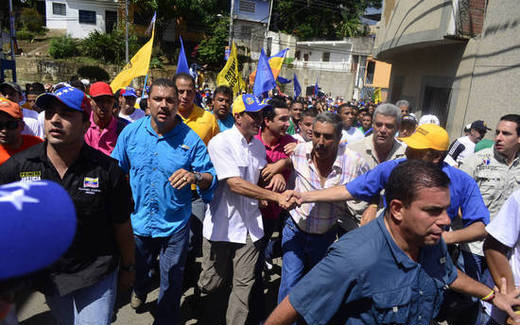
Henrique Capriles Radonski, the presidential hopeful for opposition alliance Unified Democratic Panel (MUD), visited five villages in central Aragua state (Courtesy of: G. Suárez)

Villa de Cura, in central Aragua state, became the 100th village visited by Henrique Capriles Radonski, the presidential candidate of opposition umbrella group Unified Democratic Panel (MUD), in 29 days of electoral campaign.

The candidate arrived in Villa de Cura from the villages of Barbacoa, Camatagua, San Casimiro and San Sebastián. At the end of the day, Capriles said that he is set to visit more than 300 villages by September. He added that he is determined to meet people eyeball-to-eyeball to convey his message of progress.

Capriles seized the opportunity to send “affective and respectful” greetings to public employees, and to the military officers commissioned in Aragua state, as well as to their families.

“I know that these towns are not visited by those who want to remain in power. They do not come here. They only visit the big cities. The difference lies in coming to towns, such as Camatagua, and listen to people,” said the candidate of the opposition.

He stated that “there is a battle of David versus Goliath in the country: Our only weapon are the votes.”

In Camatagua, he participated in a people’s assembly where he pointed out that the government priorities are not the same as those of the Venezuelan population. People posed five questions to the candidate, most of which were related to high crime rates in Venezuela.

He called upon people not to resign themselves to the situation of criminal violence hitting the country: “Many prisoners are between 18 and 19 years old. This means that they were five years old when this government began, but they took the path of violence anyway. This government talks as if the country was right, but the reality is very different from what they say on TV.”

Additionally, he pointed out that his Security Plan involves the promotion of sports and education, as well as arms control. “Have you seen the government seeking disarmament? No. They protect the weapons because they know where the weapons are.” He stated that the government officials lost connection with reality.

In Villa de Cura, he expressed concern about issues such as the lack of adequate education institutions, repeated power blackouts and lack of jobs, as a consequence of the dismantlement of the economic and production system.

“I have been told that many young people here are forced to leave their homes and depart for Guárico state to study because they have no universities (…) I tell you that we are going to build universities in all Venezuelan villages,” he stated.

He refused to answer to President Hugo Chávez’s insults, and said that his mother taught him “to respect the elderly.”

The opposition presidential candidate called upon Venezuelans to post their proposals for the country via Facebook on http://hayuncamino.com/tupropones/.

Translated by Karina Salas

To read this article on El Universal, please click here.