Jan
30
2013
Posted by
admin
Comments

Venezuela’s Deadliest Prison Riot Provokes Outrage

130126021907 venezuela prison riot story top1 e1359577489113 Venezuela’s Deadliest Prison Riot Provokes Outrage

Courtesy of: CNN

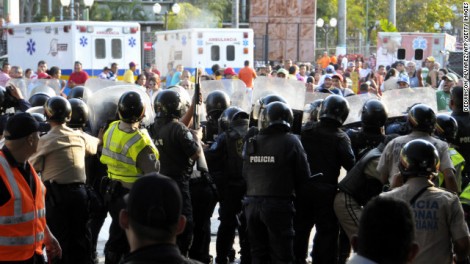
Conditions in Venezuelan prisons have long been known as dangerous and ruthless, among the worst in the hemisphere. But this weekend, in one of the deadliest prison clashes in the nation’s history, the world found out just how mismanaged Venezuela’s prison system really is. According to medical officials, 61 people were killed and 120 injured after violence erupted at the Uribana prison complex, located near the city of Barquisimeto in northwest Venezuela.

The fighting began early Friday morning after troops entered the complex to search for and confiscate illegal weapons. Just two hours into the incursion, the well-armed inmates mounted a resistance; refusing to allow officials to enter the wards. Chaos quickly followed. Venezuelan Penitentiary Service Minister Iris Varela announced the closure of the jail, but it was not until Sunday – two full days later – that authorities finished removing inmates and relocating them among 19 penitentiaries throughout the country. In the meantime, relatives of inmates were left desperately awaiting information from authorities.

Inaugurated in 1999, during Hugo Chávez’s first year in office, Uribana is Venezuela’s largest prison. At that time, the facility was held up as the model of a modern Venezuelan prison. The notion quickly faded, however, as the complex fast became an exemplar of Venezuela’s egregiously overcrowded and poorly-supervised prison system. Minister Varela even admitted on Sunday that 2,459 inmates resided in the prison, in a space built for only 850.

The Uribana tragedy has sparked outrage among human rights watchdogs. The United Nations High Commissioner for Human Rights (UNHCHR) called for a “prompt investigation” to identify those accountable and compensate the relatives of the victims. Direct blame has fallen on Varela, who has failed to make any real progress in curbing violence or reducing the rampant overcrowding of the nation’s prisons.

Already, the Venezuelan government’s response to the tragedy is fraught with political favoritism. Only members of Chávez’s party were allowed to participate in the National Assembly subcommittee charged with investigating the riot. Opposition parties, who have been denied input into the process, have called for the resignation of Varela. Vice President and acting president Nicolás Maduro gave the minister his full support. The ailing Chávez, ensconced in Cuba for nearly two months, remains completely silent on the issue.

Violence in Venezuelan prisons – particularly among rival gangs – has become essentially routine. Overcrowding is at epidemic levels, as thirty-three jails, originally built for 12,000 inmates, now house nearly 47,000 people. Weapons including guns and knives are common and widespread in these prisons, while guards remain absent or ineffectual, allowing lucrative illegal activities to take place. The 61 Venezuelans who died this weekend were hardly the first fatalities of Venezuela’s growing prison crisis. NGOs and human rights watchdogs reported that 560 people were killed in Venezuelan prisons in 2011. According to a Venezuelan rights group, more than 300 people were killed in 2012 as well, including the 25 Venezuelans killed during the highly-publicized standoff at the El Yare I prison facility. So far, however, the government’s response has been marred by political patronage, making it unlikely that the crisis will soon stop.

 
May
18
2012
Posted by
admin
Comments

In Case You Missed It… Articles Roundup Week of 5/18/12

This week: As Venezuela’s October 7 elections approach, opposition candidate Henrique Capriles spends time speaking to Venezuela’s poorest, a demographic that Chávez has long dominated; Hugo Chávez’s prolonged illness and absence from the spotlight has some wondering whether his party is preparing contingency plans for the elections, including delaying or canceling them entirely, and possibly an alternative candidate, such as Foreign Minister Nicolas Maduro. Similarities between Chávez and Putin prompt a columnist to wonder why the Venezuelan president receives less international criticism. Meanwhile, investors continue to devalue Venezuela’s debt, which is increasing at record pace due to Chávez’s election-year spending. The increased spending has also helped hide the shrinking private sector in recent GDP numbers. Venezuelan carmakers expect production to decline for the fourth consecutive year due to a lack of dollars available from the government. Finally, recent violence in a Caracas prison exposes deeply rooted corruption, violence, and drugs within Venezuela’s prison system.

Hugo Chávez’s Enemy No. 1, Businessweek

In the ramshackle town of Anaco in eastern Venezuela’s oil-rich Anzoátegui state, three yellow-shirted bodyguards rush a trim, perspiring, boyishly handsome 39-year-old in a baseball cap from house to shabby brick house through 500 cheering, flag-waving fans. Most in the throng are visibly poor, some are young women with tears of joy running down their cheeks. All are sweaty under a hot April sun.

Chavez opponent wants to be a uniter, CNN

He is running against one of the world’s most recognized presidential strongmen, but Henrique Capriles, the governor of the Venezuelan state of Miranda, exudes confidence.

Venezuela analysts cast doubt on presidential election, The Miami Herald

Is the Venezuelan government laying the groundwork to delay or even suspend the Oct. 7 presidential elections due to President Hugo Chávez’s failing health?

In Venezuela, top diplomat steps into the void while cancer forces lower profile for Chavez, The Washington Post

After nearly a year of cancer treatment that has forced President Hugo Chavez to step back from the spotlight, a burly former bus driver with a dark mustache and affable smile is emerging more than ever as the president’s stand-in.

Chávez vs. Putin, The New York Times

He came to power in the late 1990s, his energetic governing style ushering in an era of increasing prosperity that earned him plenty of goodwill. Luck also helped some: his rule coincided with an era of rising oil prices, and he used the petrodollars that flooded the state’s coffers to finance a dizzying consumption boom throughout the country.

As Chavez Resurfaces, Venezuela’s Debt Plunges, The Wall Street Journal

Signs that President Hugo Chavez has no intentions of backing down from Venezuela’s upcoming presidential elections, despite his battle with cancer, are putting a damper on the country’s red-hot sovereign debt.

Venezuela’s GDP grows amid sustainability worries, The Financial Times

If men are from Mars and women are from Venus, then “chavistas” (followers of Hugo Chávez) are from Mercury and their opponents are from Neptune.

Domestic debt up USD 40.6 billion in four months, El Universal

A Venezuelan government immersed in the election campaign has resorted to the largest spending ever over the past five years.

Outlook of automotive industry cools, El Universal

Growth expectations in the automotive industry were revised downward in 2012. Once again, delays in authorizations of US dollars by the Foreign Exchange Administration Commission (Cadivi) are present.

In Venezuela’s prisons, inmates are the wardens, Global Post

A cloud of marijuana bounces along with the bass line from a stack of six-foot high speakers in the corner of this large hall, its smell infused with that of urine.

 
Aug
12
2011
Posted by
admin
Comments

In Case You Missed It… Articles Roundup Week of 8/12/11

In this week’s roundup… President Hugo Chávez returns to Cuba for a second round of chemotherapy;  Uncertainty still looms over the controversial, so-called “Sports Law”; Admission to Venezuela’s overcrowded prisons has been halted, triggering an overflow of inmates; three government officials are brought up on charges for the Rodeo prison riots; Rolling blackouts affect PDVSA’s oil output; and Venezuela finalizes new loans with Russia and China.

Chavez in Cuba for more cancer therapy, AFP

Venezuelan President Hugo Chavez was in Cuba on Sunday for a second round of chemotherapy treatment, following the removal of a cancerous tumor in June.


Sports chiefs say Venezuela’s government promises rules won’t restrict sponsorship, Washington Post via AP

Representatives of Venezuela’s professional sports leagues said Friday the government has assured them that new rules on private sponsorship will not strip critical revenue from teams across the South American country.

Police cells fill as Venezuela halts prison intake, Associated Press

Holding cells in Venezuelan police stations have begun to fill up a week after a government order to temporarily halt new admissions to the country’s overcrowded and violent prisons.

Venezuelan Authorities Charge 3 For Roles In El Rodeo Prison Riot, Wall Street Journal via Dow Jones Newswires

Venezuelan authorities Tuesday said they brought corruption charges against a member of the National Guard and two former directors of the El Rodeo prison facility, where a 27-day prison riot last month brought the South American country’s overcrowded incarceration system into the spotlight.

Venezuela Oil Upgraders Back Online After Power Outage – PDVSA, Wall Street Journal via Dow Jones Newswires

Venezuela’s four major oil upgraders have returned to normal operations after a power failure in a transmission line halted the facilities two days ago, state oil company Petroleos de Venezuela, or PdVSA, said Wednesday.

Venezuela Finalizing New Loans Totaling $8B with China, Russia, WSJ via Dow Jones Newswires

Venezuela is finalizing agreements for two separate credit lines of $4 billion each with Russia and China, with a portion of the financing earmarked for military equipment for the South American nation, according to Venezuelan state media.