Dec
10
2012
Posted by
admin
Comments

ICYMI: Venezuela’s Hugo Chavez, facing a 4th cancer surgery, anoints successor in case he has to leave office

The Washington Post
December 9, 2012
By Juan Forero
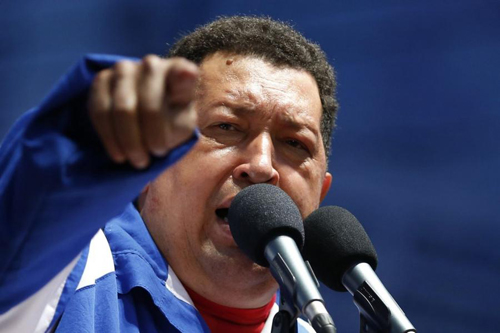
hugo chavez ICYMI: Venezuelas Hugo Chavez, facing a 4th cancer surgery, anoints successor in case he has to leave office

Courtesy of: Miraflores Press

Venezuelan President Hugo Chavez will undergo his fourth cancer surgery in Cuba in the coming days, the fiery leader said over the weekend, explaining that he had decided to designate a successor in case the illness forces him to resign from the office he has held for nearly 14 years.

The announcement was the clearest sign yet that Chavez’s battle with cancer could abruptly end his self-described socialist revolution. It prompted his followers to flock to churches and public squares Sunday to pray and chant slogans supporting him.

Saturday night, in a dour address on television, the president said “some malignant cells” had been detected in his pelvic region that would necessitate surgery in Havana’s Cimeq hospital, where he has been treated before. Chavez said he would fly to Cuba on Sunday, although the government did not confirm his departure.

Chavez, 58, said his vice president and confidant, Nicolas Maduro, would assume control if he has to step down. The populist leader urged supporters to vote for Maduro, who made his mark as Chavez’s foreign minister, should there be a need for a presidential election.

“If something happens that sidelines me, which under the constitution requires a new presidential election, you should elect Nicolas Maduro as president,” Chavez said, sitting at a table with Maduro at his side. “I ask that of you from my heart.”

Moises Naim, a former Venezuelan government official who is an analyst at the Carnegie Endowment for International Peace in Washington, called the announcement “basically a farewell speech.”

“He said goodbye to power,” Naim said. “It’s a statement full of resignation and appeals to God. There is no plan. The only talk of the future is that there will be elections and he asks for people to vote for Maduro.”

Chavez’s departure would mark the end of a tumultuous rule in which the leftist former army officer harnessed Venezuela’s considerable oil wealth to shower the poor with social programs while engineering a sharp diplomatic shift away from the country’s historical ally, the United States.

Chavez’s government forged alliances with some of Washington’s most intransigent adversaries, including Cuba, Iran and Syrian President Bashar al-Assad. He has used his lock on practically all levers of power, from the courts to the congress, to push forward the nationalization of hundreds of private companies and the seizure of wide swaths of farmland.

For Venezuela’s opposition, the possible scenarios that Chavez discussed in Saturday’s address amount to the first time the president has publicly acknowledged the severity of his illness and the impact it could have on the future of the country.

No one in the government is authorized to discuss Chavez’s medical condition except Chavez himself, who astonished his countrymen in June 2011 by telling them he had gone under the knife twice to remove a malignant growth. A third surgery followed in February.

Chavez has never disclosed what kind of cancer he has or where it is located. He has twice pronounced himself cured, without providing details.

“It was time to tell the truth to the country,” said Maria Corina Machado, an opposition member of the National Assembly. “Venezuela has been living with a lot of uncertainty. In a democratic country where the constitution is obeyed, the president must talk about his health when it is compromised.”

Should Chavez die or have to resign, the constitution calls for Venezuela to stage presidential elections within 30 days. Maduro, a 50-year-old former union organizer and bus driver who has risen through the ranks of Chavez’s movement, would become the candidate of the president’s United Socialist Party.

The constitution also requires that the vice president fill in for the president should he be temporarily absent. Chavez has spent many weeks in Cuba in the past 18 months, undergoing chemotherapy and radiation treatments. But he has remained in charge of the government, signing decrees and bills from Havana.

Machado said the opposition will call for a strict interpretation of the constitution now that Chavez has suggested the possibility of stepping aside.

“Article 233 of the constitution is clear about the only mechanism, an election within 30 days,” she said. “He can’t name a successor. It’s the Venezuelan people who decide.”

An election would mean a contest between Maduro and the opposition’s leader, Henrique Capriles.

Capriles lost to Chavez in the presidential election held Oct. 7, with the incumbent winning 55 percent of the vote to the challenger’s 44 percent. Polls, though, have shown that Capriles is more popular in Venezuela than all of Chavez’s closest associates, including Maduro.

The president’s swearing-in for another six-year term is scheduled for Jan. 10, but his announcement, following weeks in which he remained out of public view, raised questions about whether the inauguration will take place.

“This is how life goes,” Chavez said in his televised address. “God willing, I hope to be able to give you good news in the coming days.”

To read this article on The Washington Post, please click here.

 
Jul
12
2012
Posted by
admin
Comments

Chavez Hits Campaign Trail in Bid to Prove He’s Cancer-Free

Bloomberg
July 12, 2012
By Charlie Devereux

presidente Venezuela Hugo Chavez AFP ECMIMA20120712 0097 4 Chavez Hits Campaign Trail in Bid to Prove He’s Cancer Free

Courtesy of: AFP

Venezuela‘s President Hugo Chavez is hitting the campaign trail today in an attempt to persuade voters his battle with cancer hasn’t diminished his vitality ahead of what’s shaping up to be his toughest election.

Chavez will attend a rally today in the oil producing state of Anzoategui on Venezuela’s northeastern coast and plans to hold a similar event in Barquisimeto in central Lara state July 14. The rallies are the first since the former tank commander marked the official start of campaigning July 1 with a caravan and speech in Maracay, 50 miles west of Caracas.

Chavez, 57, said July 9 that he’s “totally free” of a cancer whose exact type and location he’s refused to reveal. The comment echoes similar remarks in October 2011 that he later retracted after the discovery of a second tumor in February saw him travel to Cuba for surgery and radiation treatment.

“He’s definitely still going to have to prove it,” said Gregory Weeks, director of Latin American studies at the University of North Carolina in Charlotte. ‘He’s going to have to show by his actions that he’s healthy.”

His challenger, Henrique Capriles Radonski, a 40-year-old former governor of Miranda state, has sought to mark a contrast with Chavez by visiting remote towns on a daily basis, preaching the need to unite the polarized country and saying that the economy is stagnant after 13 years of socialist government rule.

Public Spending

Venezuela’s economy grew 5.6 percent in the first quarter from a year ago, the fastest rate in nearly four years, as the government increases public spending and imports ahead of the elections. The country’s money supply has risen 53 percent in the last 12 months on the back of outlays, while annual inflation stood at 21.3 percent in June.

Venezuela’s jobless rate fell to 7.4 percent last month, the lowest in June since Chavez took power in 1999, the National Statistics Institute said today in an e-mailed report.

The percentage of export revenue derived from oil has risen to 95 percent from 80 percent when Chavez took office in 1999, according to central bank data. The price for

Venezuela’s oil export basket has averaged $106.90 this year, according to the Oil Ministry.

Capriles has sought to accentuate the contrast between himself and Chavez by highlighting his youth and vigor in day- long, house-by-house visits across the country. He has taunted Chavez by saying the campaign will be a battle between Wile E. Coyote and The Road Runner, a reference to the Warner Bros. Entertainment Inc. cartoon created in 1948.

Forgotten Villages

“I’m going to go to those villages that have been forgotten by those in power,” Capriles said July 2 in comments carried on Globovision. Capriles toured Cojedes state today.

Since returning from Cuba in May, Chavez has gradually increased the frequency and duration of his public appearances through televised events in which he’s hosted foreign leaders such as Iranian President Mahmoud Ahmadinejad and Belarus’ President Aleksandr Lukashenko and promoted military officers. The former paratrooper said last week that his presidential duties have kept him too busy to campaign until now and that he’ll need to juggle his schedule.

“We’re starting the campaign and will travel throughout the country not just to do the tours, but to explain our new six-year government plan,” Chavez said yesterday on state television. “We’re going to seek to guarantee our votes on October 7 and achieve the great victory that’s already been written but which we have to work for every day.”

Varying Polls

Recent opinion polls have varied widely. Chavez had 45.9 percent support against 45.8 percent for Capriles in a Consultores 21 poll of 1,000 people taken between June 15 and June 26. The survey had a margin of error of 3.2 percentage points. In a June poll by Caracas-based Datanalisis, Chavez had a 14 percentage-point lead.

Chavez first revealed in June 2011 that doctors had removed a tumor from his pelvic area that he later described as baseball-sized. He returned from a fourth bout of chemotherapy treatment in Cuba Oct. 20 and declared himself “free of illness.” In the months that followed he resumed some of his daily rhythm, even speaking for more than 9 hours in an address to the National Assembly in January, before announcing he would need further surgery after doctors discovered a second 2- centimeter (0.8-inch) tumor in the same area.

Trips to Cuba

His subsequent absences from the public spotlight as he shuttled back and forth between Cuba and Venezuela to receive several rounds of radiation treatment sparked a rally in Venezuelan bonds as investors speculated that Chavez’s battle with cancer would accelerate a change in government that would reverse his capital controls and nationalization policies.

Venezuelan dollar bonds have returned 17 percent year-to- date, the most among emerging markets after the Ivory Coast and Belarus, according to JPMorgan Chase & Co.’s EMBI Global index.

The yield on Venezuela’s benchmark 9.25 percent securities due in 2027 rose two basis points, or 0.02 percentage point, to 11.69 percent at 1:30 p.m. in Caracas, according to data compiled by Bloomberg. The price fell 0.11 cents to 82.81 cents on the dollar.

“Thank God I’m feeling better every day, and I don’t believe that physical limitations, as you put it, will be a factor in the campaign,” Chavez said July 9 during a press conference when asked if his illness could affect his re- election bid.

Chavez’s latest declarations on his health “take the wind out of the sails” of reports that have predicted his imminent death, said Weeks. While any sign that his cancer has worsened would damage his prospects of winning in October, Venezuelans will give him some leeway as he recuperates and won’t expect him to campaign with the same vigor as in the past, he said.

“People understand he had treatment for cancer so they’re not expecting the Chavez of the past who is giving 8-hour presentations and singing and dancing,” Weeks said.

To contact the reporter on this story: Charlie Devereux in Caracas at [email protected].

To read this article on Bloomberg, please click here.

 
Mar
2
2012
Posted by
admin
Comments

In Case You Missed It… Articles Roundup Week of 3/2/12

In this week’s roundup… Rumors surround Hugo Chávez’s health as conflicting reports emerge following his operation in Cuba; Chávez’s absence triggers discontent among the country’s military ranks; MUD candidate Capriles’ youthfulness could play to his advantage in the October presidential elections if Chávez’s condition worsens. Price controls continue to increase the country’s soaring inflation, hurting food production and industrial output; Venezuela continues to send aid to embattled Syrian president Bashar Assad despite international sanctions; public and private investments fall to 10.3 percent, below 2008 numbers; and anarchy reigns in the Venezuela penitentiary system due to a lack of government oversight.

Chávez Surgery Revives Speculation, The Wall Street Journal

Venezuelan President Hugo Chávez, who is running for re-election, was in good condition after undergoing surgery overnight in Cuba to remove a pelvic lesion near where surgeons had removed a cancerous tumor last year, Vice President Elias Jaua said on Tuesday.

Hugo Chávez’s illness triggers new reports of discontent, fear in the military, Boston Herald

President Hugo Chávez’s illness has deepened the internal fissures of the Venezuelan Armed Forces, an institution that never integrated into one unique block of support of the Bolivarian Revolution and whose members have for months shown signs of concern and discontent, according to internal reports by the private intelligence company Stratfor leaked by WikiLeaks.

Chávez Surgery Opens Venezuela Election Chances For Candidate Henrique Capriles, The Huffington Post via the Associated Press

Throughout his presidency, Hugo Chávez has relied on his vigor and endurance: playing baseball, speaking for hours at a stretch and making decisions on the fly while bounding around Venezuela exuding energy.

Chávez’s Cancer Mystery: What if Venezuela’s President Doesn’t Run for Re-Election?, TIME
Lent, the pre-Easter season that started last week, is traditionally a time when Christians ponder their mortality – and Venezuelan President Hugo Chávez had a lot of it to contemplate before he left Caracas for Havana to undergo more cancer surgery.

Chávez’s health makes an impact on Venezuelan foreign policy, El Universal

Since last September, Colombian Ambassador to Venezuela Alfredo Curé has been waiting for a meeting with Venezuelan President Hugo Chávez to produce his credentials accounting for the official notice of the beginning of his mission in the country.

Chávez, his friends and life after death, The Financial Times

One of the more interesting lines of speculation about Hugo Chávez’s deteriorating health and possible death is what it might mean for the socialist Venezuelan president’s many foreign allies.

Venezuela’s New Price Controls Order Cuts Of Up To 25 percent, Fox Business

The Venezuelan government will cut prices on a slate of basic goods up to an average of 25 percent as part of a long-awaited first wave of broadly expanded price controls that officials say will combat the country’s soaring inflation, Vice President Elias Jaua announced Monday.

Agricultural balance still in the red, El Universal

World food prices will continue playing a key role in goods availability in the Venezuelan market in 2012. While the value of some commodities, including sugar, cereal and oil, dropped at the end of 2011, international organizations fear that prices this year will continue above the average.

Venezuela’s aluminum and steel production below 1997 numbers, El Universal

Official statistics reveal that the output of the subsidiaries of the Venezuelan Guayana Corporation (CVG) and private manufacturing, of the essence to diversify exports and supply raw materials to the rest of the economy, is seriously shrinking.

Venezuela sends fuel to Syria, no plans to halt shipments aimed at aiding Assad regime, The Washington Post via the Associated Press

Venezuela has been sending diesel fuel to Syria and the government of President Hugo Chávez has no plans to halt the shipments, the country’s energy minister said Tuesday.

Public and private investment 10.3 percent below 2008 level, El Universal

Thanks to raising oil prices, the Venezuelan government is able to inject a significant dose of public spending and the economy takes again the road of growth.

Venezuela’s Gladiators, The New York Times

Two men with knives face off in a pit. Hundreds gathered around are egging them on, while on the walkway above others are picking their winner and placing bets.