Aug
31
2012
Posted by
admin
Comments

In Case You Missed It… Articles Roundup Week of 8/31/12

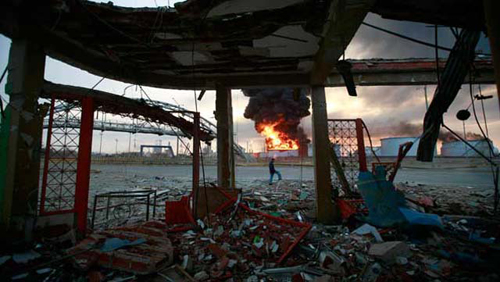
Explosion en Amuay In Case You Missed It… Articles Roundup Week of 8/31/12

Courtesy of: AFP

A series of incidents in the past week – a prison riot, bridge collapse and explosion at an oil refinery – may have damaged Venezuelan President Hugo Chávez’s reelection hopes, as new polls show he has lost the lead to opposition candidate Henrique Capriles. The explosion at the refinery in Amuay has drawn attention to the state oil company’s decaying infrastructure and Chávez’s mismanagement of the country’s oil resources. Questions remain, however, about whether the guilty parties will face any punishment for the accident. Meanwhile, an NGO released a report about media attacks in Venezuela, Chávez uses the government-controlled media to attack the opposition and the electoral council bans an opposition ad about violence in the country – opposition leaders called the ban a violation of free speech.

Venezuela’s presidential campaign: Gaining ground, The Economist

Technical glitches, heckling from his own supporters, thinning crowds and bad polling news. With just over six weeks to go before Venezuela’s presidential election, Hugo Chávez’s bid for another six years in office no longer looks quite the push-over it once seemed.

Venezuela’s Chavez faces new election threats, Miami Herald

It’s been a rough month for Venezuelan President Hugo Chávez. In less than two weeks, he has had to deal with a deadly prison riot, a collapsing bridge, flooding, an embarrassing confrontation with steel workers on live TV and the country’s worst oil-industry disaster, which killed at least 41 and still has families digging through the rubble looking for loved ones.

Chavez Trails Rival Capriles for First Time in Poll, Businessweek

Venezuelan President Hugo Chavez trailed opponent Henrique Capriles Radonski for the first time in a Consultores 21 poll ahead of elections in October.

Venezuela oil blast evidence of deteriorating infrastructure (+video), Christian Science Monitor

Venezuelan Vice President Elías Jaua said Saturday evening the death toll had reached at least 39 after a blast tore through the country’s biggest oil refinery, Amuay in Falcon state.

Venezuela’s Refinery Explosion: Has Chávez Made Petroleum Too Political?, TIME

When I visited Venezuela’s Paraguaná oil refinery complex, the world’s second largest, in 2007, anxieties seemed to flare like its burn-off pipes.

Critics question flow of Venezuelan aid, Financial Times

At the entrance to a rundown neighbourhood in the outskirts of Managua, the capital of Nicaragua, a sign proclaims: “Welcome to District Hugo Chávez”.

The Misrule of Law, New York Times

Venezuelans are reeling this week from the deadliest accident in our nation’s industrial history.

Press freedom group: Venezuela media under assault, Associated Press

The Committee to Protect Journalists said in a new report Wednesday that Venezuelan President Hugo Chavez’s government has used threats and a barrage of restrictive measures to gradually weaken the country’s private news media.

Insulting Hugo Chavez challenger is prime-time TV in Venezuela, LA Times

It’s prime-time TV in Venezuela and the host is saying that opposition presidential candidate Henrique Capriles, whose grandmother was a Holocaust survivor, is a Nazi and Hitler cultist.

Venezuelan electoral officials order political ad off the air, Chavez opponents cry foul, AP

Venezuelan electoral officials have ordered off the air a political ad that depicts the murder of a young man to highlight concerns about crime.
 
Aug
31
2012
Posted by
admin
Comments

Venezuelan electoral officials order political ad off the air, Chavez opponents cry foul

The Washington Post via Associated Press
August 31, 2012

Venezuelan electoral officials have ordered off the air a political ad that depicts the murder of a young man to highlight concerns about crime.

The opposition party Popular Will, which paid for the television ad, on Thursday criticized the decision by the National Electoral Council, calling it a violation of free speech. The party supports Henrique Capriles, who is running against President Hugo Chavez in the country’s Oct. 7 election.

The ad shows a young man who is set to graduate from university, and his mother filled with joy seeing him at their home in a poor neighborhood. Then the young man goes out into the street and is gunned down.

The video does not actually show the man being shot, but shows his mother’s horrified reaction as she watches from the window, then her cup shattering and spilling coffee on the floor.

Afterward, as the woman holds her son’s body in her arms in the street, the slogan “Security is the way” flashes on the screen. The ad can be seen on the party’s YouTube channel: http://youtu.be/UKDsZltiTYY.

Electoral council president Tibisay Lucena announced the decision on Wednesday, saying the ad apparently violates electoral law and was taken off the air as a precautionary measure while officials carry out a probe.

Lucena insisted the electoral council is not acting as a censor, but simply upholding campaign rules.

Party leader Carlos Vecchio told reporters that the ad “reflects the reality of the country.” He called it a matter of free speech and accused the electoral council of acting as a “censor.”

Chavez’s campaign manager, Jorge Rodriguez, said the advertisement violates a broadcast law that includes provisions regulating violent content.

Capriles has made crime a top issue in the campaign and has pledged to improve police forces and reduce violence.

Venezuela’s official murder rate stood at 50 per 100,000 people last year, making it one of the most violent countries in Latin America and the world. Murder rates have more than doubled since 1998, when Chavez was first elected.

In polls, Venezuelans regularly cite violence as their top concern.

“Venezuela has the highest homicide rate of any country in South America, and the murder rate has gone up substantially in the last decade of Chavez’s rule. So the crisis of citizen security would be an obvious and legitimate issue for the opposition to focus on,” said Cynthia Arnson, an analyst at Woodrow Wilson International Center for Scholars in Washington.

“That said, overt depictions of violence for political gain manipulate people’s deepest fears and sharpen the polarization that Venezuela needs to overcome — and that the opposition has for the most part taken pains to avoid,” Arnson said Friday.

The dispute over the ad also reflects opposition complaints of a pro-government bias within the National Electoral.

Four of the five members of the council are either Chavez allies or perceived as favoring the president. The National Assembly, where Chavez backers have long held a majority, appoints the council members, who include a former congresswoman from Chavez’s party and a former minister in his Cabinet. Rodriguez, the council’s former chief, is now Chavez’s campaign manager.

Lucena has insisted the electoral council is independent and balanced. It has previously announced probes into alleged campaign violations by both camps, including accusations that the state TV channel has run campaign ads of its own accord.

The council also has largely ignored opposition complaints that Chavez is hogging campaign airtime and abusing his presidential authority by regularly forcing all Venezuelan TV and radio stations to interrupt programming for his marathon speeches.

But the council’s officials have taken issue with Capriles’ frequent use of a baseball cap emblazoned with the colors of Venezuela’s flag, saying it violates regulations that prohibit the use of the colors in electoral propaganda.

Capriles has defied the council by continuing to wear the cap, insisting that he is respecting campaign rules.

The yellow, blue and red caps have become hot-selling items at Capriles’ campaign events.

To read this story on the Washington Post, please click here.

 
Aug
30
2012
Posted by
admin
Comments

Heading for the Home Stretch in Venezuela

jose r cardenas Heading for the Home Stretch in Venezuela

José R. Cárdenas

José R. Cárdenas served in several foreign policy positions during the George W. Bush administration (2004-2009), including on the National Security Council staff. He is a consultant with Vision Americas in Washington, DC.

Venezuela’s presidential election is less than six weeks away, but there has been no shortage of twists and turns in recent days that will likely impact the vote on October 7th. First, the polls, including this week’s stunner that has for the first time given challenger Henrique Capriles a couple of percentage points lead over President Hugo Chávez.

Now, polls are notoriously difficult to gauge in Venezuela, with accusations regularly traded that both sides skew their polling to favor their interests. But Consultores 21 is one of the more reliable pollsters in Venezuela; the firm accurately predicted that the opposition would win a slight majority in the popular vote in the National Assembly elections in September 2010.

Many other polls continue to show Chávez with a lead, but there is every reason to believe the gap is narrowing as Capriles’ energetic campaign blankets the country. The difference in energy level between the two candidates is palpable, as Chávez, despite all the theatrics portraying him as recovered from his cancer, is clearly nothing like his old self.

But cancer isn’t Chávez’s only problem. Other recent incidents spell trouble for his campaign.

For instance, this week’s deadly explosion at Venezuela’s largest oil refinery at Amuay was both a tragedy and a monumental case of bad-timing as it brought unwanted attention to the government’s poor track record of maintaining Venezuela’s infrastructure. The accident has also given new fuel to (well-founded) accusations that the Chávez government has placed a premium on political loyalty over technical competence in its management of state enterprises.

Also this month, the governor of Carabobo state, Henrique Salas Feo, charged that Cuba’s inefficient management of the key port of Puerto Cabello was exacerbating food shortages. Chávez gave the Cuban government a lucrative contract to manage the port but, according to Salas Feo, the result has only been more corruption and increased delays in transporting goods.

Also troubling for Chávez are indications that things may no longer be that rosy between him and his working-class base. Last week, the government was forced to hastily cut off a national television feed when workers began disrupting a Chávez campaign appearance in the northeastern state of Bolívar.

It seems that most of the workforce in the area’s state-owned factories wanted to let the President know of their displeasure that his government had repeatedly failed to renegotiate their collective contract (guaranteed in Chávez’s constitution), meaning their wages have been frozen for some two years, even as inflation has approached 30 percent.

Indeed, one suspects that spiking prices and food shortages, as well as rising street crime and deteriorating public services and infrastructure, may be taking their toll on Chávez’s base. If that is so, the home stretch of the campaign will be defined less by Capriles’s ability to present a fresh face of the opposition to Venezuelan voters — by most measures he has appeared to already have accomplished that — than by whether disillusioned Chávez supporters are fed up enough to switch their allegiances.

Of course, all things aren’t equal in Venezuela. Chávez still maintains huge advantages in money and access to the airwaves, and he still has plenty of militant supporters to intimidate voters. And a desperate Chávez is a dangerous Chávez. But it appears he is finding it increasingly difficult to prevent the election from becoming a referendum on his record in office. Whether he can survive such a referendum remains to be seen.