Courtesy of: El Universal
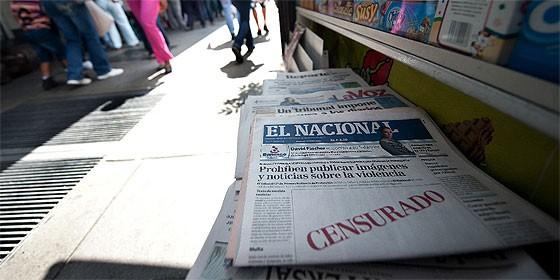
This week: The Venezuelan government tightens its control over the media as authorities freeze the assets of “El Nacional” owner Miguel Henrique Otero; Otero then accuses the government of trying to intimidate and silence his paper; pro-government deputies in Venezuela revoke the immunity of opposition lawmaker Richard Mardo and drum up “corruption” charges; Henrique Capriles responds by accusing the PSUV of “trashing” the Venezuelan constitution. An Economic Survey conducted by the Economic Commission for Latin America and the Caribbean shows that inflation takes a bigger toll on Venezuela’s poor than in any other Latin American country; daily sales of U.S. dollars to the private sector sink 13 percent as the cost of government imports and foreign debt payments take money from the private sector; Venezuela’s strong currency controls create opportunities for illegal profiteering schemes. A poll conducted by the Venezuelan Data Analysis Institute (Ivad) reveals that today 45.1 percent of Venezuelans would vote for Capriles, while only 39.3 percent would choose Maduro; former ambassador Otto Reich files a lawsuit against three Venezuelan businessmen for bribery; seven U.S. Senators introduce a bill condemning violence against the opposition in Venezuela.
Venezuela Freezes Assets of Opposition Newspaper Editor, Wall Street Journal
Venezuelan authorities have frozen the assets of Miguel Henrique Otero, the editor and owner one of the country’s largest opposition-leaning newspaper, the attorney general’s office announced Saturday.
Editor: Venezuela Government Trying to Silence Us, Associated Press
The head of one Venezuela’s last two nationally circulating opposition newspapers accused the leftist government on Monday of trying to intimidate and silence it.
Pro-gov’t deputies lift immunity of opposition lawmaker Richard Mardo, El Universal
During the regular session held at the Venezuelan Parliament on Tuesday, pro-government legislators lifted the parliamentary immunity of opposition legislator Richard Mardo on corruption accusations filed by Parliament’s Speaker Diosdado Cabello and endorsed by the president of the Comptrollership Committee of the Parliament, Pedro Carreño, both ruling party legislators.
Capriles: Deputies trashed the Constitution by revoking Mardo’s immunity, El Universal
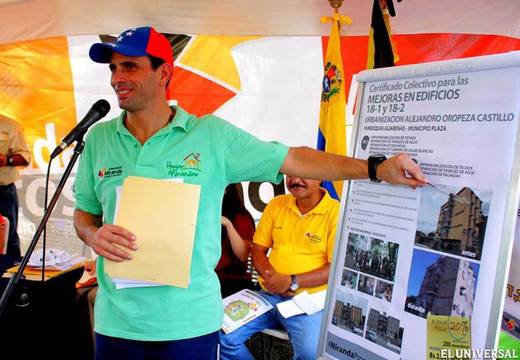
During a public event at a local community, Venezuelan opposition leader Henrique Capriles Radonski brought out the issue of opposition Legislator Richard Mardo and his parliamentary immunity –revoked– in Parliament, and stated that the “circumstantial majority in Parliament trampled on the Constitution and the decision of the Supreme Tribunal of Justice.”
Venezuela the only country where inflation lashes the poor the most, El Universal
Fairer distribution of national income has not been enough to solve the imbalance of the Venezuelan economy, which lashes the most vulnerable sector of society: the poor.
Daily US dollar sale to the private sector down 13%, El Universal
Claiming that the Venezuelan private sector was sold USD 125 million on a daily basis for ordinary imports in the first half of the year via both the Latin America Integration Association (Aladi) and the Unified System for Regional Compensation (Sucre), Armando León, member of the board of directors of the Central Bank of Venezuela, rejected allegations that authorities sold a lower amount of foreign currency with respect to the same period last year.
Venezuelan gov’t sucks up the dollars required by the private sector, El Universal
The minutes of meetings recording the decisions made by the Central Bank of Venezuela’s Board of Directors; the bank’s balance of payments; and the performances of both the Transaction System for Foreign Currency Denominated Securities (Sitme) and the Ancillary Foreign Currency Administration System (Sicad) are all cut pieces that are to be fitted together into a big jigsaw puzzle wherein foreign currency availability for the private sector is plummeting.
Venezuela central bank to sell $180 mln in forex auction, Reuters
Venezuela’s central bank said on Friday it would auction $180 million under its revamped currency exchange system known as Sicad, part of an effort to boost the flow of dollars to the economy and ease product shortages.
How Venezuelan Used ‘Scrape’ to Make Six Times Her Salary, Bloomberg
Venezuela’s currency controls are turning trips abroad into profitable junkets. A 27-year-old trade analyst from Caracas said she earned six times her monthly salary by traveling in April to Lima, where a business swiped her credit card and gave her $1,600 cash, charged at the official exchange rate of 6.3 bolivars per dollar.
Poll shows 45.1% of Venezuelans would vote Capriles, El Universal
Regardless of the outcome of the presidential election held in Venezuela last April 14, a survey conducted by the Venezuelan Data Analysis Institute (Ivad), Government Management, and Political Situation, showed that 45.1% of Venezuelans would vote Henrique Capriles over 39.3% who said would vote Nicolás Maduro.
Presumed corruption in Pdvsa and CVG aired in the United States, El Universal
The New York District Court admitted last Tuesday a racketeering and defamation lawsuit filed by US former ambassador Otto Reich against the partners of Derwick Associates in relation to contracts for the installation of electrical system executed with state-run oil holding Petróleos de Venezuela, electricity utility Corpoelec and the Venezuelan Guayana Corporation.
Suit Alleges Graft in Venezuelan Contracts, Wall Street Journal
A former top U.S. diplomat filed a lawsuit against three young Venezuelan businessmen whom he accuses of bribing senior Venezuelan officials in exchange for contracts worth hundreds of millions of dollars. The suit puts a spotlight on a group of executives who the diplomat, Otto Reich, and other critics say have made fortunes from links to Venezuela’s self-proclaimed socialist government.
US senators condemn political violence in Venezuela, Global Post
Seven US senators from both parties introduced a bill condemning violence against the opposition in Venezuela, calling for dialogue after a contested election.
 This