Aug
26
2013
Posted by
admin
Comments

ICYMI: Chavez’s Inflation Bites His Successor

Wall Street Journal
August 25, 2013
By Mary O’Grady

OB YQ920 amcol0 G 20130825120857 e1377534741885 ICYMI: Chavez’s Inflation Bites His Successor

Courtesy of: European Pressphoto Agency

Hyperinflation and political witch hunts seem to go together. Just ask the Venezuelan opposition.

With the bolivar collapsing and prices spiraling higher, the government alleged this month that its No. 1 adversary, former presidential candidate Henrique Capriles, is linked to a prostitution ring that was using minors in the state of Miranda, where he is governor.

Lest that not be enough to turn Venezuela’s socially conservative working-classes against the popular Mr. Capriles, a leading congressman from the ruling United Socialist Party of Venezuela (PSUV) used gutter talk on the floor of the national assembly to accuse the governor of homosexuality.

Don’t suppose for a minute that this mudslinging is merely about destroying Mr. Capriles. The ruling chavistas, led by President Nicolás Maduro, need a circus because there is no bread—and that’s not a metaphor. At times in Venezuela, there really is no bread. Earlier this year there was, for a time, no toilet paper. Mr. Maduro knows he is in trouble.

The “proof” of the allegations against Mr. Capriles’s chief of staff, who is accused of running the sex ring, cannot be shown to the public, according to Mr. Maduro. He says that the “videos and photos” that the government confiscated in a raid are of “un-publishable orgies.” Venezuelans will have to use their imaginations while trusting the courts—now controlled by the military government—and the government itself to get to the bottom of it all. Developments will be reported on television, which is almost exclusively state-controlled and where most Venezuelans get their news.

Mr. Capriles has said that the allegations are an attempt to distract the population from the real problems in the country. The charges are certainly well timed. An official 46% devaluation in April took the bolivar-to-dollar exchange rate to 6.3 from 4.3. Those who actually need dollars are unlikely to get them at that rate. Instead they have to go to the black market, where one greenback costs as much as 38 bolivars, up from 22 in March.

The government forecasts that inflation will hit 40% this year. But Johns Hopkins University economist Steve Hanke, director of the Cato Institute’s Troubled Currency Project, says that the soaring cost for the bolivar in the market translates into an implied annual inflation rate of more than 250%.

Earlier this month Caracas-based economist José Manuel Puente described the perfect storm to the Los Angeles Times this way: “The slowdown in economic growth, high and persistent inflation and high levels of scarcities [of basic foodstuffs] will combine to make Venezuela’s the worst-performing economy on the continent, despite the extraordinary oil boom that the country is still benefiting from.”

A mid-July survey by the Venezuelan polling company IVAD, posted on the website lapatilla.com, suggests Mr. Maduro is having no luck dodging the blame like his predecessor Hugo Chávez did so deftly. Asked what are the principal problems facing the country, almost 82% of respondents named crime. More than 53% also pointed to shortages. The scarcity is caused by the price controls that the government is using to try to hold down inflation. Those controls could explain why only 31% named “the high cost of living.”

But more than 65% said the economic situation was worse or much worse than one year ago, and more than half blamed either the national government or Mr. Maduro for the country’s problems.

Because the allegations against Mr. Capriles by the PSUV included a pejorative term for a homosexual, gay-rights groups took offense. But Venezuela’s homosexuals needn’t feel special. Hate speech as a political tool has been common practice in Venezuela’s military government for more than a decade. Catholics, Jews, entrepreneurs and the bourgeoisie have all been on the receiving end.

Mr. Maduro, coached as he is by Fidel Castro, immediately recognized that gay rights are a priority for many members of the international left. So in the aftermath of the impolitic comments by his colleague in Congress, he quickly seized a gay-pride flag to wave while he continued his verbal assaults against Mr. Capriles.

Political nonconformists regularly singled out by chavista politicians for ridicule and acrimony won’t get off so easily. This week Mr. Maduro is expected to try again to force through congress an “enabling law” that will allow him to rule by decree.

Opposition Congressman Richard Mardo has already been stripped of his congressional immunity and is slated for trial on corruption charges. Other opponents are being investigated. The Venezuelan daily El Nacional reported this month that more than one third of congressional sessions in the first half of the year were spent “harassing the opposition,” including with physical violence.

The goal is to drum up mass hysteria against opponents. Apparently Mr. Maduro has decided that if inflation cannot be contained, Mr. Capriles and his allies will be.

To read this article at Wall Street Journal, please click here.
 
Aug
12
2013
Posted by
admin
Comments

ICYMI: Venezuela Opposition Comes Under Siege

Wall Street Journal
August 9, 2013
By José de Córdoba and Ezequiel Minaya

Oscar Lopez left adviser 010 ICYMI: Venezuela Opposition Comes Under Siege

Courtesy of: Associated Press

CARACAS—Venezuela’s President Nicolás Maduro, the political heir to late populist Hugo Chávez, is ratcheting up intimidation of his political foes as his government prepares for key municipal elections amid a deteriorating economy.

Oscar López, a senior aide to former opposition presidential candidate Henrique Capriles, was in hiding Friday after a government legislator said a warrant had been issued for the aide’s arrest. Days earlier, the apartment of Mr. López, Mr. Capriles’s chief of staff, was searched by military-intelligence agents, according to opposition officials.

“He doesn’t know what this circus is all about so he is taking care of himself” by going into hiding, said Julio Borges, a legislator and national coordinator of Venezuela’s leading opposition party, Justice First.

Mr. Capriles himself faces possible arrest after the Supreme Court on Wednesday rejected his challenge to Venezuela’s April presidential election, which Mr. Maduro won by a sliver but which was marred by allegations of fraud. The court went on to fine Mr. Capriles $1,700 for what it said was a “disrespectful” filing and said the opposition leader should be prosecuted for trying to undermine the election.

“It’s a way to attack Henrique and his movement,” Mr. Borges said.

A senior U.S. official said Washington is worried about developments in Venezuela. “The Venezuelan government is increasingly taking legal actions against the opposition, a development the United States finds profoundly worrying,” the official said. The wave of actions against opposition leaders like Mr. Capriles “raises legitimate and urgent concerns,” the official said.

Venezuela’s Attorney General’s Office declined to comment as did Venezuela’s Information Ministry.

Venezuelans go to the polls in December to contest some 335 mayors’ posts throughout the country, as well as hundreds of other local offices. The elections will be the first gauge of Mr. Maduro’s popularity since his win in April’s election.

In the run-up to the vote, Venezuela’s economy has shown signs of increasing stress after years of ramped-up public spending under Mr. Chávez, who died in March. The country’s inflation is north of 42%, common consumer goods like toilet paper are scarce, and despite high oil prices, Venezuela just defaulted on the payment of a $100 million bond of a nationalized steel company, spooking bond buyers. Divisions in the Chavista movement, nominally led by Mr. Maduro, are deep.

“This is clearly a wounded government as far as its mandate and its internal dynamics. And like any wounded animal, it can be dangerous. It is taking very severe steps to consolidate power,” said Christopher Sabatini, senior director of policy at the Americas Society and Council of the Americas.

Also this week, authorities jailed and froze the assets of the editor of a small independent paper and website, Leocenis García of Sexto Poder, who has published detailed reports of alleged government corruption. On Thursday, a judge fined two opposition newspapers—including El Nacional, the country’s most influential daily—1% of their 2009 income for showing a photograph of deteriorated conditions in a morgue. The judge said showing the photo was harmful to the welfare of children.

In Caracas, Juan Carlos Zapata, an author and political analyst, said the escalating repression shows a clear government intention to frighten the opposition. “They want to dismantle the opposition, they want Capriles’s aides to flee the country, and for Capriles to throw in the towel before elections,” said Mr. Zapata. “It’s an orchestrated plan to scare off the opposition.”

The Maduro government has said that it is simply rooting out corruption, regardless of political affiliation. Soon after taking office, Mr. Maduro launched an antigraft initiative that has resulted in the arrest of a handful of mid-level state officials.

The latest government moves follow last week’s stripping of parliamentary immunity by government deputies of a popular opposition congressman, by less than the constitutionally required two-thirds majority. Richard Mardo, who has built up a large following in the Chavista state of Aragua, now must face charges of alleged corruption.

Legal moves by the government against its foes are common in Venezuela. A study by Human Rights Watch found that as of May 2012, Venezuela’s Comptroller General’s Office had temporarily disqualified some 800 people, most of them Chávez foes, from running for office due to accusations of corruption—even though charges hadn’t been filed against them. About 300 people are still barred from running for office.

During his time in office Mr. Chavez routinely brushed aside international criticism as attempts to meddle with domestic affairs and plots to topple his government.

Meanwhile, the opposition is struggling to get out its message to ordinary Venezuelans. Globovisión, once a feisty opposition TV channel—and the only one that gave Mr. Capriles significant airtime—was sold earlier this year, and its coverage of Mr. Capriles has fallen sharply. News about Mr. Capriles is now relegated to a recently opened Web channel dubbed “Capriles TV.” Mr. Borges said that the opposition would have to work hard to get its message out by taking a “grass-roots” approach.

Opposition figures as well as analysts say the repressive wave points to the deep divisions in Mr. Chávez’s movement following his death. “Chávez was a kind of crazy glue that was able to keep different elements together,” says Mr. Borges.

Mr. Borges sees different power groups within the government fighting for influence and control. Within these groups are groups of powerful businessmen and executives who control different sectors of the economy such as the state oil industry, food imports, and the country’s other basic industries. “There are no institutions anymore, just different clans balancing each other,” Mr. Borges said. “Maduro is not president of the country, he is the boss of one of these groups.”

Analysts foresee a difficult time ahead for Venezuela. “It’s a disaster in the making because nobody is in charge,” says Riordan Roett, the head of Latin American studies at Johns Hopkins University.

Many analysts believe the most powerful faction is led by Diosdado Cabello, the president of the National Assembly. Mr. Cabello, a burly and bull-necked former army lieutenant who took part in Mr. Chávez’s failed 1992 coup, has close ties to the country’s armed forces and has reportedly built up a considerable personal fortune.

In late April, Mr. Cabello presided over the congress as a number of opposition legislators were beaten in the congressional chamber. At the time, Mr. Cabello didn’t allow opposition deputies to take the floor to speak until they recognized Mr. Maduro’s victory. Mr. Cabello has ruled the chamber with an iron fist ever since.

Javier Corrales, an expert on Venezuelan politics at Amherst College says that while Mr. Maduro has shown some signs of moderation—such as meeting with top businessmen, Mr. Cabello is openly confrontational. “This crackdown seems to come from Diosdado,” he said. “His instinct appears to be brute force.”

Mr. Cabello couldn’t be reached to comment.

To read this article at the Wall Street Journal, please click here.
 
Aug
2
2013
Posted by
admin
Comments

In Case You Missed It…Articles Roundup Week of 8/2/13

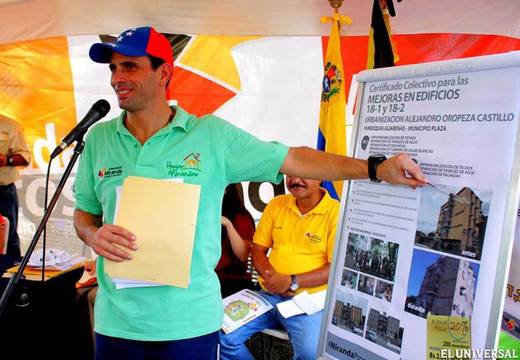
caprilesguarenas guatire.520.360 e1375469944950 In Case You Missed It…Articles Roundup Week of 8/2/13

Courtesy of: El Universal

This week: The Venezuelan government tightens its control over the media as authorities freeze the assets of “El Nacional” owner Miguel Henrique Otero; Otero then accuses the government of trying to intimidate and silence his paper; pro-government deputies in Venezuela revoke the immunity of opposition lawmaker Richard Mardo and drum up “corruption” charges; Henrique Capriles responds by accusing the PSUV of “trashing” the Venezuelan constitution. An Economic Survey conducted by the Economic Commission for Latin America and the Caribbean shows that inflation takes a bigger toll on Venezuela’s poor than in any other Latin American country; daily sales of U.S. dollars to the private sector sink 13 percent as the cost of government imports and foreign debt payments take money from the private sector; Venezuela’s strong currency controls create opportunities for illegal profiteering schemes. A poll conducted by the Venezuelan Data Analysis Institute (Ivad) reveals that today 45.1 percent of Venezuelans would vote for Capriles, while only 39.3 percent would choose Maduro; former ambassador Otto Reich files a lawsuit against three Venezuelan businessmen for bribery; seven U.S. Senators introduce a bill condemning violence against the opposition in Venezuela.

Venezuela Freezes Assets of Opposition Newspaper Editor, Wall Street Journal

Venezuelan authorities have frozen the assets of Miguel Henrique Otero, the editor and owner one of the country’s largest opposition-leaning newspaper, the attorney general’s office announced Saturday.

Editor: Venezuela Government Trying to Silence Us, Associated Press

The head of one Venezuela’s last two nationally circulating opposition newspapers accused the leftist government on Monday of trying to intimidate and silence it.

Pro-gov’t deputies lift immunity of opposition lawmaker Richard Mardo, El Universal

During the regular session held at the Venezuelan Parliament on Tuesday, pro-government legislators lifted the parliamentary immunity of opposition legislator Richard Mardo on corruption accusations filed by Parliament’s Speaker Diosdado Cabello and endorsed by the president of the Comptrollership Committee of the Parliament, Pedro Carreño, both ruling party legislators.

Capriles: Deputies trashed the Constitution by revoking Mardo’s immunity, El Universal

During a public event at a local community, Venezuelan opposition leader Henrique Capriles Radonski brought out the issue of opposition Legislator Richard Mardo and his parliamentary immunity –revoked– in Parliament, and stated that the “circumstantial majority in Parliament trampled on the Constitution and the decision of the Supreme Tribunal of Justice.”

Venezuela the only country where inflation lashes the poor the most, El Universal

Fairer distribution of national income has not been enough to solve the imbalance of the Venezuelan economy, which lashes the most vulnerable sector of society: the poor.

Daily US dollar sale to the private sector down 13%, El Universal

Claiming that the Venezuelan private sector was sold USD 125 million on a daily basis for ordinary imports in the first half of the year via both the Latin America Integration Association (Aladi) and the Unified System for Regional Compensation (Sucre), Armando León, member of the board of directors of the Central Bank of Venezuela, rejected allegations that authorities sold a lower amount of foreign currency with respect to the same period last year.

Venezuelan gov’t sucks up the dollars required by the private sector, El Universal

The minutes of meetings recording the decisions made by the Central Bank of Venezuela’s Board of Directors; the bank’s balance of payments; and the performances of both the Transaction System for Foreign Currency Denominated Securities (Sitme) and the Ancillary Foreign Currency Administration System (Sicad) are all cut pieces that are to be fitted together into a big jigsaw puzzle wherein foreign currency availability for the private sector is plummeting.

Venezuela central bank to sell $180 mln in forex auction, Reuters

Venezuela’s central bank said on Friday it would auction $180 million under its revamped currency exchange system known as Sicad, part of an effort to boost the flow of dollars to the economy and ease product shortages.

How Venezuelan Used ‘Scrape’ to Make Six Times Her Salary, Bloomberg

Venezuela’s currency controls are turning trips abroad into profitable junkets. A 27-year-old trade analyst from Caracas said she earned six times her monthly salary by traveling in April to Lima, where a business swiped her credit card and gave her $1,600 cash, charged at the official exchange rate of 6.3 bolivars per dollar.

Poll shows 45.1% of Venezuelans would vote Capriles, El Universal

Regardless of the outcome of the presidential election held in Venezuela last April 14, a survey conducted by the Venezuelan Data Analysis Institute (Ivad), Government Management, and Political Situation, showed that 45.1% of Venezuelans would vote Henrique Capriles over 39.3% who said would vote Nicolás Maduro.

Presumed corruption in Pdvsa and CVG aired in the United States, El Universal

The New York District Court admitted last Tuesday a racketeering and defamation lawsuit filed by US former ambassador Otto Reich against the partners of Derwick Associates in relation to contracts for the installation of electrical system executed with state-run oil holding Petróleos de Venezuela, electricity utility Corpoelec and the Venezuelan Guayana Corporation.

Suit Alleges Graft in Venezuelan Contracts, Wall Street Journal

A former top U.S. diplomat filed a lawsuit against three young Venezuelan businessmen whom he accuses of bribing senior Venezuelan officials in exchange for contracts worth hundreds of millions of dollars. The suit puts a spotlight on a group of executives who the diplomat, Otto Reich, and other critics say have made fortunes from links to Venezuela’s self-proclaimed socialist government.

US senators condemn political violence in Venezuela, Global Post

Seven US senators from both parties introduced a bill condemning violence against the opposition in Venezuela, calling for dialogue after a contested election.