Sep
21
2012
Posted by
admin
Comments

The Venezuelan Election Deserves Our Attention

Forbes
September 21, 2012
By Doug Schoen

4b3f7cfa9709bddca3dcc2bb73a0c167 The Venezuelan Election Deserves Our Attention

Courtesy of: AP

There is a crucial election about to take place in Venezuela. Basic issues of freedom and economic liberty are at stake for the Venezuelan people. And with Venezuela being both our largest oil provider and a chief anti-American aggressor with alliances in Iran, Syria and Russia amongst others, this election is not only critical for us but much more so than policymakers in DC have acknowledged or realized.

Democratic challenger Henrique Capriles could surely change the direction of the Venezuela. He is poised to serve as a much-needed positive force in shaping Venezuela’s future as a cooperative member of the international community if he is elected on October 7th.

The head of Venezuela’s oil workers union, the United Federation of Oil Workers, said just yesterday that his members are not even entertaining the idea of a Chavez defeat. “It is impossible for Capriles to win this year…We the working class will not allow it.”

But while some in the state run oil industry look to Chavez as a savior of their industry, he has been involved in a number of dangerous and unsavory pursuits over the years that bring a black cloud over his administration and its business. Chavez has been linked to major narcoterrorists, including Walid Makled who was designated a major drug kingpin by the Obama administration in 2009 and is a financial stalwart of Chavez’s administration. In fact, dozens of top-level figures in the Chavez government including ministers, judges and generals were on Makled’s payroll.

Roger Noriega, former US Ambassador to the Organization of American States, delivered chilling testimony to the Congressional Subcommittee on Counterterrorism wherein he detailed Venezuela’s support of Hezbollah in Latin America. And it is well known that Chavez is actively working against American interests in Latin America while he bankrupts his country in pursuit of a radical socialist agenda.

In contrast, challenger Capriles is a true democrat. A successful governor of the state of Miranda, he is a capitalist who is focused on de-politicizing Venezuela, a much needed change.

He represents a new generation of the Venezuelan political class that supports America and wants to work in genuine partnership. As a practicing Roman Catholic and a child of the Holocaust, he is acutely aware of and concerned with issues of freedom and equity, both crucial areas for the future of Venezuela.

To be sure, Capriles faces an uphill battle. Chavez has proven he will do anything, say anything, or undermine the integrity and independence of any institution to stay in power. It is therefore imperative that there be international recognition that Chavez has cheated in past elections and that he very well may cheat again. The polls are currently showing a wide range of results from a two-point advantage for Capriles to as much as a 20-point advantage for Chavez. The reality is that the two candidates are probably very close.

Chavez is convinced that he will win the election. Two weeks ago he said, “Capriles will no longer be able to surmount [the lead], even if he gets on a missile, or two, or 10…it is impossible for them to win this election. It is absolutely impossible, mathematically impossible.”

I’ve written in the past about how Chavez cheated in the 2004 referendum, which has been verified by outside, independent auditors. And indeed, there have occasionally been times that he has stood down, acknowledged defeat and moved to change the constitution like the 2007 referendum.

But the instances of Chavez circumventing the democratic process for his own personal gain far outnumber the cases where he has accepted defeat. It follows that the world must focus on this election so he cannot cheat again, a reality that has been widely predicted.

One of the keys to ensuring a free and fair election in Venezuela next month is Ambassador Diego Arria. Ambassador Arria has long pursued a lonely mission of trying to make the case of Venezuela’s importance on the world stage.

As the Permanent Representative of Venezuela to the United Nations, he predicted the Bosnian genocide in Srebrenica before it happened. And he created the “Arria Formula”, an informal consultation process that affords members of the UN Security Council the opportunity to hear persons in a confidential, informal setting which has become integral to the Security Council process.

It is critically important that Ambassador Arria continues to do his work in order to prevent Chavez from stealing yet another election and, again, consigning the Venezuelan people to further years of deprivation and poverty.

Ambassador Arria is a towering intellect and a world-class figure, a true supporter of democracy. He is playing the role of key liaison to the US and other governments around the world for Capriles and the forces of democracy in Venezuela. He is one of those genuine heroes who has effectively worked to make peace in the world and has dedicated himself to this cause for decades.

An unapologetic democrat, Ambassador Arria is working to make sure the world knows what is at stake in Venezuela. To be sure, the stakes couldn’t be higher and it is high time that the international community took notice.

To read this article on Forbes, please click here.
 
Aug
10
2012
Posted by
admin
Comments

In Case You Missed It… Articles Roundup Week of 8/10/12

iht 0810 latitude toro art3 blog480 In Case You Missed It… Articles Roundup Week of 8/10/12

Courtesy of: Carlos Garcia Rawlins / Reuters

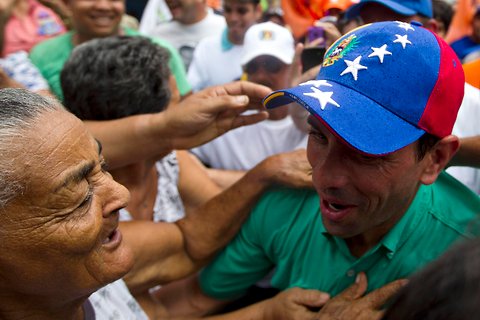
With less than 60 days before the elections, opposition candidate Henrique Capriles’ team says polls show him leading President Hugo Chávez. The latest scandal in the campaign is over Capriles’ hat, which the National Electoral Council (CNE) says violates campaign laws concerning the use of the flag. The CNE ignores Chávez’s rampant use of similar imagery in his campaign. Chávez draws criticism for accusing Capriles, the grandson of a Holocaust survivor, of having ties to Nazi groups. Meanwhile, excessive election-year spending by Chávez’s government has investors predicting a currency devaluation in the coming months. Several outlets report that the country’s oil industry, despite possessing the world’s largest reserves, has been crippled by mismanagement and poor policy. Chávez’s ties with Iran and Hezbollah provoke worries about potential threats to U.S. security.

Venezuela’s Opposition Says Capriles Leading Chavez in Polls, Bloomberg

Venezuela’s opposition said today that its candidate Henrique Capriles Radonski is surging ahead of President Hugo Chavez in opinion polls for the Oct. 7 election.

Venezuela Presidential Race Rocked by Baseball Cap, Fox News

The latest issue to put Venezuela’s presidential rivals at odds with each other? A baseball cap. At the center of their latest dispute is a cap emblazoned with the colors of Venezuela’s flag that opposition candidate Henrique Capriles frequently wears at campaign rallies ahead of the country’s Oct. 7 election.

A Feather in Capriles’s Cap, International Herald Tribune

Venezuela’s campaign for the presidential contest of Oct. 7 descended into farce last week when election officials chastised the opposition for abusing campaign rules.

Venezuela candidate slams Chavez’s Nazi accusations, AFP

Venezuela’s leading opposition candidate — whose grandmother is a Holocaust survivor — on Tuesday slammed President Hugo Chavez’s accusations that he is tied to Nazi groups.

P&G Bracing for ‘Large’ Venezuela Devaluation After Election, Bloomberg Businessweek

Venezuela may carry out a “large” devaluation after October elections, according to Procter & Gamble Co. (PG) (PG), the world’s largest consumer products company.

The Venezuelan Elections: How Can PDVSA Recover?,Journal of Energy Security

The Venezuelan oil industry can be pictured as a toothless tiger resting on its haunches before a huge slice of raw meat.

Venezuelan cheap petrol backfires on economy, Financial Times

The perverse effects of Venezuela’s cheap petrol policy can be seen everywhere in the country.

Iran’s influence in Venezuela: Washington should worry, Miami Herald

The same week that President Obama downplayed the threat to U.S. security from Venezuela’s Hugo Chávez, a high-level delegation from Hezbollah was visiting Caracas and Havana. Ammar Musawi, head of Hezbollah International Department, praised Cuba as a model on how to oppose “imperialist hegemony, arrogance, and plunder.”

 
Feb
7
2012
Posted by
admin
Comments

Game Changer in U.S.-Venezuela Relations

DSC 0754 150x150 Game Changer in U.S. Venezuela RelationsJosé R. Cárdenas served in several foreign policy positions during the George W. Bush administration (2004-2009), including on the National Security Council staff. He is a consultant with Vision Americas in Washington, DC.

Bombshell testimony on Capitol Hill last week by U.S. Director of National Intelligence James Clapper has dramatically altered the stakes in Washington’s relations with the Hugo Chávez regime in Venezuela. Speaking before the Senate Select Committee on Intelligence for the annual Worldwide Threat Assessment, Clapper said that Iranian leaders had changed their calculus and are now prepared to respond to perceived threats with terrorist attacks inside the United States.

Clapper said: “The 2011 plot to assassinate the Saudi ambassador to the United States shows that some Iranian officials — probably including Supreme Leader Ali Khamenei — have changed their calculus and are now more willing to conduct an attack in the United States in response to real or perceived U.S. actions that threaten the regime. We are also concerned about Iranian plotting against U.S. or allied interests overseas. Iran’s willingness to sponsor future attacks in the United States or against our interests abroad probably will be shaped by Tehran’s evaluation of the costs it bears for the plot against the ambassador as well as Iranian leaders’ perceptions of U.S. threats against the regime.”

The implications for U.S.-Venezuela relations are clear. Now that it has been assessed that Iran is prepared to attack the U.S. homeland, focus must now be placed on its capabilities and means to do so. That Hugo Chávez has made Venezuela — less than a three-hour flight from Florida — one of Iran’s most important international allies is now a paramount concern to U.S. security agencies.

Indeed, Chávez’s deep-seated economic, military, and intelligence relationship with Iran, running into the tens of billions of dollars, provides an enormous cover for covert operations and other destabilizing activities. That relationship runs from establishing Venezuela’s Margarita Island as a center for Iranian and Hezbollah operations in the Americas and facilitating Iran’s development of a nuclear capability by helping it obtain uranium, to blunting  sanctions by providing Iran’s access to Venezuela’s banking system and jointly trafficking in weapons (here and here) and narcotics. The DEA believes a weekly flight between Iran and Caracas is used for, among other nefarious purposes, smuggling South American cocaine to the Middle East.

Moreover, we know already that a member of the terrorist network plotting to detonate fuel tanks at JFK International Airport in New York in 2007 was arrested on the run to Venezuela, where he planned to board a Venezuelan flight to Tehran.

Lastly, the explosive documentary aired last month on Univisión, “The Iranian Threat,” included not only incriminating information on Venezuelan and Iranian diplomats discussing cyberattacks on sensitive U.S. computer systems (The State Department subsequently expelled the Venezuelan diplomat from the United States, where she had been re-posted), but also compelling evidence on how young Latinos are targeted for recruitment and paramilitary training in Iranian and Venezuelan camps visited by Hezbollah, Hamas, and the Colombian FARC.

As the Chairman of the House Foreign Affairs Committee, Congresswoman Ileana Ros-Lehtinen, put it succinctly in another hearing last week, “The Iranian regime has formed alliances with Chávez, Ortega, Castro, and Correa that many believe can destabilize the hemisphere. These alliances can pose an immediate threat by giving Iran – directly through the IRGC, the Qods force, or its proxies like Hezbollah – a platform in the region to carry out attacks against the United States, our interests, and allies.”

In addition, Clapper told the Senate that the intelligence community remains concerned about Iran’s ties to governments in the region and was tracking the issue closely, adding, specific to Iran’s activities in the region, “there is more to unfold here.”

Clearly, Clapper’s testimony reflects a substantial change in the U.S. government’s own calculus about Iran, Venezuela, and the Western Hemisphere.  If Iran is now prepared to strike the U.S. homeland, then all actions need to be pursued to debilitate its capability to do so, and that means targeting its presence in Venezuela. Hugo Chávez made a very dangerous bet when he introduced Iran to the Western Hemisphere. Now, he should be made to pay the price.