Nov
16
2012
Posted by
admin
Comments

In Case You Missed It… Articles Roundup Week of 11/16/12

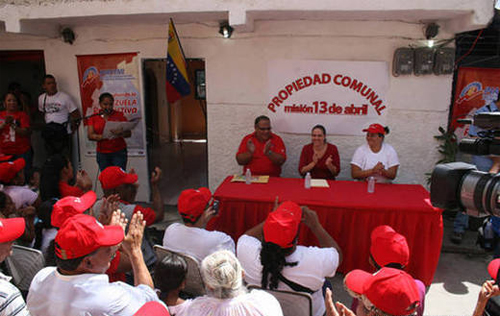
propiedad comunal In Case You Missed It… Articles Roundup Week of 11/16/12

Courtesy of: AVN

In the news this week, Venezuela won a seat on the United Nations Human Rights Council despite international criticism; regulators of the securities industry had tough questions for U.S. broker-dealers regarding practices used to mitigate money laundering and sanctions risks related to their involvement in a Venezuelan government-run exchange system; Venezuela’s crumbling infrastructure remains in the news as the electric energy minister admits the nation’s electrical system has been out of date for twenty years; and government takeovers continue as PDVSA seizes control of the Loma de Niquel mine from the Anglo American mining and natural resource company. Meanwhile, Chávez continues to lay the foundations for a communal state as forty communes await authorization by the Venezuelan government; Capriles looks to the regional December elections to legitimize the opposition coalition not only to a weary electorate but also to its own fractious members; problems persist in Venezuela’s industrial sector as the lack of raw materials reaches 83 percent; and the Venezuelan government continues to violate collective bargaining agreements, causing protests among workers. Lastly, the ADEN Competitiveness Institute ranks Venezuela among countries with the lowest competitiveness index, citing “problems of macroeconomic instability and institutional mishaps.”

Venezuela, the bane of human rights, The Washington Post

ON MONDAY, new members will be selected for the United Nations Human Rights Council, the top-level group for the protection and promotion of human rights. Its members have not always been paragons of respect for human dignity.

U.S. broker-dealers scrutinized for anti-laundering compliance in Venezuelan currency swaps, Reuters

NEW YORK, Nov. 13 (Thomson Reuters Accelus) -Securities industry regulators are beginning to ask U.S. broker-dealers tough questions about how they are mitigating money laundering and sanctions risks associated with their involvement in a 2-year-old currency exchange system run by the Venezuelan government, sources familiar with the issue said.

Some 71% of Venezuela’s electric energy system is outdated, El Universal

Venezuela’s Electric Energy Minister Héctor Navarro stated that 71% of the national electric system has been out of date for 20 years.

Venezuelan gov’t takes over Loma de Níquel mine, El Universal

Last Saturday, at 12 a.m., multinational Anglo American handed over to the Venezuelan State the control of Loma de Níquel mine, upon the expiration of the concession and failure to get a renewed term for the operation.

Communes await authorization by Venezuelan Government, El Universal

The Venezuelan National Assembly (AN) continues laying the foundations for the communal State. On October 20, during a meeting of ministers, President Hugo Chávez urged his cabinet to speed up the establishment of communes.

Capriles, Opposition Seek to Solidify Gains in Venezuela, World Politics Review

CARACAS — With campaigning for Venezuela’s December gubernatorial races now officially under way, the country’s political opposition finds itself in a tough spot. Still licking its wounds from its loss in October’s presidential election, the Democratic Unity Coalition (MUD) must get quickly off the mat to prove its credibility not only to a weary electorate but also to its own fractious members.

Lack of raw materials hits 83% of Venezuelan industries, El Universal

Obstacles are hitting the Venezuelan industrial sector, as lingering barriers continue to undermine their performance, according to data provided by the Venezuelan Confederation of Industries (Conindustria).

Government allegedly trying to uproot collective bargaining agreements, El Universal

In recent years, numerous labor protests by different sectors have sparked in Venezuela. Only in October, some 521 demonstrations were reported, 204 of which were labor-related, said the NGO Venezuelan Observatory of Social Unrest.

Venezuela among the countries with lower competitiveness index, El Universal

Chile is the leader of competitiveness among 18 Latin American countries, based on the Competitiveness Index established in October 2012 by the ADEN Competitiveness Institute. The information was disclosed by the higher studies institution based in Argentina, Efe quoted.

 
Jul
6
2012
Posted by
admin
Comments

ICYMI: Tilting the pitch

The opposition faces some extraordinary obstacles

The Economist
July 7, 2012

TO CHEERS from red-shirted supporters, on July 1st Hugo Chávez officially launched his campaign for Venezuela’s presidential election with a rally in Maracay, just west of the capital, Caracas, where he promised to “pulverise” the opposition. Mr Chávez is seeking a third consecutive six-year term, despite undergoing three operations for cancer in the past year. His centrist opponent, Henrique Capriles of the Democratic Unity coalition (MUD), spent the day flitting from the Brazilian border to the semi-desert of the Guajira in the north-west. His message was that the “most forgotten” communities can count on him to improve their lives.

That seemed calculated to underline how Mr Chávez’s uncertain health may prevent him from campaigning as actively as in the past. But in other ways, Mr Capriles is the one who faces unusual obstacles. Although almost all anti-Chávez forces are united under the umbrella of the MUD, the president can use the apparatus of the Venezuelan state to put roadblocks in his way. And he is taking full advantage.

On June 28th the supreme court (TSJ) struck against the only surviving anti-government television channel, Globovisión. As the 24-hour news channel sought to overturn in a lower court a $2.1m fine imposed by a government regulator, the TSJ ordered the seizure of assets worth $5.7m from the channel. Globovisión managers rushed to pay the original fine (imposed for its coverage of a prison siege last year) in order to avoid the seizure. Frank La Rue, the United Nations special rapporteur on freedom of expression, accused the government of using legal subterfuge to provoke the closure of critical media.

Although constitutionally independent of the executive, the TSJ has a history of obeying the president’s wishes. The former head of its criminal division, Eladio Aponte, who fled the country in April, has said the government issued instructions to the judiciary at weekly meetings.

After a 2002 coup attempt against Mr Chávez, which he accused private television channels of orchestrating, his government swore to establish its own “media hegemony”. It closed down dozens of radio and television stations, neutered others by intimidation, and created a vast state-media network which offers saturation coverage of the president’s campaign. Mr Chávez also claims the right to interrupt all terrestrial broadcast channels without notice, to speak for as long as he likes. Broadcasters are obliged by law to carry ten minutes of free government propaganda every day. Mr Capriles is mentioned in the state media only as the butt of insults.

In theory, under rules announced by the electoral authority (CNE), candidates will be entitled to just one three-minute television slot a day (and four minutes on radio) during the campaign. But the CNE has said it is powerless to prevent the president using his media prerogatives to transmit campaign speeches. It has nothing to say about the bias of state television, for whom Mr Chávez is the “candidate of the motherland”, while Mr Capriles is backed by “the bourgeoisie”.

The CNE has also ruled that 23,000 Venezuelans registered to vote in Miami, nearly all of them opposition supporters, must cast their ballots at the consulate in New Orleans, over 1,000km away by road. The excuse is that the government closed the Miami consulate after the United States expelled the consul last year. And just before the deadline for registering candidacies, the TSJ handed back to factions supporting Mr Chávez control over two formerly chavista political parties that had switched to the opposition.

None of these decisions on their own is likely to swing the result on October 7th. Most opinion polls show the president leading by a wide margin—though pollsters Consultores 21 recently put the two candidates neck-and-neck. And many voters are still undecided. But they reveal the lengths to which Mr Chávez is prepared to go to crush his opponent.

To see this article on The Economist, please click here.

 
Jul
6
2012
Posted by
admin
Comments

Tilting the pitch

The opposition faces some extraordinary obstacles

The Economist
July 7, 2012

chavez 2129761b Tilting the pitch

Courtesy of: AP / Ariana Cubillos

TO CHEERS from red-shirted supporters, on July 1st Hugo Chávez officially launched his campaign for Venezuela’s presidential election with a rally in Maracay, just west of the capital, Caracas, where he promised to “pulverise” the opposition. Mr Chávez is seeking a third consecutive six-year term, despite undergoing three operations for cancer in the past year. His centrist opponent, Henrique Capriles of the Democratic Unity coalition (MUD), spent the day flitting from the Brazilian border to the semi-desert of the Guajira in the north-west. His message was that the “most forgotten” communities can count on him to improve their lives.

That seemed calculated to underline how Mr Chávez’s uncertain health may prevent him from campaigning as actively as in the past. But in other ways, Mr Capriles is the one who faces unusual obstacles. Although almost all anti-Chávez forces are united under the umbrella of the MUD, the president can use the apparatus of the Venezuelan state to put roadblocks in his way. And he is taking full advantage.

On June 28th the supreme court (TSJ) struck against the only surviving anti-government television channel, Globovisión. As the 24-hour news channel sought to overturn in a lower court a $2.1m fine imposed by a government regulator, the TSJ ordered the seizure of assets worth $5.7m from the channel. Globovisión managers rushed to pay the original fine (imposed for its coverage of a prison siege last year) in order to avoid the seizure. Frank La Rue, the United Nations special rapporteur on freedom of expression, accused the government of using legal subterfuge to provoke the closure of critical media.

Although constitutionally independent of the executive, the TSJ has a history of obeying the president’s wishes. The former head of its criminal division, Eladio Aponte, who fled the country in April, has said the government issued instructions to the judiciary at weekly meetings.

After a 2002 coup attempt against Mr Chávez, which he accused private television channels of orchestrating, his government swore to establish its own “media hegemony”. It closed down dozens of radio and television stations, neutered others by intimidation, and created a vast state-media network which offers saturation coverage of the president’s campaign. Mr Chávez also claims the right to interrupt all terrestrial broadcast channels without notice, to speak for as long as he likes. Broadcasters are obliged by law to carry ten minutes of free government propaganda every day. Mr Capriles is mentioned in the state media only as the butt of insults.

In theory, under rules announced by the electoral authority (CNE), candidates will be entitled to just one three-minute television slot a day (and four minutes on radio) during the campaign. But the CNE has said it is powerless to prevent the president using his media prerogatives to transmit campaign speeches. It has nothing to say about the bias of state television, for whom Mr Chávez is the “candidate of the motherland”, while Mr Capriles is backed by “the bourgeoisie”.

The CNE has also ruled that 23,000 Venezuelans registered to vote in Miami, nearly all of them opposition supporters, must cast their ballots at the consulate in New Orleans, over 1,000km away by road. The excuse is that the government closed the Miami consulate after the United States expelled the consul last year. And just before the deadline for registering candidacies, the TSJ handed back to factions supporting Mr Chávez control over two formerly chavista political parties that had switched to the opposition.

None of these decisions on their own is likely to swing the result on October 7th. Most opinion polls show the president leading by a wide margin—though pollsters Consultores 21 recently put the two candidates neck-and-neck. And many voters are still undecided. But they reveal the lengths to which Mr Chávez is prepared to go to crush his opponent.

To see this article on The Economist, please click here.