Aug
26
2013
Posted by
admin
Comments

ICYMI: Chavez’s Inflation Bites His Successor

Wall Street Journal
August 25, 2013
By Mary O’Grady

OB YQ920 amcol0 G 20130825120857 e1377534741885 ICYMI: Chavez’s Inflation Bites His Successor

Courtesy of: European Pressphoto Agency

Hyperinflation and political witch hunts seem to go together. Just ask the Venezuelan opposition.

With the bolivar collapsing and prices spiraling higher, the government alleged this month that its No. 1 adversary, former presidential candidate Henrique Capriles, is linked to a prostitution ring that was using minors in the state of Miranda, where he is governor.

Lest that not be enough to turn Venezuela’s socially conservative working-classes against the popular Mr. Capriles, a leading congressman from the ruling United Socialist Party of Venezuela (PSUV) used gutter talk on the floor of the national assembly to accuse the governor of homosexuality.

Don’t suppose for a minute that this mudslinging is merely about destroying Mr. Capriles. The ruling chavistas, led by President Nicolás Maduro, need a circus because there is no bread—and that’s not a metaphor. At times in Venezuela, there really is no bread. Earlier this year there was, for a time, no toilet paper. Mr. Maduro knows he is in trouble.

The “proof” of the allegations against Mr. Capriles’s chief of staff, who is accused of running the sex ring, cannot be shown to the public, according to Mr. Maduro. He says that the “videos and photos” that the government confiscated in a raid are of “un-publishable orgies.” Venezuelans will have to use their imaginations while trusting the courts—now controlled by the military government—and the government itself to get to the bottom of it all. Developments will be reported on television, which is almost exclusively state-controlled and where most Venezuelans get their news.

Mr. Capriles has said that the allegations are an attempt to distract the population from the real problems in the country. The charges are certainly well timed. An official 46% devaluation in April took the bolivar-to-dollar exchange rate to 6.3 from 4.3. Those who actually need dollars are unlikely to get them at that rate. Instead they have to go to the black market, where one greenback costs as much as 38 bolivars, up from 22 in March.

The government forecasts that inflation will hit 40% this year. But Johns Hopkins University economist Steve Hanke, director of the Cato Institute’s Troubled Currency Project, says that the soaring cost for the bolivar in the market translates into an implied annual inflation rate of more than 250%.

Earlier this month Caracas-based economist José Manuel Puente described the perfect storm to the Los Angeles Times this way: “The slowdown in economic growth, high and persistent inflation and high levels of scarcities [of basic foodstuffs] will combine to make Venezuela’s the worst-performing economy on the continent, despite the extraordinary oil boom that the country is still benefiting from.”

A mid-July survey by the Venezuelan polling company IVAD, posted on the website lapatilla.com, suggests Mr. Maduro is having no luck dodging the blame like his predecessor Hugo Chávez did so deftly. Asked what are the principal problems facing the country, almost 82% of respondents named crime. More than 53% also pointed to shortages. The scarcity is caused by the price controls that the government is using to try to hold down inflation. Those controls could explain why only 31% named “the high cost of living.”

But more than 65% said the economic situation was worse or much worse than one year ago, and more than half blamed either the national government or Mr. Maduro for the country’s problems.

Because the allegations against Mr. Capriles by the PSUV included a pejorative term for a homosexual, gay-rights groups took offense. But Venezuela’s homosexuals needn’t feel special. Hate speech as a political tool has been common practice in Venezuela’s military government for more than a decade. Catholics, Jews, entrepreneurs and the bourgeoisie have all been on the receiving end.

Mr. Maduro, coached as he is by Fidel Castro, immediately recognized that gay rights are a priority for many members of the international left. So in the aftermath of the impolitic comments by his colleague in Congress, he quickly seized a gay-pride flag to wave while he continued his verbal assaults against Mr. Capriles.

Political nonconformists regularly singled out by chavista politicians for ridicule and acrimony won’t get off so easily. This week Mr. Maduro is expected to try again to force through congress an “enabling law” that will allow him to rule by decree.

Opposition Congressman Richard Mardo has already been stripped of his congressional immunity and is slated for trial on corruption charges. Other opponents are being investigated. The Venezuelan daily El Nacional reported this month that more than one third of congressional sessions in the first half of the year were spent “harassing the opposition,” including with physical violence.

The goal is to drum up mass hysteria against opponents. Apparently Mr. Maduro has decided that if inflation cannot be contained, Mr. Capriles and his allies will be.

To read this article at Wall Street Journal, please click here.
 
Jul
30
2013
Posted by
admin
Comments

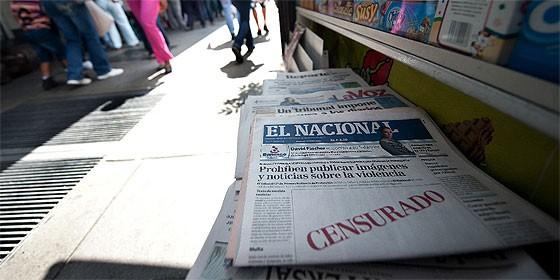
ICYMI: Venezuela Government Trying to Silence Media

Associated Press
July 30, 2013
By Fabiola Sanchez and Frank Bajak

censura 560x280 e1375200697147 ICYMI: Venezuela Government Trying to Silence Media

Courtesy of: Periodista Latino

The head of one Venezuela’s last two nationally circulating opposition newspapers accused the leftist government on Monday of trying to intimidate and silence it.

Miguel Henrique Otero, editor and publisher of El Nacional, was responding to a weekend announcement by Venezuela’s chief prosecutor asking to have his bank accounts frozen.

“It is a brazen act” to call for “such a measure against someone via Twitter without me even knowing what I’m accused of,” Otero told The Associated Press by phone.

Prosecutor Luisa Ortega Diaz used her official Twitter account Saturday to request that Otero’s bank accounts be frozen. Her office issued a press release saying the action was related to a lawsuit by a former Caracas mayor who claims Otero owes him $3.5 million.

The former mayor, Alfredo Pena, fled Venezuela a decade ago and his whereabouts are unknown. The release said Ortega wanted to determine how Pena obtained the money and why Otero owed such a sum.

Asked whether freezing his bank accounts could affect El Nacional, Otero said, “I don’t think so, but I haven’t seen the court papers.” His lawyers also hadn’t seen the documents, he said.

That is not unusual in today’s Venezuela, whose government is accused by international human rights groups of employing a pliant judiciary as a tool of political repression since the late President Hugo Chavez gained firm control of all state institutions.

Otero said he considered Ortega’s action an attempt to “silence, intimidate (and) discredit” the newspaper.

“They have a policy of besieging, buying up and threatening news media,” he said. “This is clearly part of that process.”

One of Otero’s lawyers, Juan Garanton, said it was highly unusual for the chief prosecutor’s office to get involved in a private affair between two individuals. He also said the alleged debt doesn’t exist and can’t be confirmed by Pena because the former mayor long ago left the country.

The AP sought comment from the chief prosecutor’s press office but was told by a spokesman that he had nothing to add. The spokesman would not identify himself. The AP also sought comment from the communications minister, who did immediately respond to an email request.

Maria Fernanda Flores, former general manager of Globovision TV, called Ortega’s action part of a campaign to silence all media critical of President Nicolas Maduro’s government.

“Out of panic, out of fear, it’s meant to oblige censorship and self-censorship,” said Flores, whose April resignation from the last remaining opposition TV station was a condition of its sale to businessmen friendly with the government.

Globovision’s previous owners were repeatedly sanctioned by the Conatel telecommunications agency, which fined it millions of dollars for purported transgressions such as tax filing errors and running allegedly incendiary reports on a 2011 prison riot. The former owners said they simply could no longer afford to continue broadcasting.

Pro-government broadcasters now dominate Venezuela’s airwaves, mostly drowning out dissenting voices.

Speeches by opposition leader Henrique Capriles, who claims fraud cost him a surprisingly tight April 14 presidential election, are no longer broadcast live by Globovision. So Capriles has taken to broadcasting weekly appearances on the Internet.

Flores expects the opposition to increasingly publish online. “The problem is that Internet bandwidth in Venezuela is so poor that streaming video freezes up,” she said.

Chavez, who died March 5 after a long battle with cancer, had accused El Nacional of being among news organizations that backed the failed 2002 attempt to overthrow him.

To read this article at Associated Press, please click here.

 
Aug
13
2010
Posted by
admin
Comments

VenEconomy: Eliminating the Adversary

Latin American Herald Tribune VenEconomy: Eliminating the AdversaryThis article was originally posted by The Latin American Herald Tribune

Two months ago, Banco Federal, owned by Nelson Mezerhane, was intervened. At that time, it was commented that there seemed to be no technical or financial explanation for the measures as, according to the latest available financial statements, Banco Federal was solvent. So, in the opinion of the analysts, the intervention was prompted by “political considerations,” by the simple fact that Mr. Mezerhane is the owner of 20% of Globovisión, which, in turn, is one of the few media that dare to criticize the Chávez administration’s policies.

On Tuesday, August 10, at a press conference, Planning and Finance Minister Jorge Giordani and Bank Superintendent Edgar Hernández Behrens announced the sale of part of the assets of the intervened Banco Federal in order to pay customers whose deposits were not guaranteed by Fogade. They also announced the winding up of the bank. Reading between the lines, Giordani’s and Hernández’s statements seem to corroborate the perception that there were no technical or financial reasons for intervening the bank.

Proof of the bank’s solvency, in the eyes of some, is the fact that Banco Federal supported a run on the bank provoked by a malicious campaign launched via the state-owned media and opinion mongers sympathetic to Chavismo.

But things haven’t stopped with Banco Federal. The fact is that the government has mounted an unprecedented campaign against Nelson Mezerhane, which goes from issuing a warrant for his arrest to the confiscation of his companies and other property, and even a campaign to discredit him in the government-sponsored media, which have submitted him to public derision.

Read More