Oct
8
2010
Posted by
admin
Comments

Nobel a platform for outspoken Vargas Llosa

latimes 200x300 Nobel a platform for outspoken Vargas Llosa This article was originally posted by Angop

The Nobel Prize in literature brings a long-awaited accolade to Peruvian author Mario Vargas Llosa, and also a new platform for him to assail leftist leaders Hugo Chavez of Venezuela and Fidel Castro of Cuba.

The 74-year-old writer has been a combative political activist in denouncing what he views as threats to democracy and freedoms in Latin America.

As he basked in praise for winning the prize Thursday, he pointedly singled out Venezuela and Cuba during a news conference in New York, saying those two countries represent a step backward for a hemisphere emerging from an era of strongman leaders.

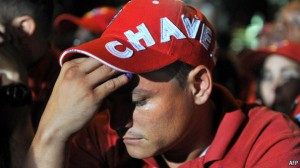
Vargas Llosa has regularly directed barbs at Chavez, denouncing him as autocratic. When the novelist visited Venezuela last year to attend a pro-democracy forum, he was stopped by authorities at the airport for nearly two hours.

Chavez disputed that account at the time, saying his critics were putting on a show to discredit his government.
 
Sep
30
2010
Posted by
admin
Comments

The revolution checked

AFP 300x168 The revolution checkedThis article was originally posted by The Economist

AFTER five years in the wilderness, Venezuela’s opposition is back in parliament and in contention. By winning 65 seats in the 165-member, single-chamber National Assembly, in an election on September 26th, the Venezuela Unity coalition dealt a blow to the hopes of Hugo Chávez, the leftist president, of exercising indefinite hegemony. Even worse for the president and his claim to be leading a popular revolution was the fact that the overall vote of 5.4m for the ruling United Socialist Party (PSUV) and its communist allies, was just below that of their opponents (5.7m).

Only blatant gerrymandering of constituencies and an electoral reform that abolished proportional representation allowed Mr Chávez to keep control of the legislature. Even so, he failed to retain the two-thirds majority he had said was vital for his regime’s future. Without it, the government must negotiate appointments to key posts, such as supreme court justices and members of the electoral authority (the CNE). And it cannot pass, or amend, laws which affect constitutional rights. Particularly irksome will be the fact that it may not be able to muster the 99 deputies required to authorise Mr Chávez to rule by decree, as he has been wont to.

In his 11 years in power Mr Chávez has profited from the opposition’s mistakes, which have included an attempted coup in 2002 and an ill-judged boycott of the previous legislative election in 2005. Over that period he has won a dozen national votes (the only exception being a constitutional referendum in 2007). The opposition’s rehabilitation began with a strong showing in big cities in a regional vote two years ago. For the legislative election, its multitude of constituent groups managed to hammer out a united front. Their success increases the chance that they will unite behind a single candidate against Mr Chávez in the presidential election that is due in two years’ time.

Read More

 
Sep
24
2010
Posted by
admin
Comments

Venezuela’s violent crime challenges Chavez in key polls

This article was originally posted by Petroleumworld

Three years ago, Venezuelan Fabiana Dominguez’s 17-year-old son was shot dead in a botched robbery attempt.

Two days ago, a friend of her son was shot in the head in broad daylight, just days after her husband was mugged at gunpoint in a shopping center.

“Nothing has changed in Venezuela,” the 42-year-old said on a shopping trip in Catia, a district of clumsily stacked slums on the hills of Caracas where gun crime is rife.

Dominguez plans to vote against leftist President Hugo Chavez’s party in parliamentary elections Sunday to protest his failure to address rising insecurity in 11 years in power.

As the elections have become yet another plebisicite on the populist president, the opposition — hungry to return to parliament after boycotting the last vote five years ago — has tapped into concern about crime.

Ahead of the campaign, official figures leaked to the press showed more than 19,000 murders in Venezuela in 2009, making it the most violent country in the region, above Mexico, Brazil or El Salvador.

Venezuela has long had a violent reputation, but the murder rate has more than doubled in the past decade, according to NGOs who provide the only regularly-published figures on the issue, citing leaked police reports.

Caracas streets empty out at night and many live behind barred windows.

Analysts blame the rise on various factors, from a broad gap between rich and poor in the westernized, oil rich nation, to unemployment and the easy availability of arms on a key drug trafficking route to Europe.

Read More