Jun
29
2012
Posted by
admin
Comments

Tilting the playing field

The Economist
June 29, 2012
By P.G.
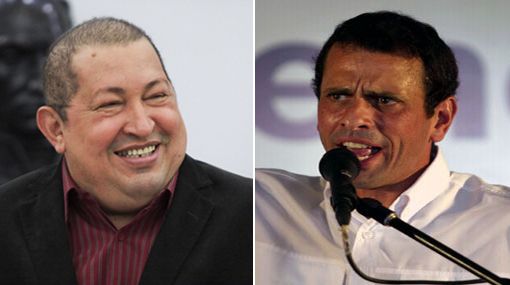
capriles chavez 20532 20120404 56 Tilting the playing field

Courtesy of: Reuters / Jamil Bittar

WHEN Hugo Chávez was re-elected as Venezuela’s president in 2000 and 2006, most polls indicated he would have won comfortably even if he had not used his control of Venezuela’s state institutions to his advantage. This year, as he stands for a third consecutive term, he faces a credible threat from his challenger for the first time: a recent poll by Consultores 21 gave him just a 3.4 percentage-point lead over Henrique Capriles of the Democratic Unity coalition (though other surveys suggest the president has a much bigger edge). The campaign for the election to be held on October 7th starts officially on July 1st. But even before it begins, Mr Chávez has made abundantly clear that he is willing to dispense with any remaining pretence of differentiation between himself, his United Socialist party and supposedly autonomous organs of the Venezuelan state in order to secure a victory.

On June 28th Venezuela’s supreme court (TSJ) struck a potentially fatal blow against Globovisión, the only surviving television station critical of the president. A state regulator had previously fined the 24-hour news channel over $2m for its coverage of the government’s siege of a jail where prisoners staged a mutiny last year. Globovisión was seeking to have the penalty overturned in a lower court. But with no advance warning, the TSJ ordered the seizure of assets belonging to the channel worth almost three times as much as the fine. The company then rushed to pay the original penalty in an effort to avoid the much bigger confiscation ordered by the court.

The TSJ is constitutionally independent of the executive. However, it has a history of strict obedience to Mr Chávez’s wishes. According to the former head of its criminal division, Eladio Aponte, who fled the country in April, the government regularly gave orders to the judiciary at weekly meetings.

Mr Chávez’s information minister has spoken openly of his desire to establish “media hegemony” for the government. The president has had dozens of broadcast outlets closed, neutered others by administrative intimidation, and created a vast state media network offering undiluted propaganda. He also claims the right to interrupt all terrestrial broadcast channels without notice and speak for as long as he likes, and introduced a law requiring them to carry ten minutes of free government propaganda every day. State media only mention Mr Capriles as the butt of insults. Outside observers were quick to condemn the TSJ’s move: Frank LaRue, the UN’s special rapporteur on freedom of expression, accused the government of using legal subterfuge to provoke the closure of critical media.

Mr Chávez has also used the TSJ to weaken his rivals more directly. Just before the June 11th deadline for registering candidacies, the court put his allies in control of two political parties that had previously opposed him. Citing alleged irregularities in internal voting procedures, the TSJ handed the reins of the social-democratic Podemos to Didalco Bolívar, a former state governor who has made up with Mr Chávez after fleeing the country when he was accused of corruption in 2009. The leftist Fatherland for All was similarly snatched from its anti-chavista leadership just in time to appear on the ballot in support of the president’s re-election.

Another nominally independent state agency is the national electoral authority, the CNE. It has also taken decisions beneficial to the president of late, ruling that voters living in Miami—home to the world’s biggest Venezuelan expatriate community—must vote at the consulate in New Orleans, over 1,000km (660 miles) away by road. The vast majority of the 23,000 registered voters in Miami oppose Mr Chávez. The CNE justified the policy by arguing that the government closed the consulate in Miami after the United States expelled the consul in January.

Individually, none of these decisions is likely to tip the balance in the president’s favour in October. But taken together, they demonstrate that Mr Chávez is both willing and able to deploy the entire weight of the state to crush his opponent.

To view this article on The Economist, please click here.
 
Jun
14
2012
Posted by
admin
Comments

Venezuela’s Election Campaign Begins

screenshot1 Venezuela’s Election Campaign Begins

Joel D. Hirst

Joel D. Hirst is a democracy activist and a Principal at Cordoba Group International. He tweets @joelhirst.

The differences could not have been starker. On Sunday Governor Henrique Capriles Radonski registered his candidacy for the Presidency of Venezuela. The energetic 39 year old ran for six kilometers to the National Electoral Council (CNE); accompanied by a multi-color volunteer tide which numbered in the hundreds of thousands (if not a million). Capriles (as he is known by the people) gave a speech about hope and the future. The event felt like a celebration.

On Monday, President Hugo Chavez, Venezuela’s most familiar face, registered his candidacy for a term that would finish with him having been in office for 19 years. Due to a debilitating fight with a rare form of cancer, Chavez was ferried to the CNE on a truck, taking a few painful steps to the podium where he delivered a three hour message which, as Venezuelans have come to expect, was laced with threats, insults and attacks. Chavez was also accompanied by a large crowd, a red tide that flowed alongside his carnival truck. Using the anonymous mechanism of social media, not-so-revolutionary public servants began to fill the twittosphere with copies of letters sent by the government demanding that public servants be forced to march alongside their comandante. The mood was somber; a clearly aging and swollen Chavez seemed to personify the revolution that he is so keen to protect, though it may cost him his life.

This election campaign, which culminates in the October 7th general election, could not offer up a more divergent set of ideas. On the one side have marshaled the forces of representative democracy, a hard nucleus of civil and political rights, the pre-eminence of private property and entrepreneurship and free market capitalism as the means to advance personally while delivering the best quality, most affordable services to the greatest majority. On the other side are the forces of 21st century socialism: of communes, economic and social rights given in exchange only for total loyalty to a caudillo, the centralization of power in the executive and the eternal government of one man.

It would seem a fool’s choice; save that the perennial poor have come to accept the role of their government as a service provider and expect from their executive the handouts that President Chavez has been so successful in delivering. This is not the time to challenge these now-ingrained ideas. For this reason, Governor Radonski has been walking a fine line, comparing a potential Capriles administration to Brazil’s wildly popular and generally successful “Lula” administration. It seems to be working; polls show him tied with President Chavez.

To be sure, as in any election cycle there are wild cards, and Venezuela is no different. Speculation continues around President Chavez’s health. A formidable campaigner, his disease has kept him out of the public eye and has unleashed tremendous speculation about his potential successor. Should he not make it to the October 7th date, the United Socialist Party (PSUV) would have to choose a different candidate which could postpone the elections.

Another wild card is the role that fraud will have in this election. The Government of Venezuela has perfected 21st century electoral fraud. Instead of ballot stuffing, so popular in authoritarian regimes of the past, they use a more sophisticated system. The issuing of voter IDs to millions of ghost voters; the crushing use of state propaganda in favor of Chavez; the use of state oil resources in favor of the government’s candidates; the open threats to the over 5 million people who depend directly on the government that their votes are not secret; the migration of opposition voters to other voting centers far from their homes; and most recently the closure of the consulate in Miami in order to disenfranchise hundreds of thousands of potential voters. Will the people, the same who filled the airwaves with silent protests against forced marches, choose to risk a vote against their comandante?

These are the questions, for the government’s fraud is not foolproof. It is overcome through massive voter turnout and the vigilance of organized poll watchers present in every single voting booth. This is the challenge of the Venezuelan democrats; to transform the excitement for change into an organization which leads to action at the polls on Election Day. For them, and for those who come after, this is the most important election in history.

 
May
7
2012
Posted by
admin
Comments

ICYMI: Chavez reelection bid in doubt

AFP
May 6, 2012
By Anna Pelegri

ALeqM5ggp4 52scG8ZGv0qQAYmsqUR3v6A ICYMI: Chavez reelection bid in doubt
Names of possible successors to Hugo Chavez have begun to circulate (Photo: AFP / Juan Barreto)

President Hugo Chavez’s repeated trips to Cuba for cancer treatment and the government’s silence about his health are fueling rumors that he will name a successor to run in October presidential elections.

So far, the government has fiercely maintained that there is no alternative to Chavez, who still leads in the polls. But several names have begun to circulate among observers to take the helm should Chavez delegate his powers.

Foreign Minister Nicolas Maduro, Vice President Elias Jaua and National Assembly President Diosdado Cabello are considered potential candidates. They are already cited in polls, triggering speculation over the ramifications of a possible succession battle.

Any departure of Chavez from the national stage would have profound consequences in Venezuela, where he has governed since 1999. It would also have a huge impact across Latin America, especially in leftist ally nations which have been showered with his country’s oil wealth.

Jaua will soon be named president of the Council of State, an advisory body whose creation this week is seen by some analysts as the first step toward a potential political transition since Chavez experienced a relapse of the cancer first detected in June 2011.

“With the lack of information, all scenarios are possible, including Chavez’s absence and the naming of a successor” for the October 7 vote, said Datanalisis polling firm president Luis Vicente Leon.

Chavez returned to Cuba on Tuesday for what he called the “home stretch” of his radiation treatment, without providing more details. His previous stay, which was supposed to have been his last, stretched out for 11 days.

The exact nature of the cancer has never been disclosed. The 57-year-old underwent an operation in Havana on February 26 to remove a second cancerous tumor in his pelvic area, where a baseball-sized growth was extracted a year ago.

Usually all over the Venezuelan media, Chavez now rarely appears in public and has been reduced to sending out tweets during his long absences in Cuba.

Chavez is running for reelection as a “revolutionary socialist” against Henrique Capriles, the youthful Miranda state governor and center-left candidate for the united opposition.

Capriles scoffed at the pervasive uncertainty surrounding Chavez’s political future. “A country cannot be ruled via Twitter, the Internet or by telephone,” he said Friday.

Even in the president’s own ranks, tensions and divisions are growing. But so long as Chavez is alive, “these confrontations will be relegated to the back stage, because the president of the United Socialist Party can still destroy” his rivals, Leon said.

For now, the firebrand leftist leader’s health is overshadowing the run-up to the presidential campaign.

Yet “his absence is not yet having an effect on how most Venezuelans intend to vote,” analyst John Magdaleno said.

But Leon warned that the government’s silence on Chavez’s wellbeing and ability to run the country could be hiding a political maneuver.

“The president could be trying to prepare a triumphant return and then, the bigger the speculation about his health, the less he will need to make new proposals” upon his return, Leon added.

The electoral campaign officially gets under way on July 1, but the law allows for replacing a candidate unable to run at any time, constitutional lawyer Enrique Sanchez Falcon noted.

The most prominent face of the left in Latin America, Chavez has rallied a group of like-minded leaders as a counterweight to the United States.

To read this article by AFP in its entirety, please click here.