Aug
26
2013
Posted by
admin
Comments

ICYMI: Chavez’s Inflation Bites His Successor

Wall Street Journal
August 25, 2013
By Mary O’Grady

OB YQ920 amcol0 G 20130825120857 e1377534741885 ICYMI: Chavez’s Inflation Bites His Successor

Courtesy of: European Pressphoto Agency

Hyperinflation and political witch hunts seem to go together. Just ask the Venezuelan opposition.

With the bolivar collapsing and prices spiraling higher, the government alleged this month that its No. 1 adversary, former presidential candidate Henrique Capriles, is linked to a prostitution ring that was using minors in the state of Miranda, where he is governor.

Lest that not be enough to turn Venezuela’s socially conservative working-classes against the popular Mr. Capriles, a leading congressman from the ruling United Socialist Party of Venezuela (PSUV) used gutter talk on the floor of the national assembly to accuse the governor of homosexuality.

Don’t suppose for a minute that this mudslinging is merely about destroying Mr. Capriles. The ruling chavistas, led by President Nicolás Maduro, need a circus because there is no bread—and that’s not a metaphor. At times in Venezuela, there really is no bread. Earlier this year there was, for a time, no toilet paper. Mr. Maduro knows he is in trouble.

The “proof” of the allegations against Mr. Capriles’s chief of staff, who is accused of running the sex ring, cannot be shown to the public, according to Mr. Maduro. He says that the “videos and photos” that the government confiscated in a raid are of “un-publishable orgies.” Venezuelans will have to use their imaginations while trusting the courts—now controlled by the military government—and the government itself to get to the bottom of it all. Developments will be reported on television, which is almost exclusively state-controlled and where most Venezuelans get their news.

Mr. Capriles has said that the allegations are an attempt to distract the population from the real problems in the country. The charges are certainly well timed. An official 46% devaluation in April took the bolivar-to-dollar exchange rate to 6.3 from 4.3. Those who actually need dollars are unlikely to get them at that rate. Instead they have to go to the black market, where one greenback costs as much as 38 bolivars, up from 22 in March.

The government forecasts that inflation will hit 40% this year. But Johns Hopkins University economist Steve Hanke, director of the Cato Institute’s Troubled Currency Project, says that the soaring cost for the bolivar in the market translates into an implied annual inflation rate of more than 250%.

Earlier this month Caracas-based economist José Manuel Puente described the perfect storm to the Los Angeles Times this way: “The slowdown in economic growth, high and persistent inflation and high levels of scarcities [of basic foodstuffs] will combine to make Venezuela’s the worst-performing economy on the continent, despite the extraordinary oil boom that the country is still benefiting from.”

A mid-July survey by the Venezuelan polling company IVAD, posted on the website lapatilla.com, suggests Mr. Maduro is having no luck dodging the blame like his predecessor Hugo Chávez did so deftly. Asked what are the principal problems facing the country, almost 82% of respondents named crime. More than 53% also pointed to shortages. The scarcity is caused by the price controls that the government is using to try to hold down inflation. Those controls could explain why only 31% named “the high cost of living.”

But more than 65% said the economic situation was worse or much worse than one year ago, and more than half blamed either the national government or Mr. Maduro for the country’s problems.

Because the allegations against Mr. Capriles by the PSUV included a pejorative term for a homosexual, gay-rights groups took offense. But Venezuela’s homosexuals needn’t feel special. Hate speech as a political tool has been common practice in Venezuela’s military government for more than a decade. Catholics, Jews, entrepreneurs and the bourgeoisie have all been on the receiving end.

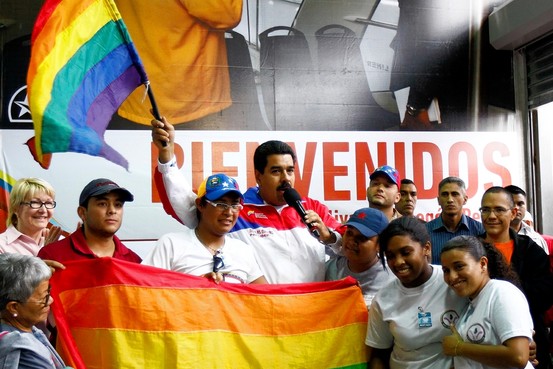
Mr. Maduro, coached as he is by Fidel Castro, immediately recognized that gay rights are a priority for many members of the international left. So in the aftermath of the impolitic comments by his colleague in Congress, he quickly seized a gay-pride flag to wave while he continued his verbal assaults against Mr. Capriles.

Political nonconformists regularly singled out by chavista politicians for ridicule and acrimony won’t get off so easily. This week Mr. Maduro is expected to try again to force through congress an “enabling law” that will allow him to rule by decree.

Opposition Congressman Richard Mardo has already been stripped of his congressional immunity and is slated for trial on corruption charges. Other opponents are being investigated. The Venezuelan daily El Nacional reported this month that more than one third of congressional sessions in the first half of the year were spent “harassing the opposition,” including with physical violence.

The goal is to drum up mass hysteria against opponents. Apparently Mr. Maduro has decided that if inflation cannot be contained, Mr. Capriles and his allies will be.

To read this article at Wall Street Journal, please click here.
 
Aug
23
2013
Posted by
admin
Comments

In Case You Missed It…Articles Roundup Week of 8/23/13

capriles.520.360 e1377285185692 In Case You Missed It…Articles Roundup Week of 8/23/13

Courtesy of: El Universal

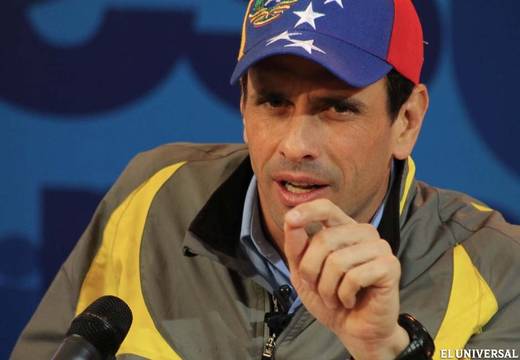
This week: Nicolás Maduro tries to pass an Enabling Law, which would grant him increased decree powers in his alleged fight against corruption; and Henrique Capriles says that if they law was somehow passed, Venezuelans would disregard it. The Venezuelan government hurls anti-gay slurs at the opposition as part of their “war on corruption,” while continuing to preach social inclusion; eight senior journalists quit Venezuela’s former opposition news channel, Globovisión, in protest of government manipulation; and due to increasing government control of the media, Venezuelan officials are communicating first through Twitter, not TV or radio. PSUV members are angry at Maduro for skipping the grassroots election preceding December’s municipal election; infighting and corruption in Maduro’s party threaten Hugo Chávez’s socialist legacy in Venezuela;   the Central Bank issues more bonds to curb liquidity and attempts to boost the failing economy by auctioning $300 million in the currency exchange system; and Venezuelan doctors demand that the government declare a health emergency in the county.

Showdown looms in Venezuela over decree powers plan, Reuters

Venezuelan politicians traded insults over the weekend with a showdown looming in the National Assembly over President Nicolas Maduro’s plans to ask for fast-track decree powers he says he needs to combat corruption. Maduro, who narrowly won an April election to replace his late mentor Hugo Chavez, says he is ready to change “all the laws” if necessary to stamp out widespread graft that is denting his popularity with some core supporters.

Capriles: “If passed, Venezuelans would disregard the Enabling Law”, El Universal

“I say responsibly to the country that if they (pro-government officials) want to pass an Enabling Law throughout abuses and disregarding the Constitution, we, Venezuelans would disregard such law,” Henrique Capriles Radonski, Miranda state Governor and opposition leader stressed on Tuesday on his live web show Venezuela Somos Todos (“Venezuela is all of us”) as he commented that President Nicolás Maduro would request special legislative powers via an Enabling Law to the National Assembly in order to allegedly fight against corruption.

Venezuela Government Under Fire for Anti-Gay Slurs, Wall Street Journal

Venezuela’s leftist government, which often touts its social inclusion and antidiscrimination policies, is under fire from rights groups after a tirade of antigay slurs in the National Assembly, prompting President Nicolas Maduro to take to the airwaves waving a conciliatory gay-pride flag—before continuing to attack his political opponents. Lawmakers from Mr. Maduro’s United Socialist Party of Venezuela released photos that appeared to be from a private gathering in which a top aide to the opposition’s former presidential candidate is seen hugging other men and, in others, mugging for the camera while wearing a shawl and a feathered head piece.

Journalists Quit Venezuela TV News Channel in Censorship Protest, Bloomberg

Eight senior journalists quit Venezuela’s main television news channel Globovision in the past week in protest at alleged government manipulation of coverage. “We have progressively seen changes and unacceptable conditions to the free exercise of our profession,” the anchors and reporters at the broadcaster said in a joint e-mailed statement late yesterday. The journalists resigned in solidarity with director Leopoldo Castillo, who announced his exit from Globovision on Aug. 16 after 12 years at the channel.

Latin American presidents and their often love affair with Twitter, Associated Press

Whenever Argentina’s President Cristina Fernandez uses Twitter, controversy often follows. Although tweet discussions range in content and frequency, there’s never a lack of debate. Fernandez, who almost never gives interviews or takes questions from reporters, often uses her official Twitter account, https://twitter.com/CFKArgentina , which claims more than 2.2 million followers, to have a direct connection to the people.

Maduro’s explanation for skipping grassroots election is rebutted, El Universal

Since its foundation in 2007, the ruling United Party of Venezuela (Psuv) has gone through at least four grassroots elections in preparation of  several municipal, state and parliamentary polls, even for the election of Psuv authorities. This is not the case for the municipal election to be held next December 8. This time, top authorities took care of it. The decision, ultimately in the hands of the High Political Command of the Revolution, was justified recently by Venezuelan President Nicolás Maduro.

Hugo Chávez: His legacy at stake, Financial Times

When almost 500 families invaded the estate owned by the Santa Teresa rum company in 2000, Alberto Vollmer decided that using brute force to expel them would be futile. Hugo Chávez had just won the presidency and was encouraging Venezuelans to squat on private land. So instead, Mr Vollmer devised a plan to allow some families to remain, so long as the government paid for their housing.

Venezuela Opens Bidding Process for Latest Dollar Auction, Wall Street Journal

Venezuela authorities began accepting bids Wednesday for the government’s latest hard currency auction, which will offer for the first time dollar-denominated bonds issued last year among the $330 million slated to be injected into the import-heavy economy. The central bank will take bids until Thursday from companies in the food sector, those importing goods for the holiday season in December and firms looking to buy textiles and chemicals, among a limited group of permitted participants.

Venezuelan Doctors Say Country Faces Health Emergency, Latin American Herald Tribune

The president of the Venezuelan Medical Association asked the Venezuelan government Tuesday to declare a health emergency and take steps to address serious problems with the Andean nation’s healthcare system. “We demand… a healthcare emergency be declared here in Venezuela,” Dr. Douglas Leon said during a press conference in Caracas.

 
Aug
19
2013
Posted by
admin
Comments

ICYMI: Venezuela Government Under Fire for Anti-Gay Slurs

Wall Street Journal
August 15, 2013
By Kejal Vyas and Ezequiel Minaya

WO AP040 VENGAY G 20130816182829 e1376937194509 ICYMI: Venezuela Government Under Fire for Anti Gay Slurs

Courtesy of: Reuters

CARACAS—Venezuela’s leftist government, which often touts its social inclusion and antidiscrimination policies, is under fire from rights groups after a tirade of antigay slurs in the National Assembly, prompting President Nicolas Maduro to take to the airwaves waving a conciliatory gay-pride flag—before continuing to attack his political opponents.

Lawmakers from Mr. Maduro’s United Socialist Party of Venezuela released photos that appeared to be from a private gathering in which a top aide to the opposition’s former presidential candidate is seen hugging other men and, in others, mugging for the camera while wearing a shawl and a feathered head piece.

Though the pictures showed nothing lurid, the lawmakers charged that they were “unquestionable” proof of the opposition’s “moral degradation” and evidence of their involvement with “prostitutes” and orgies.

Socialist party congressman Pedro Carreño said “we in the revolution accept sexual diversity,” before using antigay slurs and vulgarities to describe the opposition leader Henrique Capriles and his Primero Justicia party.

The following day, Mr. Carreño apologized, adding, “but I had to put them in their place.”

Ramón José Medina, a director of the opposition coalition, dismissed the allegations as trumped-up efforts by government officials to divert attention from the mountain of economic and social problems plaguing Venezuela, including high crime and an inflation rate topping 40%.

“All of this is clearly an attempt to attack those close to Capriles,” he said.

He said some of the photos as well as receipts to a party-services company cited by Socialist party lawmakers to support allegations of corruption came from property seized during the search of the aide’s residence a week ago.

He said they do not prove any wrongdoing and added that officials were violating the law by publicly showcasing private property. “We’re still trying to figure out what offense they say was committed here,” Mr. Medina said.

Activist groups said the slurs followed a pattern of increasing demonization of homosexuals in the political arena during the past year amid a pair of hard-fought presidential elections. Last October, Mr. Capriles came close to beating former President Hugo Chávez, who died of cancer in March.

Politicians in Venezuela use gay and transgender slurs to “destroy” political adversaries, said Yonatan Matheus, director of the gay advocacy group Venezuela Diversa.

Venezuela has one of the least friendly legal environments toward the gay community in the Spanish-speaking Americas, experts said. Homosexual acts are legal but civil-unions aren’t recognized, in contrast to an increasing number of other countries in the region, said Javier Corrales, a political-science professor at Amherst College, who has written on homosexual and transgender issues in Latin America.

Allies of Venezuela like Argentina and Uruguay have both moved forward with legalizing gay marriage. Meanwhile in Ecuador, courts fined a former presidential candidate earlier this year and stripped him of his political rights for one year after he made homophobic comments.

Mr. Chávez, who often celebrated diversity and inclusion policies toward women, blacks and indigenous peoples, steered clear of the issue.

“What happened in the National Assembly will go down in history as one of the most aggressively homophobic acts in contemporary Latin America,” Mr. Corrales said. “The government is hoping that the public becomes more scandalized by issues of ‘indecency’ than by issues of actual money-related corruption.”

On Wednesday, Mr. Maduro appeared on television holding a rainbow-colored flag and said that he was in solidarity with people of different sexual orientation but backed his ally, Mr. Carreño, calling him an “honorable man.”

He then went on the offensive again, accusing Mr. Capriles of holding orgies in his office. What was shown in the National Assembly, “is only 1% of all that has been uncovered. The orgy videos and photos aren’t publishable…it would be denigrating to the human condition,” the president said.

Mr. Maduro, facing growing criticism of alleged government corruption in his regime, has promised to tackle widespread graft but his withering rhetoric so far has focused almost exclusively on his political foes.

During the presidential campaign in April, Mr. Maduro used gay slurs against Mr. Capriles and other political rivals. Mr. Maduro later offered a tacit apology on state television.

“This is what I would call the pattern of a state that’s schizophrenic,” said Tamara Adrián, a Venezuelan lawyer, professor and local gay and transsexual rights advocate.

Ms. Adrián said Venezuela has signed international accords for protection of sexual diversity, “but it’s not what we see every day,” citing frequent cases of harassment and violent crimes against lesbians and gays.

To read this article at Wall Street Journal, please click here.