Jul
17
2012
Posted by
admin
Comments

Government on top; opposition at bottom of the ballot

Congressman Juan Carlos Caldera reported on a challenge by pro-government Nuevo Camino Revolucionario

El Universal
Ocarina Espinoza
July 17, 2012

tarejetonboceto.jpg.520.360 Government on top; opposition at bottom of the ballot

A sketch of the ballot (Handout Photo)

The parties that support Venezuelan President Hugo Chávez will take the first two rows of the ballot, whereas the organizations that back opposition candidate Henrique Capriles Radonski will be located at the bottom.

The information was supplied by Deputy Juan Carlos Caldera. He also pointed out that from this moment on, all political parties are permitted to launch a campaign to vote directly in the positions occupied by them.

He specified that in the case of his party, opposition Primero Justicia, the box will be at the bottom, on the left hand side. “More than 22 organizations supporting Capriles are arranged from the third row of the ballot downside.”

Caldera noted that when choosing the places in the ballot, there was one challenge only by pro-government Nuevo Camino Revolucionario. The National Electoral Council (CNE) will make a decision in this regard in the next few hours.

To read this article on El Universal, please click here.

 
Jul
3
2012
Posted by
admin
Comments

Who will Succeed Hugo Chávez?

Over the past several months, What’s Next Venezuela has reported on the uncertainty surrounding Hugo Chávez’s health, including the speculation about who will take Chávez’s place on the ballot should he be unable to stand for re-election on October 7. Over the next several weeks, we will profile the most likely successors to Hugo Chávez, starting today with Elías Jaua.

VICE PRESIDENT ELÍAS JAUA

elias jaua Who will Succeed Hugo Chávez?

Courtesy of: Reuters

Named earlier this year as the head of the newly-created Council of State, current Vice President and Minister of Agriculture Elías Jaua is one of several on the short list to succeed Venezuelan President Hugo Chávez.

Since the return of Chavez’s cancer in February, Jaua has spent significant time in the spotlight. Polls show that he is the most popular member of Chávez’s party, after the president himself. In recent months, he has served as a proxy for Chávez, leading rallies, giving speeches, and attacking the opposition while the president received treatment in Cuba. He remains the government’s point-man for denying any negative reports about President Chávez’s health; when bad news breaks in Venezuela about Chávez’s cancer, Jaua is often the first to brand the stories as rumors and publicly state that the president is in recovery.

He also made headlines after the public allegations of judicial corruption made by former Supreme Court judge Eladio Aponte Aponte. Aponte claims that Jaua held weekly meetings with judges of the Venezuelan high court, telling them how to rule on sensitive cases.

Despite his high profile, Jaua lacks the charisma and eloquence of Chávez, who seems to keep Jaua by his side for his fierce loyalty. Recently, the president showed his gratitude, by putting Jaua in charge of the new Council of State, which many have claimed is charged with planning the transition of power if Chávez succumbs to his battle with cancer. If recent history is any indication, Jaua may just have both the political clout and leadership skills to keep things on track within the PSUV, even if Chávez continues his long absences from the political scene.

Legally, he is next in line should Chávez no longer be able to serve. Article 233 of the Venezuelan constitution states that if the president cannot execute his responsibilities, the vice president will take his place until the next election. If Chávez dies, or is declared incapable performing his duties, Jaua will become the next president of Venezuela, at least until October. Such a scenario would only increase the likelihood that Jaua, as incumbent president, would seek outright election against MUD candidate Henrique Capriles Radonski. As of now, Jaua plans to run for governor of Miranda state in the fall, but if Chávez becomes gravely ill or incapacitated, anything goes.

Originally from the Miranda state, Jaua made his name as a student leader in the 90s. His first meeting with Chávez was in 1996, when he participated in the founding of the Fifth Republic Movement, which is now the PSUV. He was one of the authors of the 1999 Constitution, and has since held various positions under Chávez, mostly in economic roles. He was named Minister of Land and Agriculture in 2006 and Vice President in 2010.

Jaua is currently the default replacement for Chávez, and it’s clear, given his appointment to the Council of State, that he has the leader’s trust. But his apparent lack of personality may be a liability in what will certainly be a difficult election. Timing may be everything; if Chávez is able to win re-election himself he might simply pass on the reigns to Jaua to manage his government. But if his health takes a turn for the worst, he may need to pick someone with more public appeal to get his party past its biggest hurdle yet on October 7.

 
Jun
27
2012
Posted by
admin
Comments

Venezuela poll shows tight race for Chavez

Reuters
June 27, 2012
By Brian Ellsworth

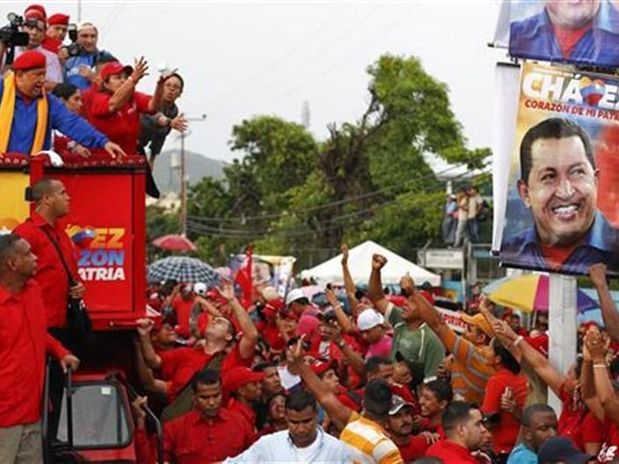
chavez 300x200 Venezuela poll shows tight race for Chavez

Courtesy of: Reuters / Carlos Garcia Rawlins

A new poll shows Venezuelan President Hugo Chavez only slightly ahead of challenger Henrique Capriles in the October 7 presidential election, welcome news for the opposition following numerous surveys showing Chavez with a wide lead.

The leftist former soldier is seeking re-election for a third term to extend his self-styled socialist revolution, and he has boosted his public appearances as his health seems to be recovering from a cancer diagnosed last year.

Capriles is seeking to tap into pent-up frustration among the OPEC nation’s voters who are weary of high crime, soaring prices and a continuing wave of nationalizations.

Respected pollster Consultores 21 said its most recent survey shows Chavez holding a 3.4 percentage point lead over Capriles in contrast to the double-digit lead that other public opinion groups have given Chavez in recent surveys.

The news highlights the frequent disparities among the polls in Venezuela, where public opinion researchers are often thrust to the center of the country’s polarized politics and face constant accusations of favoring one side or the other.

Consultores 21 President Luis Christiansen told Reuters the firm’s June survey showed 47.9 percent of voters intend to vote for Chavez compared with 44.5 percent for Capriles.

The poll has a margin of error of 2.4 percentage points and was carried out between June 2 and June 12, he said.

Reuters did not have access to the full poll, which was released only to Consultores 21 clients.

The results were largely in line with the firm’s March poll, which showed Chavez with 46.3 percent and Capriles at 44.8 percent. Though Chavez edged up slightly from that poll, the increase is within the margin of error.

Chavez is set to officially launch his candidacy on Sunday with rallies around the country. Earlier this month he brought hundreds of thousands of supporters into the center of Caracas to officially register his candidacy.

DIVERGENT POLLS

Capriles, who is also boosting his public appearances after a months-long “house-by-house tour” through Venezuela meant to win over supporters, has shrugged off negative poll readings and mocked pollsters as government lackeys.

“If you want to get into a booming business right now, do a poll, say the government is ahead, and you’ll see the money flowing in,” Capriles said during a press conference this week.

He has burnished his image of physical fitness during Chavez’s months of convalescence. He walked and jogged 10 km (6.2 miles) to register his own candidacy in the company of hundreds of thousands of supporters.

The last survey by pollster Datanalisis, which is also widely respected, showed Chavez with a 15.9 percentage point lead over Capriles.

Analysts have said part of the reason for the discrepancy between the Datanalisis and Consultores 21 figures is that the former indicates 28.7 percent of voters are undecided – a surprisingly high figure given the country’s polarized politics.

The Consultores 21 poll numbers suggest that a maximum of only 7.5 percent of the country’s voters are undecided.

Government leaders were quick to interpret the poll as beneficial to Chavez.

“It’s significant that that particular pollster, which is so linked to (the opposition), has joined other pollsters that consistently show the patriotic candidate as the favorite,” said Information Minister Andres Izarra, referring to Chavez by a catch-phrase frequently used by party members.

Polls are historically controversial in Venezuela. One opposition exit poll in a 2004 recall referendum showed Chavez losing by around 20 percentage points – almost the exact opposite of the result later certified by electoral authorities.

(Additional reporting by Andrew Cawthorne; Editing by Anthony Boadle)

To read this article on Reuters, please click here.