Jun
18
2013
Posted by
admin
Comments

ICYMI: Breast-feeding is best, so ban bottles, Venezuelan lawmaker proposes

CNN
June 18, 2013
By Catherine E. Shoichet

population e1371580976192 ICYMI: Breast feeding is best, so ban bottles, Venezuelan lawmaker proposes

Courtesy of: Reuters

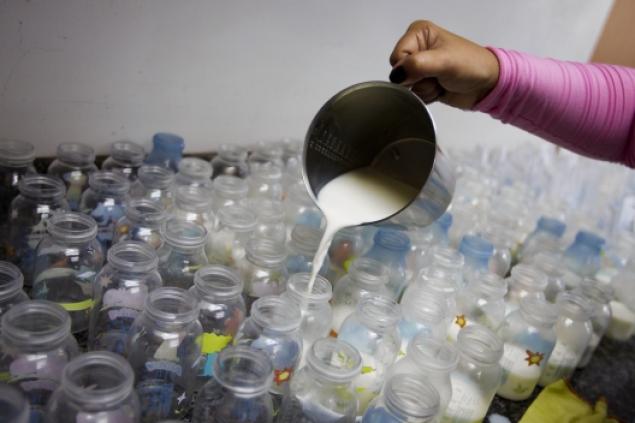
Venezuelan lawmakers are weighing whether to ban the use of baby bottles as part of a push to promote breast-feeding, state media reported.

The proposed measure will be up for debate in the South American country’s National Assembly on Tuesday, lawmaker Odalis Monzon said in an interview with state-run VTV.

“Every baby has the right to breast-feeding,” said Monzon, a lawmaker from the ruling United Socialist Party of Venezuela.

In addition to banning bottle-feeding, the proposed revisions to Venezuela’s Law of Promotion and Protection of Breastfeeding also include plans to penalize those who advertise baby formula, she said.

Transnational companies that market formula, she said, have interfered with a crucial bond between mother and child.

“The most important is the love, the connection between mother and child, that sometimes is lost because they do not give them the warmth that nursing a baby provides,” Monzon told VTV.

The proposal includes exceptions for mothers who cannot breast-feed due to illness, Monzon said. It would also provide for the creation of more breast-milk banks and require companies to set aside space for mothers to nurse.

She did not provide details about how authorities would enforce the measure if it passes, or what sorts of punishments violators would face.

The measure has drawn sharp criticism from some lawmakers, who argue that the government can promote breast-feeding without prohibiting anything, CNN affiliate Globovision reported.

“This is unacceptable and alarming,” said Eduardo Marin, a lawmaker for the opposition Justice First party.

The 2007 law that Monzon is pushing to amend was aimed at promoting breast-feeding, Marin said, not “questioning, stigmatizing and practically criminalizing those who have opted for (other methods) of feeding.”

Earlier this month, Venezuela’s Health Ministry said that 27.1% of mothers in the country who are able to breast-feed actually do so and that officials aimed to increase that number to 70% by 2019,VTV reported.

To read this article at CNN, please click here.

 
Jun
11
2013
Posted by
admin
Comments

ICYMI: Looking for toilet paper in Venezuela? There’s an app for that

Financial Times
June 10, 2013
By Benedict Mander

venezuela toilet paper reuters 1200 ICYMI: Looking for toilet paper in Venezuela? There’s an app for that

Courtesy of: Reuters

It turns out that President Nicolas Maduro thinks that the plan to introduce food rationing in Zulia, Venezuela’s most populous state, is “crazy”.

Regardless of whether he always thought that, or whether, perhaps, the increasingly unpopular president was responding to widespread rejection of the plan, he’s right – it is not the way to put an end to the problem of shortages that has become so acute that someone has even invented an app to help Venezuelans locate specific goods they are having difficulty finding.

Maduro was also right when he said that “the answer to our problems is to produce more”.

Let’s just forget for the moment that in saying this he was rather undermining the Zulia governor, Francisco Arias Cardenas, who had denied that the scheme even amounted to rationing in the first place, and that in fact it was aimed at preventing smuggling (if you wanted to do something about that, you probably wouldn’t produce more, but instead perhaps try and do something about the irresistible arbitrage opportunities in Colombia thanks to Venezuela’s price controls, or at the very least introduce stronger controls on the border).

Let’s also ignore the fact that the government has already put in place another rationing scheme in Zulia, for petrol, which by Maduro’s logic ought probably be pretty “crazy” too. Again, officials insist the idea is to prevent gasoline contraband, which is indeed rife in Zulia since it is magnificently profitable – some suggest it is an even bigger business in Venezuela than the cocaine trade.

In any case, increased production would certainly go a long way to solving Venezuela’s shortages problem. Ideally it would be an increase in the production of the goods that are scarce, especially food, but increased oil production might do too, as crude exports could provide the dollars needed to import more. This would probably be more practical in the shorter term, given the problems Venezuela has producing just about anything that is not oil (although that is not to say state oil company PDVSA does not have serious challenges of its own).

The problem is that, in the current conditions, Venezuelan businesses are unlikely to start producing much more. In order for this to happen, a lot needs to change: for starters, the business climate must improve, and that includes doing something about price and currency controls, something which Maduro has shown no signs of doing. And don’t expect state companies to pick up the slack – the government is even said to have seriously considered the offer of Venezuela’s largest private company, Polar, to help run underperforming state-owned food processing plants.

The app that aims to help Venezuela’s long-suffering shoppers, known as Abasteceme (or Supply Me) and which uses Google Maps and “crowdsourcing” to enable users to notify one another where a certain product is for sale, has so far only been downloaded 12,000 times. It is a scheme that promises to be infinitely more successful than Zulia’s still-born rationing plans.

To read this article at Financial Times, please click here.

 
Jun
7
2013
Posted by
admin
Comments

In Case You Missed It… Articles Roundup Week of 6/7/13

jaua kerry.jpg.520.360.thumb  e1370640648452 In Case You Missed It… Articles Roundup Week of 6/7/13

Courtesy of: Associated Press

This week: Venezuela’s economy slows sharply in the first quarter, signaling a difficult year for the already struggling nation; in a clear sign that food shortages are worsening, restrictions on the sale of 20 basic goods are set to begin next week in Venezuela’s most populous state; Telefonica plans to boost spending in Venezuela to avoid sitting on cash that may lose a third of its value if a second currency devaluation occurs this year; Venezuela’s inflation hits a record monthly high of 6.1 percent in May, taking its annualized rate to a startling 35.2 percent; meanwhile, pressure mounts on the government to accelerate the approval of foreign currency. After months of tensions, U.S. Secretary of State John Kerry meets with Venezuelan foreign minister Elías Jaua during an OAS meeting; U.S. filmmaker Timothy Trace, who had been arrested earlier this year, is released and expelled from the country; Venezuela’s opposition hits the diplomatic road, traveling abroad to pressure the government following April’s disputed election; and the sale of Venezuela’s largest private media group reignites concerns that the government is attempting to silence the press, masking falling popular support and deteriorating economy. The number of cases submitted to the ICC because of arbitrary arrests and power abuses in Venezuela amount to 194; Venezuelan attorney rejects international allegations of torture by the Maduro government; and Venezuela’s opposition says it will submit records of 180,125 dead people that remain eligible to vote.

Venezuela’s economy slows sharply as ‘stagflation’ looms, Reuters

Venezuela’s economy slowed sharply in the first quarter, the central bank said on Friday, auguring a difficult year for the OPEC nation that is already struggling with galloping inflation and shortages of basic consumer goods.

Rationing of 20 products to begin in Venezuelan state next week, Associated Press

In a sign Venezuela’s food shortages could be worsening, restrictions on the sale of 20 basic items including toilet paper and chicken subject to price controls are set to begin next week in its most populous state, officials said Tuesday.

Telefonica Said to Plan for Another Venezuela Devaluation, Bloomberg

Telefonica SA (TEF) plans to boost spending in Venezuela to avoid sitting on cash that may lose a third of its value as speculation mounts that the government may devalue the bolivar for a second time this year, according to a person familiar with the matter.

Venezuela inflation soars to record monthly high 6.1 pct, Reuters

Venezuela’s inflation hit a record monthly high of 6.1 percent in May, compounding new President Nicolas Maduro’s economic headaches less than two months after taking office in the OPEC member country.

Toilet Paper-Less Venezuela Fueling Bond Sale Talk: Andes Credit, Bloomberg

Venezuelan Finance Minister Nelson Merentes is planning the nation’s first overseas meetings with creditors in nine years as a scarcity of dollars exacerbates shortages of everything from toilet paper to soap.

Kerry Meets With Official of Venezuela to Set Talks, New York Times

After months of tensions between the United States and Venezuela, Secretary of State John Kerry met on Wednesday with the Venezuelan foreign minister, Elías Jaua, in Antigua, Guatemala, and announced the start of talks aimed at improving relations between the two countries.

Venezuela frees, expels U.S. filmmaker, CNN

A U.S. filmmaker arrested in Venezuela and accused of instigating unrest was released from prison and expelled from the country, his attorney told CNN affiliate Globovisión.

Venezuela’s opposition hits the diplomatic road, Foreign Policy

Last week, Venezuelan opposition leader Henrique Capriles made his first trip abroad following last April’s disputed election.

Fears for Venezuela press freedom as critic is silenced, Financial Times

The sale of Venezuela’s largest private media group has reignited concerns that the government is attempting to muzzle the press to mask falling popular support amid a deteriorating economy and widespread shortages.

Demonstration is now considered a crime, El Universal

A total number of 194 cases of youngsters and minors who were arbitrarily detained and abused or tortured by state police officers and para-police groups, have been substantiated and submitted by the team of lawyers grouped in the Venezuelan Criminal Forum to the International Criminal Court based in The Hague.

Attorney General rejects international complaints against Venezuela, El Universal

Venezuelan Attorney General Luisa Ortega Díaz stated on Thursday that the Venezuelan State has acted promptly in specific cases related to violation of human rights.

Opposition introduces register of voters including 180,125 dead, El Universal

Experts from the opposition Unified Democratic Panel (MUD) plan to submit this week to the National Electoral Council (CNE) data of 180,125 dead people that remain enabled to vote.