Apr
29
2013
Posted by
admin
Comments

ICYMI: US Filmmaker Held in Venezuela Sought to Show Political Divide, Friends Say

The New York Times
April 26, 2013
By María Eugenia Díaz and William Neuman
venezuela popup e1367259291482 ICYMI: US Filmmaker Held in Venezuela Sought to Show Political Divide, Friends Say

Courtesy of: Associated Press

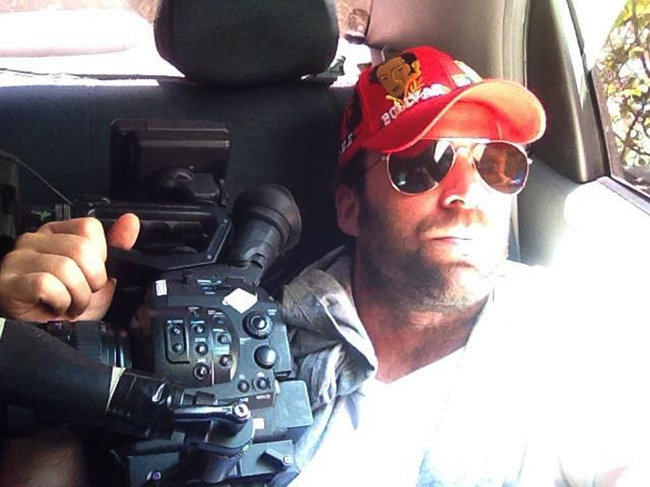
CARACAS, Venezuela — Just a few weeks ago, Tim Tracy spoke of his time shooting a documentary in Venezuela as a rollicking adventure and a filmmaker’s dream. Now he is under arrest, accused by the Venezuelan government of a different kind of adventure: taking part in what officials here said was a plot to destabilize the country and incite a civil war.

The government said Friday that Mr. Tracy, an American citizen, would be charged with involvement in acts of violence after the April 14 presidential election. Mr. Tracy was arrested by the intelligence police on Wednesday at the international airport near Caracas as he was about to leave the country, the government said.

Mr. Tracy was originally identified in a report released by Venezuela’s Information Ministry as Timothy Hallett. Hallett is his middle name.

Interior Minister Miguel Rodríguez said Thursday that Mr. Tracy had training as a spy and was part of a conspiracy to set off a civil war.

But those who knew Mr. Tracy in Caracas and in the United States, including in Los Angeles, where he lived, described him as an innocent — or perhaps naïve — filmmaker who had sought to portray Venezuela’s bitter political divide, not take sides in it.

Mr. Tracy spent time with both opposition student protesters and hard-core supporters of former President Hugo Chávez “to show the two sides of the story he was filming,” said Tuki Jencquel, a Venezuelan filmmaker who became friends with Mr. Tracy.

“He always seemed to be very evenhanded in his work and neutral in relation to what was happening in Venezuela,” he said. “I don’t think there’s anything subversive about that.”

In a conversation with a New York Times reporter about a week after the March 5 death of Mr. Chávez, Mr. Tracy spoke enthusiastically about the months he had spent working on his film.

And he described himself as one of the most unlikely people to do so: an American with rudimentary Spanish who started out with virtually no knowledge of Venezuela or its politics. He seemed like a man on a lark.

Mr. Tracy said that he had made friends in one of the most pro-Chávez slums in Caracas, an area known as 23 de Enero, and in particular with a man who appeared often at rallies dressed up as the revolutionary Ché Guevara. He marveled at how he had won the man’s confidence, despite the government’s anti-American stance.

But he also sounded a note of concern, saying that the ersatz Ché stopped talking to him after Mr. Chávez’s death. The government expelled two military attachés from the American Embassy on the day Mr. Chávez died, claiming that they were trying to destabilize the country. Mr. Tracy said he wondered if the man had taken the government propaganda to heart and regretted their friendship.

He said he had also filmed opponents of the government, but he seemed most enthusiastic about his ability to break through the apparent barriers and get close to Chávez loyalists.

Mr. Jencquel said that Mr. Tracy had been detained twice before for filming, once at a Chávez rally and once at the presidential palace in Caracas. On Friday, after being allowed to visit Mr. Tracy, Mr. Jencquel said his friend told him he was innocent.

Mr. Tracy, 35, identified himself on LinkedIn, a professional networking Web site, as a director and producer who had been involved in a television series that appeared on the History Channel and a movie. He attended Georgetown University.

Mr. Rodríguez, the interior minister, said that Mr. Tracy had funneled money to student protesters who the government claimed were connected to postelection violence.

But student groups said on Friday that they had not received money from Mr. Tracy, and they denied involvement in violence. “It seems to me like a big farce on the part of the government to distract attention,” said Gaby Arellano, 26, who has taken part in the protests. She said that Mr. Tracy had interviewed her about her reasons for protesting.

Tensions in Venezuela have increased in the wake of the election, which Nicolás Maduro, Mr. Chávez’s heir, won by less than 2 percent. His opponent, Henrique Capriles Radonski, claims that Mr. Maduro stole the election, and he has demanded a recount.

After the election, Mr. Capriles urged his supporters to protest by marching in the streets and banging pots at home at night.

The government responded by claiming that Mr. Capriles was seeking to foment violence. It pointed to several people who were killed the day after the election, saying they were Maduro supporters murdered by members of the opposition.

But it has provided little hard evidence to back up the claims that the deaths were politically motivated. In one case, the father of a man who was shot dead said that his son was killed while taking part in a protest against Mr. Maduro’s victory, contradicting the government’s account.

It is typical of the government here to sometimes make wild claims about conspiracies without providing evidence. During the campaign, Mr. Maduro repeatedly warned of plots to kill him, and he said that foreign agents were entering the country to undermine the government.

In all of this, Mr. Maduro is sticking to the playbook of Mr. Chávez, who regularly warned of threats from the United States or suspected homegrown traitors.

Mr. Maduro has sent mixed signals in recent weeks about whether he hopes to improve his country’s rocky relationship with the United States, which is a major buyer of Venezuelan oil.

“We hope that many of these conspiracies and interventions by sectors of the C.I.A. and the Pentagon can finally be put behind us and we can have a relation with President Obama based on respect,” he said Thursday.

Patrick Ventrell, a State Department spokesman, said Friday that Mr. Tracy had no ties to any government agency. “The U.S. continues to categorically reject any allegations of U.S. government efforts to destabilize the Venezuelan government,” Mr. Ventrell said.

In a statement released Friday, Mr. Tracy’s parents said, “We believe a mistake has been made with the detention of our son Timothy by the Venezuelan authorities.”

To read this article at The New York Times, please click here.
 
Mar
4
2013
Posted by
admin
Comments

In Chávez’s Absence, the Government Seeks to Dissipate Opposition with Fear

iX2qiGY5WWjk e1362422860756 In Chávez’s Absence, the Government Seeks to Dissipate Opposition with Fear

Courtesy of: Agence France Presse

As is well documented, the Venezuelan government’s record on human rights has been substandard at best. For years, human rights watchdogs have criticized the government for consolidating power in the executive branch and using that power to intimidate, censor and prosecute those who criticize the president or his regime. During Hugo Chávez’s prolonged absence, these problems have only gotten worse.

Fears that Chávez’s declining health will force a new presidential election in the coming months has the United Socialist Party of Venezuela (PSUV) party concerned. Both of Chávez’s likeliest successors lack the charisma and deep popular support the president enjoys, prompting many within the government to wonder whether the movement will survive without its strong leader. A slumping economy has further exposed the government’s failures, and the PSUV has continually sought to change the subject.

Knowing of this – and of the PSUV’s penchant for strongman tactics – it is hardly surprising that there has been significant harassment of Venezuela’s opposition in the past month.

For example, the government has stepped up accusations that three opposition lawmakers were involved in corruption, in a clear attempt to demoralize, fracture and damage the reputation of the opposition. Leaders of the ruling PSUV have threatened to jail those involved and have pledged to pursue further investigations into the alleged financial irregularities.

The attacks weren’t limited to these lesser known lawmakers. Just this week, Chávez’s chosen successor, Vice President Nicolás Maduro, launched a scathing assault on the opposition’s charismatic leader, Henrique Capriles. Capriles was in the United States visiting his sister and her family, who live in New York. Maduro alleged – without any evidence – that Capriles himself owns a lavish high-rise in New York City, and accused Capriles of engaging with Venezuelan expatriates in a plot to destabilize the country. He boasted to a friendly audience that he was “tracking the movements” of Capriles. Capriles called the accusations false, and suggested that Maduro was trying to distract Venezuelans from the damage wrought by a currency devaluation, rampant violence and escalating shortages – not to mention the continuing secrecy surrounding Chávez’s battle with cancer.

“It seems ridiculous to me, with all the problems that there are in Venezuela, that this is what the government is talking about,” Capriles told the New York Times.

Last week, Venezuelan prosecutors brought influence peddling charges against Leopoldo López, a prominent opposition leader, economist and former mayor of the Chacao Municipality of Caracas. He is accused of accepting donations from Venezuela’s state-run oil company in 1998, donations that were purportedly authorized by his mother, Antonietta Mendoza de Lopez, who was a PDVSA administrative employee at the time. Government officials allege the funds were used to form the now popular First Justice Party. Arguing the charges are politically motivated, López denies any wrongdoing.

Of course, if it’s corruption they are after, the PSUV need look no further than itself: under their rule, Venezuela is considered the most corrupt nation in Latin America by Transparency International.

According to Luis Vicente León, analyst and head of the renowned Datanálisis polling firm, the point of these measures is to make the country believe there is a strong government in place despite Chávez’s absence. He expects a series of symbolic actions against key players of the opposition, to instill fear in society and dissuade others from speaking out against Chavismo.

Attacks against the media have become a clear example of this intimidation strategy. Globovisión, the last television network in Venezuela openly critical of the government, was not among the list of stations to be included when the country transitions to a new digital TV signal. The decision will likely drive the station off the air at that time. The government has refused to offer an explanation for the exclusion. Similarly, the website analisis24.com and its Twitter account have been blocked in Venezuela after publishing a series of pictures of Chávez and his daughters in Cuba.

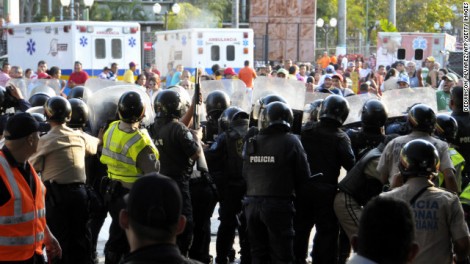
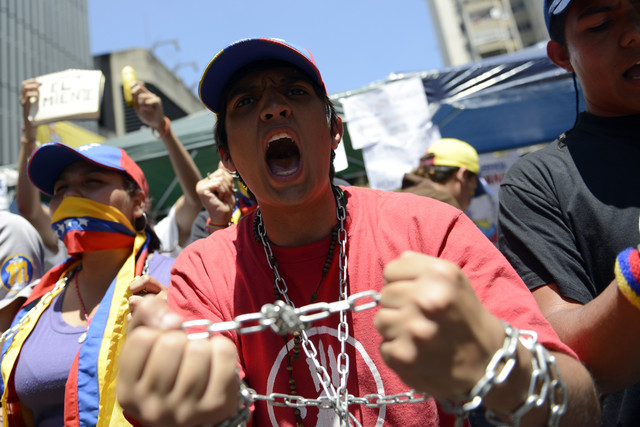
Most troubling thus far, however, were the attacks against students during a peaceful demonstration. Frustrated after not hearing from President Chávez for 80 days, about 120 students gathered in front of the Executive Directorate of the Judiciary to demand answers from the government about the true health of their president. They were received instead by members of the military, who wielded ​​ batons and fired pellets, injuring four of them. Once again, the government has offered no justification for these attacks on its own citizens.

Though there has been no word on whether Chávez will ever return to power, it is clear that the regime fears the uncertainty that would follow if he passes. After 14 years under the strong leadership of Hugo Chávez, PSUV faces the difficult task of convincing Venezuela it is capable of governing without him. The dire economic situation in the country shows that they have much to prove on that front. Yet thus far, fear, intimidation and the suppression of free speech appear to be their only solutions.

 
Jan
30
2013
Posted by
admin
Comments

Venezuela’s Deadliest Prison Riot Provokes Outrage

130126021907 venezuela prison riot story top1 e1359577489113 Venezuela’s Deadliest Prison Riot Provokes Outrage

Courtesy of: CNN

Conditions in Venezuelan prisons have long been known as dangerous and ruthless, among the worst in the hemisphere. But this weekend, in one of the deadliest prison clashes in the nation’s history, the world found out just how mismanaged Venezuela’s prison system really is. According to medical officials, 61 people were killed and 120 injured after violence erupted at the Uribana prison complex, located near the city of Barquisimeto in northwest Venezuela.

The fighting began early Friday morning after troops entered the complex to search for and confiscate illegal weapons. Just two hours into the incursion, the well-armed inmates mounted a resistance; refusing to allow officials to enter the wards. Chaos quickly followed. Venezuelan Penitentiary Service Minister Iris Varela announced the closure of the jail, but it was not until Sunday – two full days later – that authorities finished removing inmates and relocating them among 19 penitentiaries throughout the country. In the meantime, relatives of inmates were left desperately awaiting information from authorities.

Inaugurated in 1999, during Hugo Chávez’s first year in office, Uribana is Venezuela’s largest prison. At that time, the facility was held up as the model of a modern Venezuelan prison. The notion quickly faded, however, as the complex fast became an exemplar of Venezuela’s egregiously overcrowded and poorly-supervised prison system. Minister Varela even admitted on Sunday that 2,459 inmates resided in the prison, in a space built for only 850.

The Uribana tragedy has sparked outrage among human rights watchdogs. The United Nations High Commissioner for Human Rights (UNHCHR) called for a “prompt investigation” to identify those accountable and compensate the relatives of the victims. Direct blame has fallen on Varela, who has failed to make any real progress in curbing violence or reducing the rampant overcrowding of the nation’s prisons.

Already, the Venezuelan government’s response to the tragedy is fraught with political favoritism. Only members of Chávez’s party were allowed to participate in the National Assembly subcommittee charged with investigating the riot. Opposition parties, who have been denied input into the process, have called for the resignation of Varela. Vice President and acting president Nicolás Maduro gave the minister his full support. The ailing Chávez, ensconced in Cuba for nearly two months, remains completely silent on the issue.

Violence in Venezuelan prisons – particularly among rival gangs – has become essentially routine. Overcrowding is at epidemic levels, as thirty-three jails, originally built for 12,000 inmates, now house nearly 47,000 people. Weapons including guns and knives are common and widespread in these prisons, while guards remain absent or ineffectual, allowing lucrative illegal activities to take place. The 61 Venezuelans who died this weekend were hardly the first fatalities of Venezuela’s growing prison crisis. NGOs and human rights watchdogs reported that 560 people were killed in Venezuelan prisons in 2011. According to a Venezuelan rights group, more than 300 people were killed in 2012 as well, including the 25 Venezuelans killed during the highly-publicized standoff at the El Yare I prison facility. So far, however, the government’s response has been marred by political patronage, making it unlikely that the crisis will soon stop.