Aug
12
2013
Posted by
admin
Comments

ICYMI: Venezuela Opposition Comes Under Siege

Wall Street Journal
August 9, 2013
By José de Córdoba and Ezequiel Minaya
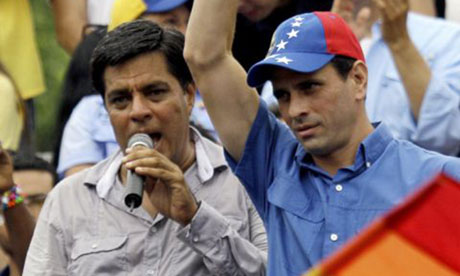
Oscar Lopez left adviser 010 ICYMI: Venezuela Opposition Comes Under Siege

Courtesy of: Associated Press

CARACAS—Venezuela’s President Nicolás Maduro, the political heir to late populist Hugo Chávez, is ratcheting up intimidation of his political foes as his government prepares for key municipal elections amid a deteriorating economy.

Oscar López, a senior aide to former opposition presidential candidate Henrique Capriles, was in hiding Friday after a government legislator said a warrant had been issued for the aide’s arrest. Days earlier, the apartment of Mr. López, Mr. Capriles’s chief of staff, was searched by military-intelligence agents, according to opposition officials.

“He doesn’t know what this circus is all about so he is taking care of himself” by going into hiding, said Julio Borges, a legislator and national coordinator of Venezuela’s leading opposition party, Justice First.

Mr. Capriles himself faces possible arrest after the Supreme Court on Wednesday rejected his challenge to Venezuela’s April presidential election, which Mr. Maduro won by a sliver but which was marred by allegations of fraud. The court went on to fine Mr. Capriles $1,700 for what it said was a “disrespectful” filing and said the opposition leader should be prosecuted for trying to undermine the election.

“It’s a way to attack Henrique and his movement,” Mr. Borges said.

A senior U.S. official said Washington is worried about developments in Venezuela. “The Venezuelan government is increasingly taking legal actions against the opposition, a development the United States finds profoundly worrying,” the official said. The wave of actions against opposition leaders like Mr. Capriles “raises legitimate and urgent concerns,” the official said.

Venezuela’s Attorney General’s Office declined to comment as did Venezuela’s Information Ministry.

Venezuelans go to the polls in December to contest some 335 mayors’ posts throughout the country, as well as hundreds of other local offices. The elections will be the first gauge of Mr. Maduro’s popularity since his win in April’s election.

In the run-up to the vote, Venezuela’s economy has shown signs of increasing stress after years of ramped-up public spending under Mr. Chávez, who died in March. The country’s inflation is north of 42%, common consumer goods like toilet paper are scarce, and despite high oil prices, Venezuela just defaulted on the payment of a $100 million bond of a nationalized steel company, spooking bond buyers. Divisions in the Chavista movement, nominally led by Mr. Maduro, are deep.

“This is clearly a wounded government as far as its mandate and its internal dynamics. And like any wounded animal, it can be dangerous. It is taking very severe steps to consolidate power,” said Christopher Sabatini, senior director of policy at the Americas Society and Council of the Americas.

Also this week, authorities jailed and froze the assets of the editor of a small independent paper and website, Leocenis García of Sexto Poder, who has published detailed reports of alleged government corruption. On Thursday, a judge fined two opposition newspapers—including El Nacional, the country’s most influential daily—1% of their 2009 income for showing a photograph of deteriorated conditions in a morgue. The judge said showing the photo was harmful to the welfare of children.

In Caracas, Juan Carlos Zapata, an author and political analyst, said the escalating repression shows a clear government intention to frighten the opposition. “They want to dismantle the opposition, they want Capriles’s aides to flee the country, and for Capriles to throw in the towel before elections,” said Mr. Zapata. “It’s an orchestrated plan to scare off the opposition.”

The Maduro government has said that it is simply rooting out corruption, regardless of political affiliation. Soon after taking office, Mr. Maduro launched an antigraft initiative that has resulted in the arrest of a handful of mid-level state officials.

The latest government moves follow last week’s stripping of parliamentary immunity by government deputies of a popular opposition congressman, by less than the constitutionally required two-thirds majority. Richard Mardo, who has built up a large following in the Chavista state of Aragua, now must face charges of alleged corruption.

Legal moves by the government against its foes are common in Venezuela. A study by Human Rights Watch found that as of May 2012, Venezuela’s Comptroller General’s Office had temporarily disqualified some 800 people, most of them Chávez foes, from running for office due to accusations of corruption—even though charges hadn’t been filed against them. About 300 people are still barred from running for office.

During his time in office Mr. Chavez routinely brushed aside international criticism as attempts to meddle with domestic affairs and plots to topple his government.

Meanwhile, the opposition is struggling to get out its message to ordinary Venezuelans. Globovisión, once a feisty opposition TV channel—and the only one that gave Mr. Capriles significant airtime—was sold earlier this year, and its coverage of Mr. Capriles has fallen sharply. News about Mr. Capriles is now relegated to a recently opened Web channel dubbed “Capriles TV.” Mr. Borges said that the opposition would have to work hard to get its message out by taking a “grass-roots” approach.

Opposition figures as well as analysts say the repressive wave points to the deep divisions in Mr. Chávez’s movement following his death. “Chávez was a kind of crazy glue that was able to keep different elements together,” says Mr. Borges.

Mr. Borges sees different power groups within the government fighting for influence and control. Within these groups are groups of powerful businessmen and executives who control different sectors of the economy such as the state oil industry, food imports, and the country’s other basic industries. “There are no institutions anymore, just different clans balancing each other,” Mr. Borges said. “Maduro is not president of the country, he is the boss of one of these groups.”

Analysts foresee a difficult time ahead for Venezuela. “It’s a disaster in the making because nobody is in charge,” says Riordan Roett, the head of Latin American studies at Johns Hopkins University.

Many analysts believe the most powerful faction is led by Diosdado Cabello, the president of the National Assembly. Mr. Cabello, a burly and bull-necked former army lieutenant who took part in Mr. Chávez’s failed 1992 coup, has close ties to the country’s armed forces and has reportedly built up a considerable personal fortune.

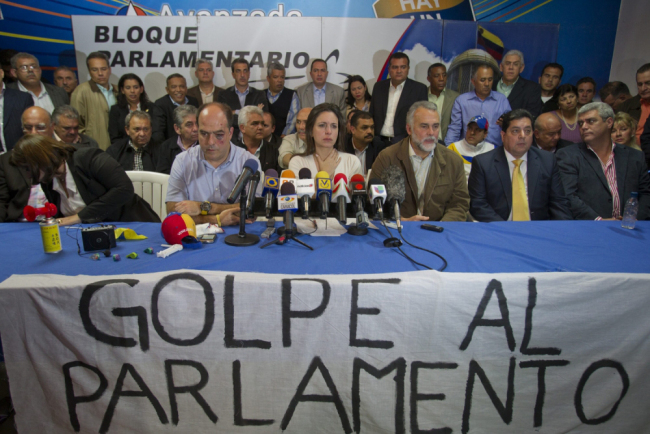
In late April, Mr. Cabello presided over the congress as a number of opposition legislators were beaten in the congressional chamber. At the time, Mr. Cabello didn’t allow opposition deputies to take the floor to speak until they recognized Mr. Maduro’s victory. Mr. Cabello has ruled the chamber with an iron fist ever since.

Javier Corrales, an expert on Venezuelan politics at Amherst College says that while Mr. Maduro has shown some signs of moderation—such as meeting with top businessmen, Mr. Cabello is openly confrontational. “This crackdown seems to come from Diosdado,” he said. “His instinct appears to be brute force.”

Mr. Cabello couldn’t be reached to comment.

To read this article at the Wall Street Journal, please click here.

 
May
8
2013
Posted by
admin
Comments

Nicolás Maduro off to an inauspicious start as Venezuela’s dubiously-elected president

Nicolas Maduro e1368042661461 Nicolás Maduro off to an inauspicious start as Venezuela’s dubiously elected president

Courtesy of: Agence France Presse

Almost immediately after Venezuela’s partisan electoral authority declared Nicolás Maduro the winner of last month’s presidential election, he and his ruling PSUV party faced a choice that may yet define Venezuela’s future for years to come. Reports of thousands of irregularities in the voting process, including suspicions of fraud, sparked fears about the election’s legitimacy. The actions of Maduro – who first consented to the opposition’s calls for a full and transparent recount, later issued a hasty retraction, and then began a crackdown on peaceful opposition protestors – has only deepened those fears.

Maduro’s desperation is perhaps well-founded: a poll today found that a majority of Venezuelans believe the country is on the wrong track and, if given the chance, most would now choose Henrique Capriles for president over Maduro. The uncertainty and repression surrounding the Venezuelan election has grown so egregious that President Obama has abstained from recognizing Maduro as the winner. The President observed that the “entire hemisphere has been watching the violence, the protests, the crackdowns on the opposition.” ABC reports:

President Barack Obama avoided recognizing the government of Venezuela during an interview with Univision, explaining that he was concerned about recent “crackdowns” against members of the Venezuelan opposition. He also said that recent reports suggest that basic principles of democracy and human rights are not being fully observed by Venezuela’s government.

Obama and the U.S. State Department are among a growing chorus calling for a full and transparent recount of the Venezuelan election, a chorus that now includes the Organization of American States, former Colombian president Alvaro Uribe, and internationally-respected human rights watchdog groups. Though Maduro may lack Hugo Chávez’s charisma and support among Venezuelans, he evinces the same contempt for the international community.  That contempt, combined with Maduro’s increasingly flagrant repression of his own people, mean that recent weeks for Venezuela have been turbulent indeed.

It’s hard to deny that Maduro’s “election” lacks legitimacy, before the eyes of both Venezuelans and the world. The partial audit the government agreed to is viewed as little more than a public relations gesture, and hardly sufficient to investigate the serious voting irregularities that led many to wonder whether Capriles was the election’s true winner.

As those doubts grow, Maduro has flexed the government’s authoritarian muscle to stifle dissent and cow the opposition into obedience. The state-run media – which recently tightened its grip on the airwaves by purchasing the previously-independent TV station Globovision – has dutifully propagandized on behalf of Maduro; the government recently severed the video feed of a Capriles speech, preventing the opposition leader from making his case to Venezuelans.

Such tactics haven’t prevented the opposition from making their voice heard. The din of “Cacerola” protests resounds throughout the country. Capriles has filed an official protest with the country’s Supreme Court which, comprised of Maduro’s political allies, is unlikely to intervene. Maduro and the PSUV have met these peaceful expressions of dissent, however, with strongman tactics. Capriles called off an opposition March after the government issued a veiled-threat of violence against the protestors. Opposition lawmakers have been barred from speaking in the National Assembly. And a bloody brawl in the National Assembly injured 17 opposition lawmakers. Now the government has intimated it may throw Capriles in jail.

Such tactics, though they fly in the face of democracy and human rights, at least demonstrate that Maduro is feeling the pressure. The Economist opined after the election that “without Chávez at the helm, chavismo, a noxious cocktail of populism, incompetence and repression, is a far less potent force.” Nicolas Maduro cannot strong-arm his way to legitimacy. But that hasn’t stopped him trying.

 
May
3
2013
Posted by
admin
Comments

In Case You Missed It… Articles Roundup Week of 5/03/13

ay 108972837 e1367612866751 In Case You Missed It… Articles Roundup Week of 5/03/13

Courtesy of: EPA

This week: Venezuela stumbles deeper into political chaos after a bloody brawl in Congress; Venezuela’s opposition asks for an investigation into the brawl on the floor of Congress that injured several of its lawmakers and caused at least one of them to undergo surgery; Venezuela’s government charges a US filmmaker for allegedly trying to incite anti-government violence and charges an ex-general for being critical of president Nicolás Maduro; and Maduro visits Cuba to meet with former leader Fidel Castro and re-pledge Venezuela’s allegiance to the island. The government begins a partial audit of the disputed election, though the opposition rejects the move as insufficient; unable to force a sweeping review of the disputed election, Venezuelan opposition supporters march on International Workers Day; opposition leader Henrique Capriles files a lawsuit in Venezuela’s Supreme Court to overturn the election, alleging fraud in the counting of ballots and voter intimidation; and Venezuelans become increasingly upset with daily power outages, growing food scarcities and a general fear of the government. Venezuelan debt remains severe as tensions continue to rise; homicides in Venezuela reach a record high in 2013, as nearly 58 are killed per day during the first four months of the year, highlighting a dire security situation amid political instability; and the sale of Globovisión, Venezuela’s sole television station critical of the government, hurts free speech in Venezuela even further.

Political Chaos Grips Venezuela After Legislative Brawl and Rival Marches, The New York Times

Venezuela stumbled deeper into political chaos this week as legislators brawled in the National Assembly and government supporters and opponents took to the streets for rival marches amid continuing tensions over the narrow election victory of President Nicolás Maduro.

Venezuela Opposition Wants Probe of Violence, The Associated Press

Venezuela’s opposition on Thursday asked prosecutors to investigate a brawl on the floor of congress that injured several of its lawmakers and forced at least one of them to undergo surgery.

Venezuela Charges U.S. Filmmaker, Arrests Ex-General, The Wall Street Journal

Venezuelan authorities brought criminal charges over the weekend against a U.S. filmmaker for allegedly trying to foment antigovernment violence, and arrested a retired Army general who has become a vocal critic of the government.

Venezuela’s New Leader Visits Cuba, Meets With Castro, The Wall Street Journal

Nicolás Maduro met with former Cuban President Fidel Castro in Havana on Saturday, an indication Venezuela’s new president will maintain the same close relations with the Communist island nation as that of his predecessor Hugo Chávez, who died last month after a battle with cancer.

Contentious Venezuela vote audit begins, AFP

Venezuela began a partial audit of the disputed election won by the late Hugo Chavez’s handpicked successor, as the opposition rejected the move as insufficient.

Venezuelan opposition protests vote, The Washington Post

Unable to force a sweeping review of last month’s disputed presidential election, opposition supporters marched in the streets Wednesday to demonstrate their fury at the ruling party’s efforts to blunt a recount.

Venezuelan Opposition Sues to Overturn Election, The Wall Street Journal

Venezuela opposition leader Henrique Capriles filed a lawsuit Thursday with the Supreme Court that seeks to overturn April’s presidential election, alleging fraud in the counting of ballots and pre-election voter intimidation.

Venezuelans on the Brink, Putting Up With Daily Outages, Growing Scarcity and Fear, Fox News Latino

There’s an old joke about the rabbi who explained to his congregants that Adam and Eve were the first communists, because they wore no clothes, had one apple between them, and thought they lived in paradise.

Venezuelan Debt Under Pressure As Tensions Rise, The Wall Street Journal

Abating a week ago, tensions in Venezuela are fast rising again, and it doesn’t bode well for the country’s debt.

Venezuelan Homicides Reach Record High In 2013, InSight Crime

Murders in Venezuela reached a record high of 58 per day during the first four months of the year, according to police figures contested by the government, highlighting a dire security situation amid political instability.

What the Sale of Venezuela’s Opposition TV Station Means for Free Speech, The Atlantic

Globovision is Venezuela’s last-remaining television station that is openly critical of the government of Hugo Chavez, (and his chosen puppet successor Nicolas Maduro) but on April 15, the majority shareholder Guillermo Zuloaga sold his portion to businessman Juan Domingo Cordero, sending both members of the opposition and some journalist rights groups into a frenzy.