Jun
29
2012
Posted by
admin
Comments

ICYMI: Venezuela court orders embargo on channel’s assets

CBS Money Watch
June 29, 2012

CARACAS, Venezuela — Venezuela’s Supreme Court on Thursday ordered an embargo on nearly $5.7 million in assets belonging to a television channel that takes a critical line against President Hugo Chavez’s government. The decision came as regulators sought to force the channel to pay a fine totaling more than $2 million.

The Supreme Court said in a statement that it had ordered an embargo on Globovision’s assets totaling 24.4 million bolivars, or $5.7 million.

The channel has been trying to challenge the fine imposed by regulators for its coverage of a prison uprising last year. But Ricardo Antela, a lawyer for the news channel, said it now plans to pay to original fine to avoid a larger penalty.

“There are only two options left: pay the fine of 9 million bolivars ($2.2 million) or expose ourselves to an embargo of almost 25 million,” Antela said. If Globovision were to face the higher penalty, he said, it could lead to the “the closing of the channel.”

He said that Globovision’s executives have decided since “there isn’t going to be justice in this case,” they will go to court to pay the original fine on Friday. Antela said they also plan to pay interest as determined by the Central Bank.

Once the fine is paid, the court’s order of an embargo on assets should be lifted, he said. The lawyer said the court had ordered a jury to convene to formally put in place the embargo on Globovision’s assets.

The court said it had responded to a request by the National Telecommunications Commission due to the channel’s failure to pay the fine initially imposed in October. Government officials did not immediately comment on the court’s decision.

Globovision, a 24-hour news network, has been the only anti-Chavez channel on the air since another opposition-aligned station, RCTV, was forced off cable and satellite TV in 2010. RCTV had been booted off the open airwaves in 2007.

Telecommunications regulators last year imposed the fine against Globovision accusing it of “apologizing for crime,” “altering the public order” and promoting political intolerance during its coverage of an intervention by troops to quash rioting at El Rodeo prison.

The commission’s director general, Pedro Maldonado, said at the time that for four days Globovision broadcast 18 emotional reports with relatives of the prisoners and repeated them almost 300 times, adding the sound of gunfire over the reports.

The June 2011 prison riot erupted after troops raided one of two adjacent prisons looking for weapons. The raid set off gunfights that left three dead, and the standoff finally ended with negotiations after 27 days. Authorities said four inmates who escaped also were slain by soldiers.

Globovision has accused Chavez’s government of trying to shut it down, and has said it did nothing wrong.

Globovision still has three pending appeals seeking to challenge the fine, while two have been rejected by courts, Antela said. The Supreme Court previously upheld the $2 million fine against Globovision in March.

The channel’s majority owner, Guillermo Zuloaga, fled into exile in 2010 after a court issued an arrest warrant on charges of usury and conspiracy. He has accused prosecutors of carrying out a vendetta on orders from Chavez.

To read this article on CBS Money Watch, please click here.
 
Jun
29
2012
Posted by
admin
Comments

Tilting the playing field

The Economist
June 29, 2012
By P.G.

capriles chavez 20532 20120404 56 Tilting the playing field

Courtesy of: Reuters / Jamil Bittar

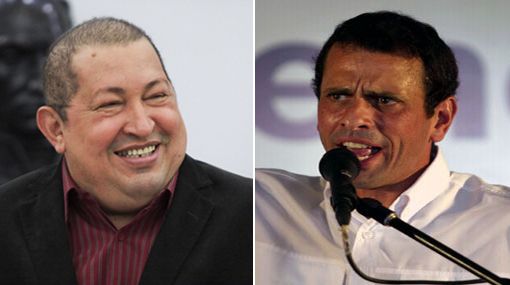
WHEN Hugo Chávez was re-elected as Venezuela’s president in 2000 and 2006, most polls indicated he would have won comfortably even if he had not used his control of Venezuela’s state institutions to his advantage. This year, as he stands for a third consecutive term, he faces a credible threat from his challenger for the first time: a recent poll by Consultores 21 gave him just a 3.4 percentage-point lead over Henrique Capriles of the Democratic Unity coalition (though other surveys suggest the president has a much bigger edge). The campaign for the election to be held on October 7th starts officially on July 1st. But even before it begins, Mr Chávez has made abundantly clear that he is willing to dispense with any remaining pretence of differentiation between himself, his United Socialist party and supposedly autonomous organs of the Venezuelan state in order to secure a victory.

On June 28th Venezuela’s supreme court (TSJ) struck a potentially fatal blow against Globovisión, the only surviving television station critical of the president. A state regulator had previously fined the 24-hour news channel over $2m for its coverage of the government’s siege of a jail where prisoners staged a mutiny last year. Globovisión was seeking to have the penalty overturned in a lower court. But with no advance warning, the TSJ ordered the seizure of assets belonging to the channel worth almost three times as much as the fine. The company then rushed to pay the original penalty in an effort to avoid the much bigger confiscation ordered by the court.

The TSJ is constitutionally independent of the executive. However, it has a history of strict obedience to Mr Chávez’s wishes. According to the former head of its criminal division, Eladio Aponte, who fled the country in April, the government regularly gave orders to the judiciary at weekly meetings.

Mr Chávez’s information minister has spoken openly of his desire to establish “media hegemony” for the government. The president has had dozens of broadcast outlets closed, neutered others by administrative intimidation, and created a vast state media network offering undiluted propaganda. He also claims the right to interrupt all terrestrial broadcast channels without notice and speak for as long as he likes, and introduced a law requiring them to carry ten minutes of free government propaganda every day. State media only mention Mr Capriles as the butt of insults. Outside observers were quick to condemn the TSJ’s move: Frank LaRue, the UN’s special rapporteur on freedom of expression, accused the government of using legal subterfuge to provoke the closure of critical media.

Mr Chávez has also used the TSJ to weaken his rivals more directly. Just before the June 11th deadline for registering candidacies, the court put his allies in control of two political parties that had previously opposed him. Citing alleged irregularities in internal voting procedures, the TSJ handed the reins of the social-democratic Podemos to Didalco Bolívar, a former state governor who has made up with Mr Chávez after fleeing the country when he was accused of corruption in 2009. The leftist Fatherland for All was similarly snatched from its anti-chavista leadership just in time to appear on the ballot in support of the president’s re-election.

Another nominally independent state agency is the national electoral authority, the CNE. It has also taken decisions beneficial to the president of late, ruling that voters living in Miami—home to the world’s biggest Venezuelan expatriate community—must vote at the consulate in New Orleans, over 1,000km (660 miles) away by road. The vast majority of the 23,000 registered voters in Miami oppose Mr Chávez. The CNE justified the policy by arguing that the government closed the consulate in Miami after the United States expelled the consul in January.

Individually, none of these decisions is likely to tip the balance in the president’s favour in October. But taken together, they demonstrate that Mr Chávez is both willing and able to deploy the entire weight of the state to crush his opponent.

To view this article on The Economist, please click here.

 
Jun
8
2012
Posted by
admin
Comments

Venezuela court decisions shake up 2 small parties, Chavez rival denounces ‘judicial tricks’

Associated Press
June 8

Venezuela Opposition.JPEG 0d60e 300x214 Venezuela court decisions shake up 2 small parties, Chavez rival denounces ‘judicial tricks’

Courtesy of: Ariana Cubillos / Associated Press

CARACAS, Venezuela — Venezuela’s Supreme Court has issued decisions shaking up the leadership of two small political parties, apparently preventing them from backing opposition presidential candidate Henrique Capriles.

Capriles condemned the court decisions on Thursday, saying that President Hugo Chavez’s government is resorting to desperate tactics to keep the Podemos and PPT parties from supporting his candidacy. Both used to be pro-Chavez but have moved to the opposition.

Chavez’s critics have repeatedly accused the president of wielding undue influence over the judiciary and using it to go after his adversaries. Chavez has denied those accusations.

“Only those who are desperate resort to judicial tricks!,” Capriles said in one of several messages on Twitter. “Whatever they do, the majority of the bases of those political organizations are with us.”

The Supreme Court said in a statement on its website Thursday that it had decided to recognize former pro-Chavez state governor Didalco Bolivar as the leader of Podemos, rather than established leader Ismael Garcia, a vocal government critic.

A similar ruling in the case of PPT was announced by the court on Wednesday. It voided the party’s most recent internal elections, which were carried out in October, and ordered it to hold new elections within 90 days.

The decisions appear to prevent the parties from backing Capriles before a Monday deadline for parties to specify the presidential candidate they will support. Capriles and Chavez both plan to formally sign up as candidates on Sunday and Monday, respectively, as they prepare for the Oct. 7 presidential vote.

Leaders of the two small parties could not immediately be reached for comment. Podemos broke with Chavez’s government in 2007. PPT, which in Spanish stands for Fatherland For All, similarly has irked Chavez’s government by defecting from its camp.

The court’s decisions drew criticism from others as well. Gustavo Hernandez Acevedo, a blogger writing on the website Caracas Chronicles, said the ruling “showcases just how far Hugo Chavez is willing to go to punish those he sees as traitors.”

In the case of Podemos, the Supreme Court said in a statement that it had decided to review an earlier decision by its Electoral Chamber, which in March had denied a challenge by Bolivar to an agreement by party leaders to postpone internal elections.

The court said that Bolivar will lead the party “until the current case is dealt with in depth.” That means Bolivar is to have the last word on which candidate the party will back in the presidential election, and he is expected to support Chavez.

On the ballot in Venezuela, candidates’ photos typically appear along with the symbols of parties that back them.

Bolivar, a former governor of Aragua state, previously faced corruption charges and has changed political loyalties. He split with Chavez in 2007 when the governor refused to participate in the president’s plan for various parties to join together in a single pro-government party.

In 2009, Bolivar was summoned for arraignment on corruption charges and sought asylum in Peru, saying he was being targeted for political reasons. He then returned to Venezuela in August 2011 saying he would face justice. He was jailed but later freed.

Since his return to Venezuela, Bolivar has repeatedly expressed support for Chavez.

Capriles has the backing of a coalition of opposition parties. He was chosen in a February primary to be the opposition’s single challenger to take on Chavez.

The leftist president, who was first elected in 1998, is seeking another six-year term. He has recently scaled back his public appearances after undergoing cancer treatment in Cuba, and the race so far has been dominated by speculation about whether his illness may interfere with his re-election bid.

Capriles has been trailing in the polls, with survey results varying widely. Some polls touted by the government have given Chavez a lead of more than 20 percentage points, while others indicate a smaller margin for the president, some less than 5 percentage points.

To read the original article from the Associated Press, please click here.